



Rewrite the following content into a 2000-word, SEO-optimized article in English. Write it in the style of a professional journalist or news reporter. The article should be fully humanized, natural, and engaging — not robotic or repetitive.
Focus on clarity, flow, and storytelling while preserving the meaning of the original. Structure the article into 6 well-developed paragraphs with smooth transitions, strong headlines, and a professional tone. Use varied vocabulary, sentence lengths, and natural phrasing to make it read like human-written journalism.
Avoid keyword stuffing, but naturally integrate important SEO keywords throughout the article. Ensure the final article feels like it was written by a skilled reporter for a reputable news outlet.
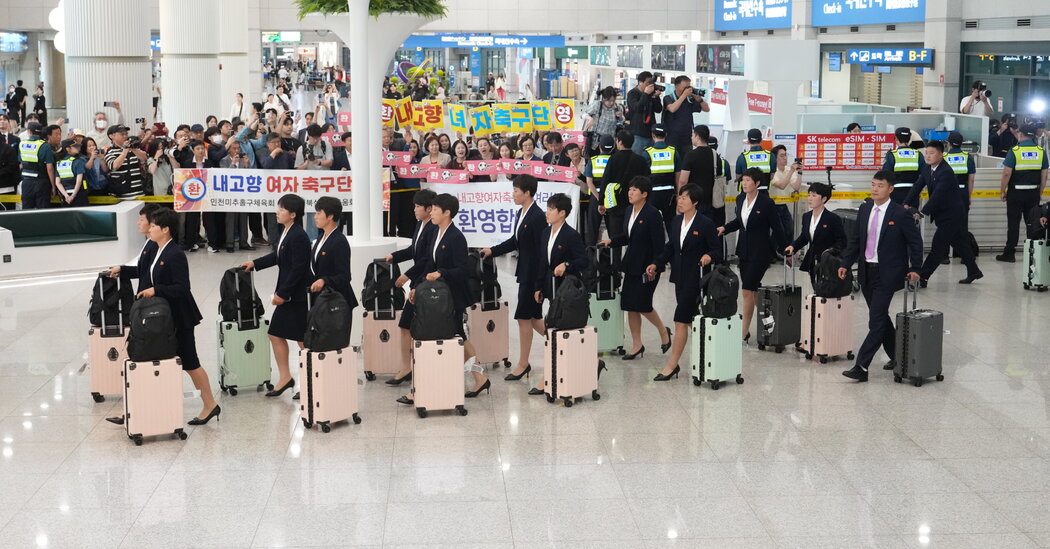
A North Korean women’s soccer team arrived on Sunday in South Korea, the first athletes from the North to set foot in the South in seven and a half years, despite political tensions so inflamed that the countries’ governments are not on speaking terms.
The team, Naegohyang Women’s F.C., will face a South Korean club, Suwon F.C. Women, on Wednesday evening, in a semifinal of the Asian Football Confederation’s Women’s Champions League. When athletes from the two Koreas, who are still technically at war, meet, the exchange is never only about the game.
Here is what to know about the trip.
Why Is Naegohyang Traveling to the South?
Naegohyang, which means “my hometown” in Korean, is based in Pyongyang and sponsored by a well-known North Korean consumer goods company of the same name.
It is the first North Korean team to compete in the A.F.C. Women’s Champions League, a top-tier club competition in Asia, and will play a semifinal match in Suwon, a city south of Seoul.
If the team wins on Wednesday, it will stay in South Korea for the championship game on Saturday, which will also take place at the Suwon Sports Complex. The other semifinal match pits Australia’s Melbourne City F.C. against Japan’s Tokyo Verdy Beleza.
Naegohyang’s roster includes players from the North Korean national teams that won the FIFA Under-20 and Under-17 Women’s World Cups in recent years.
Female soccer players are darlings of North Korea’s leader, Kim Jong-un, who rules through an elaborate personality cult. When he hosted the Under-17 World Cup-winning squad at a year-end celebration in December, the players appeared to be moved to tears, swarming him as if he were a rock star.
“The comrade general secretary’s love and trust were the source of strength that propelled our women’s soccer team to shake the world and create a great legend,” Kim Jong-sik, a North Korean soccer official, said at the time, invoking Mr. Kim’s official title.
Is the Trip Politically Significant?
The rival Korean states have intermittently pursued sports exchanges, at times using them as a channel to explore diplomatic openings. These periods of rapprochement, however, have repeatedly proved short-lived, derailed by deep political rifts — most notably over North Korea’s pursuit of nuclear weapons.
Since 1990, the neighbors have staged dozens of joint athletic initiatives, at times fielding unified teams in table tennis, soccer and basketball competitions. In powerful displays of shared identity, their athletes have marched together at the opening ceremonies of the Olympic and Asian Games, carrying a white-and-blue flag depicting an undivided Korean Peninsula. Reunification, however unlikely, had long been a policy goal in both Koreas until Mr. Kim abandoned it in 2023.
In 2018, Mr. Kim sent officials and athletes to Pyeongchang, South Korea, for the Winter Olympics. That led to an inter-Korean summit, which in turn set the stage for Mr. Kim’s historic summits with President Trump that year and in 2019. But the talks collapsed — and inter-Korean relations chilled — after they failed to reach a deal to scale back North Korea’s nuclear program.
The last inter-Korean sports exchange took place in December 2018, when South Korea’s Jang Woo-jin and North Korea’s Cha Hyo-sim teamed up to win silver in mixed doubles at an international table tennis tournament in Incheon, South Korea.
What Is the Reaction in South Korea?
All North Koreans traveling abroad are accompanied by secret police agents, who monitor them closely for any signs of disloyalty. When North Korean delegations visit South Korea, local police are required to provide security along their routes, as anti-North Korean activists have previously tried to approach them, shouting slogans and waving placards.
Nonetheless, South Korea has welcomed Naegohyang.
Tickets for the match sold out quickly, an unusual sign of enthusiasm in a country where women’s soccer games typically draw sparse crowds. To ensure the North Korean players do not feel isolated, civic groups have organized volunteer cheering squads, pledging to support both teams in the spirit of peace.
But there are almost no political overtones to the trip. North Korea’s participation was driven by its obligation to the A.F.C., not by diplomacy. The logistics themselves highlighted the political freeze: Naegohyang had to detour through Beijing because of a ban on direct flights between the two Koreas.
While the South Korean president, Lee Jae Myung, has sought to ease military tensions and restore ties with Pyongyang, Mr. Kim has shown no interest in reconciliation in recent years — a sharp contrast to his diplomatic charm offensive ahead of the 2018 Olympics.
In February, he described inter-Korean ties as “the most hostile state-to-state relationship.” The next month, the North’s Parliament scrubbed all references to reunification from its Constitution, replacing them with mandates to fight “nonsocialist” cultural influences from South Korea.
“Naegohyang’s visit demonstrates that channels for inter-Korean contact, which seemed completely closed, can still function — albeit in a limited way — through international sports,” said Lee Woo-tae, a senior researcher at the Seoul-based Korea Institute for National Unification. “But this visit should not be overestimated as a signal for a thaw in inter-Korean relations or the resumption of dialogue.”