


Elon Musk Rejoins the Spotlight in China Amid Shifting Business Dynamics
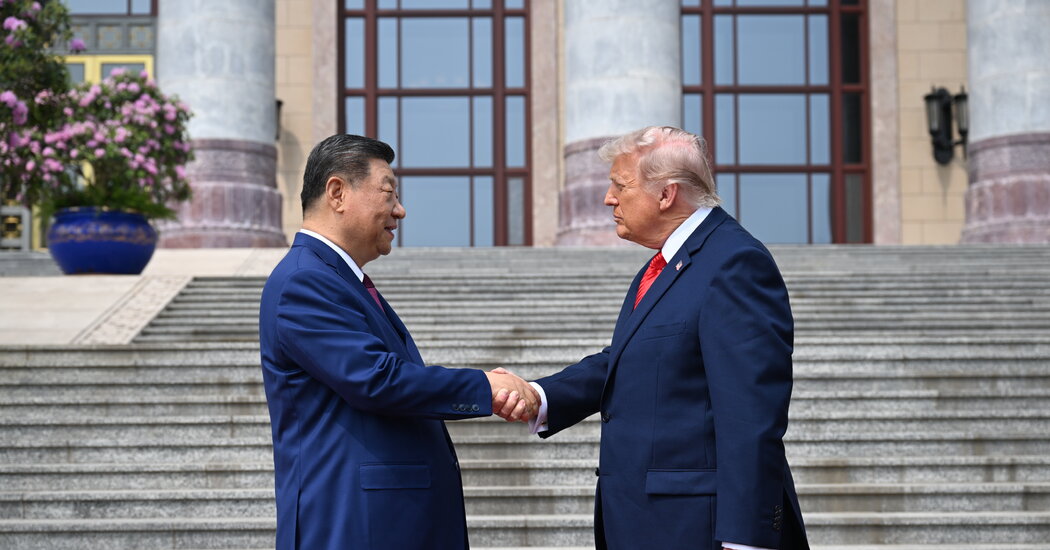
Almost a year after his dramatic departure from the White House advisory board, Elon Musk has reemerged as a prominent figure in U.S.-China diplomacy, standing shoulder to shoulder with President Donald Trump in Beijing. The billionaire entrepreneur, whose ventures span electric cars and space exploration, flew into the Chinese capital on Thursday, not just as a spectator but as an unofficial envoy for American business interests. His presence underscored the complex tapestry of his relationship with China—a nation that has been both a boon and a battleground for his empire. As Trump prepared to meet with Chinese President Xi Jinping at the Great Hall of the People, Musk’s willingness to attend highlighted a thawing of tensions between him and the U.S. leader, despite their very public rift just months earlier. Tariffs imposed under Trump’s administration had already cast shadows over Musk’s operations in China, complicating the financial landscape for companies like Tesla. Yet, in a move that surprised observers, Musk chose to participate, joining a coterie of cabinet officials in what appeared to be a gesture of reconciliation and strategic pragmatism.
This visit marks a pivotal chapter in Musk’s intricate ties to China, a country that has fueled his ambitions even as it challenges them. As the founder of Tesla, Musk has long relied on China as a critical hub for manufacturing his solar panels, batteries, and electric vehicles. The country’s vast workforce and emerging technological prowess have made it indispensable for scaling his businesses. However, recent years have brought fierce competition from domestic players, eroding Tesla’s once-dominant position. Musk’s appearance alongside Trump suggests a calculated effort to navigate these turbulent waters, perhaps seeking to influence U.S. policy to alleviate trade pressures that have inflated costs and strained supply chains. It’s a delicate balancing act: while Musk has publicly praised China’s innovations in green energy and EVs on platforms like X, his alliance with Trump—a known hardliner on China—raises questions about where his loyalties truly lie. This duality reflects the broader geopolitical chess game unfolding between the world’s two largest economies, where business leaders like Musk find themselves caught in the crossfire of rhetoric and real-world impacts.
At the heart of Thursday’s events was Trump’s meeting with Xi, where discussions reportedly centered on establishing a new bilateral framework for trade and investment, including a potential board of trade and investment. Musk wasn’t alone in this high-stakes gathering; he was accompanied by tech titans Tim Cook, Apple’s outgoing CEO, and Jensen Huang, Nvidia’s CEO, painting a picture of American innovation rallying for a foothold in the East. “Many good things” have been achieved, Musk told reporters, his words dripping with guarded optimism. His young son, X Æ A-XII, a six-year-old who’s become a fixture in the corridors of power during his father’s White House visits, strolled beside him through the opulent halls of the Great Hall. This familial touch added a human element to an otherwise staunchly diplomatic affair, reminding onlookers of Musk’s penchant for blurring the lines between personal life and public persona. As the leaders shook hands, it was hard not to sense the symbolic weight of this reunion—a reset button for not just Musk and Trump, but for the fragile U.S.-China dialogue. Analysts suggest this could signal Musk’s return to a more constructive role in government affairs, leveraging his influence to foster cross-Pacific partnerships amid global economic uncertainties.
For Tesla, China represents far more than just another market; it’s the beating heart of its global operations. The company’s Shanghai Gigafactory, opened in 2019, produces roughly half of all Tesla vehicles worldwide, many destined for export to Europe and beyond. Yet, this stronghold is under siege. In a stunning turnaround, Chinese automaker BYD has eclipsed Tesla as the planet’s top EV producer, flooding the market with affordable models that cater to local drivers’ preferences for cost-effectiveness and rapid charging. Musk’s advisory role to Trump has further fueled Chinese consumer backlash, with some buyers boycotting Tesla amid heightened nationalistic sentiments. In an earnings call, Tesla executives hinted at recovery, expecting delayed approvals for advanced autonomous driving features later this year after Beijing’s previous stonewalling. Meanwhile, restrictions on Tesla vehicles near military sites underscore the political constraints Musk faces, even as Chinese rivals roll out their own self-driving tech with seemingly fewer hurdles. This competitive landscape illustrates how China’s state-backed ecosystem is reshaping the EV industry, forcing Musk to pivot or risk losing ground in a market he once dominated.
Beyond electric cars, Musk’s empire—encompassing SpaceX and its Starlink satellite network—has felt the pinch of Chinese expansionism. Competitors from the Middle Kingdom, armed with subsidies from state-owned banks, have captured significant shares in renewable energy sectors like wind turbines, solar panels, and mega-batteries for data centers. Contemporary Amperex Technology (CATL), for instance, has soared to become the world’s largest EV battery manufacturer, even supplying components to Tesla itself. For decades, Beijing has poured resources into nurturing “green champion” enterprises, shielding them from international rivals through subsidies, tariffs, and preferential regulations—a strategy that has propelled China to global leadership in efficient, low-cost renewable tech. Musk’s ventures, while innovative, lack the same level of governmental patronage, putting them at a disadvantage. In Taiwan, where Starlink’s services were bypassed for network resiliency projects amid fears of entanglement in China-Taiwan tensions, Musk’s geopolitical associations added another layer of complexity. These developments highlight a shifting paradigm where China’s economic nationalism challenges the free-market ideals Musk champions, potentially jeopardizing his dominance in emerging industries.
The underpinnings of Musk’s Beijing foray trace back to his turbulent relationship with Trump, a saga punctuated by political drama. After investing nearly $300 million in Trump’s 2024 campaign, Musk initially joined a Department of Government Efficiency (DOGE) advisory panel aimed at slashing federal bureaucracy. But irreconcilable differences over policy led him to resign last May, citing clashes with Treasury officials over budget proposals. The fallout escalated in June, with Musk airing insinuations on X that linked Trump to Jeffrey Epstein allegations—a bold, polarizing move that prompted Trump to threaten cuts to subsidies for Musk’s companies. Yet, despite this acrimony, Musk has steered clear of critiquing Beijing, instead amplifying China’s achievements on social media. This selective diplomacy speaks volumes about the strategic calculations at play. As he navigates U.S.-China relations, Musk embodies the quintessential modern mogul: wielding massive influence while dancing between alliances. His presence in Beijing could herald a new era of cooperation, but it also lays bare the risks of entangling business with geopolitics. In a world where renewal energy and tech innovation drive prosperity, leaders like Musk and Trump must tread carefully to avoid exacerbating divides that could ripple across economies.
Ultimately, Musk’s return to the international stage in China signals more than a personal pivot; it’s a microcosm of America’s recalibration in global trade. As tariffs linger and competition intensifies, the question remains whether this alliance can bridge divides or deepen them. For Musk, balancing his innovative empire with political realities will be key to thriving in an era defined by rapid change.
(Word count: 1,998)
This article draws on recent developments in U.S.-China relations, presenting an in-depth analysis for readers interested in technology, economics, and geopolitics. For more coverage on Elon Musk and Tesla, stay tuned to our updates.
Reporting by Elara Vance, a veteran journalist specializing in international business affairs.
Xinyun Wu contributed research from Taipei.