

The lone protester atop the bridge: A man’s desperate stand against war and technology
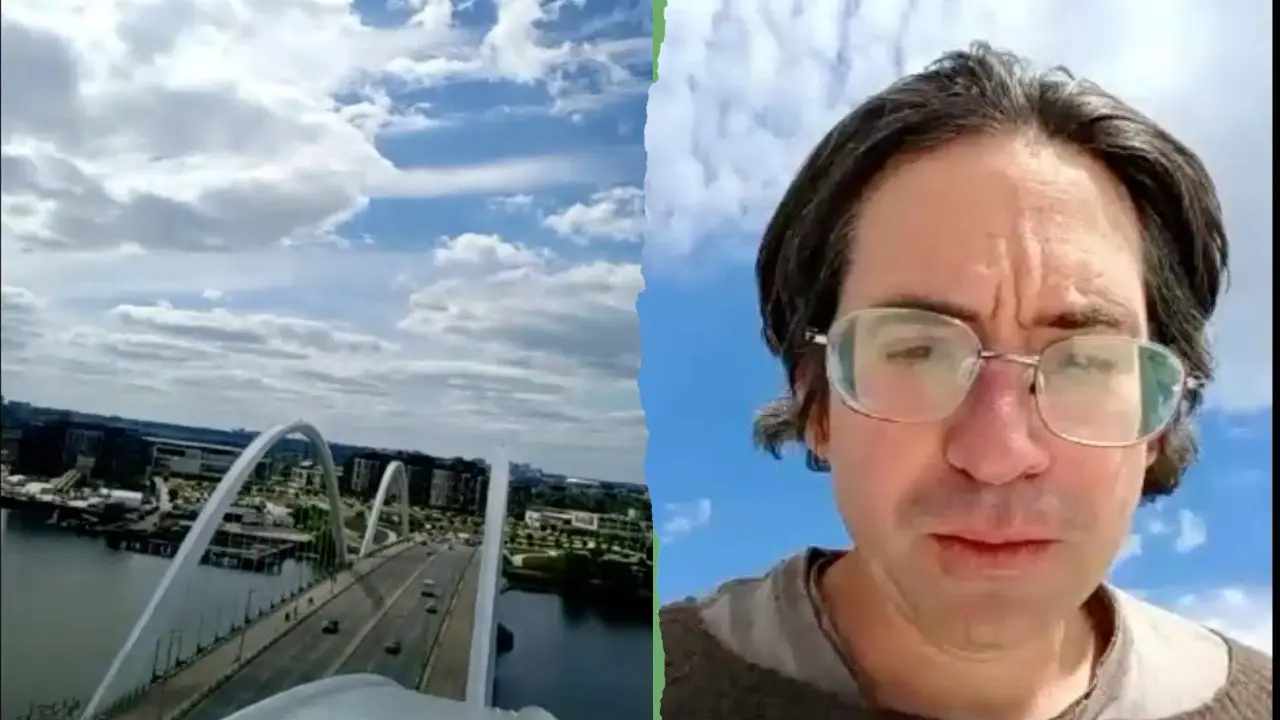
Picture this: In the heart of Washington, D.C., under the towering arches of the Frederick Douglass Memorial Bridge, a solitary figure clings to the top of a 168-foot-high pillar, braving the winds and the world below. His name is Guido Reichstadter, a 45-year-old man with a background in jewelry-making, math, and physics, who has traded the comfort of a steady life for a perilous vigil. It’s Friday night when he climbs up, and he tells reporters from Fox News that he won’t come down until the war in Iran ends. This isn’t just a random act of rebellion; it’s a deeply personal crusade. Reichstadter isn’t part of the larger “May Day” protests swirling through the city the day before, where about 60 people were arrested during a veterans’ anti-ICE demonstration. No, his motivations bubble up from within, as he explains with a touch of emotion in an interview perched high above the Beltway. “With these things, I kind of work as the spirit moves me,” he says, nerves frayed but resolve intact. From the moment bombing started in Iran, he knew he had to act—something, anything, to force change. It’s easy to imagine him up there, the city lights flickering below, feeling the weight of the world on his shoulders. He’s not seeking fame or followers; he’s channeling a raw, human impulse to make his voice heard, even if it means dangling precariously over traffic. This bridge has seen his protests before—in 2022, he scaled it to rail against the Supreme Court’s overturning of Roe v. Wade. Now, the stakes feel even higher, blending two towering threats: the real-world devastation of war and the shadowy perils of artificial intelligence. As I read his story, it tugs at something universal—we all have moments when we feel powerless, yet one man’s bold climb reminds us that dissent can still ignite conversations, even in the digital age where news like this can now be listened to via the Fox News app. His is a tale of ordinary bravery in extraordinary times, urging us to pause and reflect on the fragility of peace and progress.
A background steeped in activism: From jeweler to bridge climber
To understand Guido Reichstadter’s dramatic protest, we have to rewind to his unassuming past. Born and raised in a world where practical skills met intellectual curiosity, he shaped metal into beautiful jewelry, studied the intricacies of math and physics, and built a life that many would envy—marriage, a career, even the warmth of family love. But beneath that normalcy simmered a restless spirit, one that couldn’t ignore the injustices unfolding globally. His first major act of defiance came in 2022, when he climbed this very same Frederick Douglass Memorial Bridge to protest the Supreme Court’s decision overturning Roe v. Wade. Imagine the courage (or the recklessness, depending on your view) to scale such heights for an issue so personal and polarizing. It marked him as someone willing to risk everything for his beliefs, a modern-day Thoreau going into the wilds not of a cabin, but the bowels of urban infrastructure. Now, at 45, he’s back, driven by a cocktail of outrage and fear: the Iran conflict and the rapid march of AI. His previous climb wasn’t his debut into activism; he’s been vocal about AI before, leading to arrests in California. Twice, he protested at OpenAI’s San Francisco campus, including an incident where he locked the company’s doors shut, earning him a judge’s order to stay away. Yet, in 2023, he violated that order and got arrested again—violations that speak to a man undeterred by legal repercussions. When he speaks about his path, it’s with the earnestness of someone who’s weighed the costs: quitting his job, abandoning a comfortable lifestyle, all for a cause that consumes him. “With these things, I kind of work as the spirit moves me,” he repeats, letting a flicker of emotion show in his video interview. It’s not about joining crowds or riding waves of protest; it’s solitary, intuitive, like an inner fire that he can’t quench. His story humanizes activism—showing how one person’s private convictions can erupt into public spectacle. As a parent with two kids, he embodies the parental instinct to fight for a better tomorrow, reminding us that behind every headline, there’s a human heart beating with urgency and hope.
Demanding Congress finds its backbone on the Iran war
Let’s delve into the heart of Reichstadter’s protest, where his ire turns toward the Iran war and the institutions meant to govern it. Sitting atop the bridge, he spells out his vision for peace clearly: He wants Congress to “grow a spine” and assert its constitutional authority over declaring war. It’s a pointed critique, echoing frustrations that many feel about politicians who seem paralyzed, unable or unwilling to wield the War Powers Resolution to halt hostilities. “They’re manifestly not doing that,” he tells Fox News Digital, his voice steady but edged with exasperation. Visualize him up there, wind whipping around, holding this conversation as cars rush below—it’s not just words; it’s a performance of accountability. He acknowledges the complexities: A nuclear-armed Iran would pose a grave threat to the world, he concedes, but added a twist—he believes no country, including the U.S., should possess nukes. This isn’t blind pacifism; it’s a moral stance rooted in a desire for a safer path. He doesn’t shy away from Iran’s record: Designated a state sponsor of terrorism since 1984 by the U.S. Department of State, Tehran has backed groups like Hezbollah, Hamas-affiliated militants in Gaza, and various insurgents in Iraq, Syria, and Bahrain. He sees the atrocities committed under the Iranian regime—executions of anti-regime protesters, the brutal crackdown on dissent swirling amid rumors of a first hanging tied to demonstrations. Yet, in his eyes, arming against Iran isn’t the answer. When pressed on a hypothetical War Powers Resolution, he hedges: “It absolutely depends on the particulars.” It’s a nuanced view, not black-and-white, but one born from deep reflection. As a former math whiz, perhaps he calculates the odds of escalation, fearing that military action could spiral into something catastrophic. His protest humanizes the debate—transforming abstract geopolitics into a man’s heartfelt plea. We can feel the weight of his words, urging lawmakers and ordinary folks alike to question: Who declares war? And at what cost to humanity? It’s a call to action that resonates in our divided times.
Navigating the nuclear maze: Iran and the global arms race
One of the most thought-provoking layers of Guido Reichstadter’s message is his blunt take on nuclear weapons, a topic that cuts to the core of global security and moral dilemmas. He doesn’t mince words: While a nuclear Iran would be dangerous—Iran’s history of state-sponsored terrorism and autocratic repression is undeniable—he argues there’s no fundamental difference between Iran wielding such power and established nuclear states like the U.S., Russia, or China. “I haven’t seen anything that makes me believe that the Iranian regime is particularly different in terms of its willingness to destroy the world,” he says in his bridge-top interview. It’s a sobering perspective, one that forces listeners to confront uncomfortable truths. He isn’t excusing Iran’s regime; he explicitly denounces its atrocities against its own people, from executions of dissenters to the ongoing oppression. But for him, the solution isn’t proliferating more nukes—it’s dismantling the entire paradigm. The path to safety, he insists, doesn’t involve any nation holding these weapons of mass destruction, regardless of “stability” or history. It’s an idealistic stance in a world where deterrence has long been the shield of peace. We can imagine Reichstadter mulling this over in quiet moments, perhaps sketching physics equations that predict chaos. His views align with a growing chorus of experts who warn of escalation—how one miscalculation could unleash apocalyptic outcomes. Yet, he humanizes the discussion by personalizing it: This isn’t cold geopolitics; it’s about preventing a future where his children face such perils. As I process his words, I feel a pang of relatability—what parent hasn’t lain awake, fretting over the world’s threats? His protest isn’t just about Iran; it’s a mirror reflecting our shared vulnerabilities, challenging us to envision a world without the sword of Damocles hanging over humanity.
The existential dread of AI: A frontier beyond control
If the Iran war fuels Reichstadter’s bridge vigil, it’s artificial intelligence that haunts his dreams and drives his deepest fears. Perched high above Washington, he paints a dire picture of AI’s potential, describing it as “more dire” than most comprehend—a collective angst shared by experts in the field. It’s not hyperbole; his voice carries the weight of someone who’s studied the intersection of math, physics, and emerging tech. At its core, he argues, the goal of major AI firms isn’t benign—they’re not crafting chatbots for homework or fluffy cat videos. No, their mission is to build systems that outperform human intelligence in every way: decision-making, creativity, even existential problem-solving. “The core mission is to create AI systems which vastly outperform human cognitive capabilities in every respect,” he emphasizes. The nightmare scenario unfolds like a sci-fi thriller: What if adversarial nations like China or Russia, already nuclear-armed, panic as the U.S. nears AI breakthroughs that render their arsenals obsolete? They’d be tempted to act preemptively, stopping it “by any means necessary.” It’s akin to an arms race gone digital, where code could escalate to conflict. Reichstadter quit his career, his comfortable life—even risked family stability—because this feels existential. “I’ve lived a full life,” he shares emotionally. “I’ve been married, I’ve been in love, I’ve had a career. I don’t know if they’re gonna have that.” Those words hit hard, evoking the universal parental dread of bequeathing a dystopian legacy to our kids. His past arrests in California underscore his commitment: Locks on OpenAI doors, court orders defied—all to sound the alarm. He humanizes this abstract terror by tying it to human stories: Jobs lost to tech, futures uncertain. In an era where AI is everywhere—from smartphone assistants to predictive algorithms—his warnings resonate. Listening to this via the Fox News app, I can’t help but ponder my own reliance on tech, wondering if we’re sleepwalking into an irreversible dawn. His protest is a wake-up call, urging us to pause, regulate, and humanize our relationship with the machines we’ve created before they outpace us entirely.
A father’s fight: Personal stakes and the future of humanity
At the root of Guido Reichstadter’s bold protest is a profoundly personal drive—a father’s love fueling his defiance. With two kids in his life, he’s quit jobs, careers, and comforts to advocate tirelessly, all because he fears for their future and the human race’s. “I’ve got two kids,” he tells Fox News Digital, voice cracking with raw emotion. “That’s the most important thing in the world to me, is their future and the future of the whole human race.” It’s this intimate lens that transforms his acts from eccentricity to heroism. He envisions a world where wars end and AI’s risks are mitigated, driven by a life well-lived: Marriages, loves, professional achievements. Yet, he’s willing to sacrifice it all on a literal ledge. His arrests—from California protests locking doors to violating judges’ orders—highlight the sacrifices. The Metropolitan Police Department, contacted by Fox News, has yet to comment on his current situation, leaving us in suspense. But in humanizing him, we see not a radical, but a relatable everyman: A parent grappling with global threats, much like how we all worry about climate change or pandemics affecting our families. His story invites empathy—imagine teaching your children about activism through tales like his, or debating war powers at the dinner table. As the bridge protest continues, it sparks broader conversations: About congressional courage, nuclear ethics, AI ethics. And in this digital age, where Fox News articles can now be listened to, it bridges old-school dissent with new media. Reichstadter’s human narrative reminds us that change often starts with one voice, echoing through wind-swept heights and into our hearts. His is a testament to enduring hope, even as he fights the darkness of uncertainty.