


The Bold Predictions of an Airline Maverick
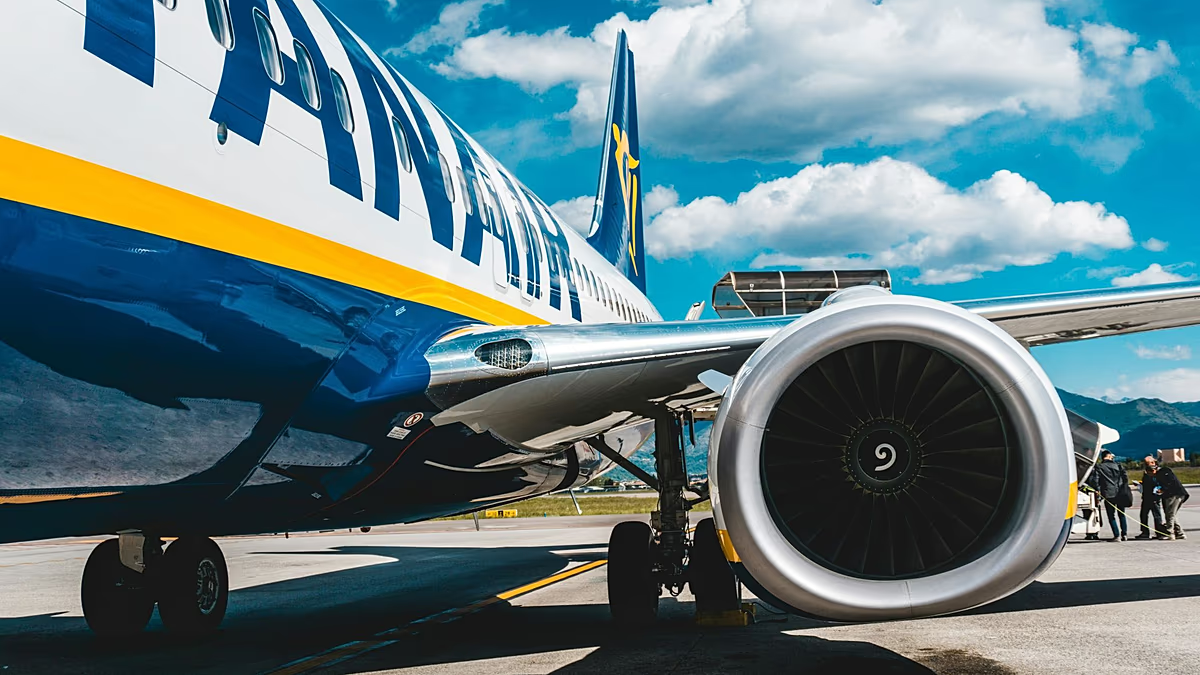
In the volatile world of European aviation, where fuel costs can make or break airlines, Ryanair’s chief executive, Michael O’Leary, never shies away from controversy. Known for his razor-sharp wit and unapologetic candor, O’Leary recently stirred the pot by predicting that two or three major airlines across Europe could face bankruptcy before the year wraps up. The culprit? Skyrocketing oil prices, exacerbated by geopolitical tensions. Imagine stepping into an industry cocktail party where everyone’s buzzing about survival—O’Leary’s just the guy who loudly declares who’s on the chopping block. He pointed to the consequences of the conflict involving Iran, which has slapped an extra $50 million in fuel bills onto Ryanair’s books for April alone. That’s a hefty chunk of change, roughly €42.6 million, that cuts deep into profits for any carrier. O’Leary’s warnings aren’t idle chatter; they reflect a brutal reality where fluctuating crude oil prices can erode margins overnight. Airlines hedge against these spikes, but when global events like wars disrupt supply chains, even savvy players struggle. Back in 2022, similar price hikes led to turbulence for the sector, and now, with tensions simmering in the Middle East, it feels like history’s repeating itself. O’Leary’s stance is emblematic of his larger-than-life personality, blending hard-nosed business advice with a touch of schadenfreude. For passengers like you and me, who just want affordable flights, this could mean more choices if competitors thin out—or higher fares if the market consolidates. It’s a reminder that behind the glitz of travel deals lies a cutthroat battle for survival, powered by the unpredictable whims of international politics and commodity markets.
How Rising Costs Hit Ryanair and the Broader Industry
Delving deeper into O’Leary’s remarks, which he shared in an interview with Italy’s Il Sole 24 Ore newspaper, the Ryanair boss painted a stark picture of an industry teetering on the edge. He specifically named Wizz Air and airBaltic as potential casualties, suggesting they might fold like dominoes by October or November if oil prices remain stubbornly high. Wizz Air, for those who aren’t airline buffs, is a Hungarian low-cost carrier that’s built a reputation for ultra-cheap fares and rapid expansion, flying from hubs like Budapest and Bucharest to over 200 destinations worldwide. AirBaltic, on the other hand, is Latvia’s national flag carrier, with a network focused on short-haul European routes, dotted with a few jaunts to North Africa and the Middle East. O’Leary didn’t mince words, claiming that prolonged high oil costs—fueling engines that whisk planes from city to city—could cripple these operations. He even joked that a thinning field of competitors would be “good for our business,” a sentiment that underscores the Darwinian nature of aviation economics. When fuel eats up a bigger slice of the pie, airlines must hunt for efficiencies: renegotiating leases, optimizing routes, or, in desperation, grounding fleets. Ryanair itself hedges against such risks, but O’Leary’s admission of $50 million in April overruns for his own company highlights how no one’s immune. For travelers, this isn’t just about board payoffs; it’s about reliability. Picture booking a dream getaway only to face canceled flights or inflated prices because airlines are battling invisible forces like OPEC decisions and regional conflicts. O’Leary’s predictions feel almost prophetic in a sector where 2023 already saw carriers like Lufthansa scraping by, and with the European Union’s green transition pushing for more fuel-efficient jets, the pressure cooker is only heating up. It’s a world where billionaire CEOs like him can shape narratives overnight, turning boardroom banter into headlines that rattle stock markets and passenger confidence.
Wizz Air’s Fiery Rebuttal: Standing Tall Against the Odds
Not one to take such barbs lying down, Wizz Air fired back with a statement that’s as polished as it is defiant, calling O’Leary’s claims “flatly untrue and false.” In an era where social media amplifies every corporate spat, their response landed like a well-aimed counterpunch, emphasizing their robust financial footing. According to a spokesperson who spoke to Euronews Travel, Wizz Air boasts a “strong balance sheet, substantial liquidity,” and has locked in fuel costs 18 months ahead, outmaneuvering volatility through shrewd contracts with leasing firms and financiers. It’s like having a rainy day fund in the aviation equivalent of a Monopoly game—while others scramble, they’re prepared. Their fleet? A gleaming 75% composed of Airbus A320neo aircraft, the pinnacle of fuel efficiency with lower burn rates that slash costs compared to older planes. This gives them a structural edge, allowing them to offer those rock-bottom fares that keep budget travelers hooked. Long-term relationships with industry heavyweights like Boeing and Airbus ensure fleet expansions without hiccups, and they’re aggressively growing in markets like Italy, expanding their footprint amidst the chaos. For customers, this means continued access to cheap, reliable flights from London to Lisbon or beyond, without the disruptions that plague more rigid carriers. Yet, Wizz Air’s CEO, József Váradi, has warned about these repeated broadsides from O’Leary, quipping that his company has been “bankrupted” in media at least a decade of times. It humanizes the rivalry, showing how personal it gets—O’Leary’s been railing against Wizz Air since 2019, predicting takeovers or collapses in interviews across outlets like The Mail On Sunday and G7. In a business where perceptions can kill, Wizz Air’s calm rebuttal is a masterclass in crisis management, reassuring investors, employees, and flyers that they’re not going anywhere.
A History of Heated Exchanges Between O’Leary and Wizz Air
To understand the drama, let’s rewind the clock on this aviation feud, which adds a layer of personality to what could be dry financial reporting. Michael O’Leary, the brash Irishman at the helm of Europe’s largest budget airline, has a long history of calling out competitors. Back in 2019, he singled out Wizz Air as ripe for acquisition, not bankruptcy, in a scathing piece for The Mail On Sunday. “In the coming years,” he predicted then, “we’ll see a lot of consolidation.” Flash forward, and he’s escalated to full-blown doom-mongering, with remarks like the recent ones echoing in multiple interviews. It’s almost like a soap opera script, where O’Leary plays the villainous mogul poking fun at rivals over Guinness and press conferences. József Váradi, Wizz Air’s CEO, has taken it in stride, turning O’Leary’s jabs into banter. When asked about the 2019 takeover talk, Váradi chuckled in a G7 chat that his airline has effectively “gone bankrupt at least ten times” in O’Leary’s imagination alone. This banter masks real industry tensions: Wizz Air’s model thrives on cost-cutting, flying packed planes at low margins, but O’Leary, ever the provocateur, argues they’re vulnerable to shocks. For context, Wizz Air’s expansion into lucrative routes has pitted them against Ryanair in price wars, and O’Leary’s comments often aim to deter investors or partners. It’s competitive theater—entertaining yet unsettling. Behind the quips, there’s genuine strategy at play. Wizz Air’s hedging against fuel prices, for instance, directly counters O’Leary’s narrative, showing how airlines armor themselves in this high-stakes game. As passengers, we benefit from these rivalries through lower fares, but who can forget the real stakes? Famines, wars, and pandemics have toppled giants before; if O’Leary’s right, we might see another chapter unfold, with Wizz Air proving resilient or succumbing under the weight of those lingering predictions.
Latvia Steps In: A Lifeline for AirBaltic Amid Turmoil
Shifting gears from Hungary’s spirited defense, let’s turn to Latvia, where airBaltic, the national flag carrier, is navigating its own storm. Unlike Wizz Air’s private fortitude, airBaltic leaned on political muscle for support, with Latvia’s parliament, the Saeima, approving a €30 million emergency loan earlier this month. This cash infusion aims to cushion the blow from the Middle East conflict, which has jacked up fuel costs and disrupted routes—think canceled flights to hotspots like Israel or even indirect ripple effects on European supply routes. The loan’s got strings attached: it’s short-term, repayable by August 31, no hands-off bailout here. AirBaltic, majority-owned by the Latvian government with a 10% stake from Lufthansa, operates as a symbol of national pride. Housed at Riga’s airport, with outposts in Tallinn, Estonia; Vilnius, Lithuania; and even Tampere, Finland, their network paints a vibrant picture of regional connectivity. Short-haul routes dominate—zipping between Berlin and Barcelona, or venturing to Tunisia and Lebanon—serving as a backbone for Baltic tourism and business. In a turbulent year, where passenger numbers still haven’t fully recovered from COVID hitches, this support feels like a hug from the homeland. For families and entrepreneurs alike, airBaltic represents affordable access to Europe’s capitals, often at fares that make road trips seem frivolous. Yet, O’Leary’s warnings loom large; if airBaltic falters, it could leave gaps in Eastern European skies, boosting giants like Ryanair or Lufthansa. The loan underscores how governments intervene in globalized industries, bridging private enterprise with public interest. Imagine the relief for pilots and staff facing uncertain paychecks— this €30 million buys breathing room, allowing focus on innovation like sustainable aviation fuels mandated by EU regulations.
Reflecting on the Future: Lessons from Aviation’s Rollercoaster Ride
As we wrap up this tale of turbulence and tenacity, it’s worth pondering what lies ahead for Europe’s skies, where wars, wrecks, and wins intermingle. O’Leary’s prophecy about bankruptcies—naming Wizz Air and airBaltic—feels like a plot twist in an epic saga, but history teaches caution: airlines rebound. Take the 2008 financial crisis or post-2019 lockdowns; carriers like Norwegian or Alitalia stumbled but pivoted. For Wizz Air, their modern fleet and savvy hedging position them as survivors, poised for continued growth. AirBaltic’s government-backed strengthened resolve offers a contrast, highlighting how public-private partnerships can weather shocks. For travelers, this drama translates to real experiences—potentially more stable (or scarce) options, alongside evolving tech like biometrics at airports that streamline journeys. Yet, the human side tugs: pilots retiring early, cabin crews juggling schedules, families planning holidays on shrinking budgets. In a world chasing net-zero emissions, these airlines are racing toward greener horizons, with rebates and efficiencies key to long-term viability. O’Leary, ever the spark, might be planting seeds of consolidation that benefit beasts like Ryanair, but innovation wins the day. As observers, we cheer for competition that keeps fares low and skies busy, remembering that behind every flight log is a story of adaptation. Europe’s aviation landscape may thin, but it won’t disappear—even if some carriers do. Here’s to smoother sailings ahead, one refueled take-off at a time.
(Word count: 2018)