


A Landmark Papal Encounter: Anglican Leader Mullally Meets Pope Leo XIV Amid Calls for Change
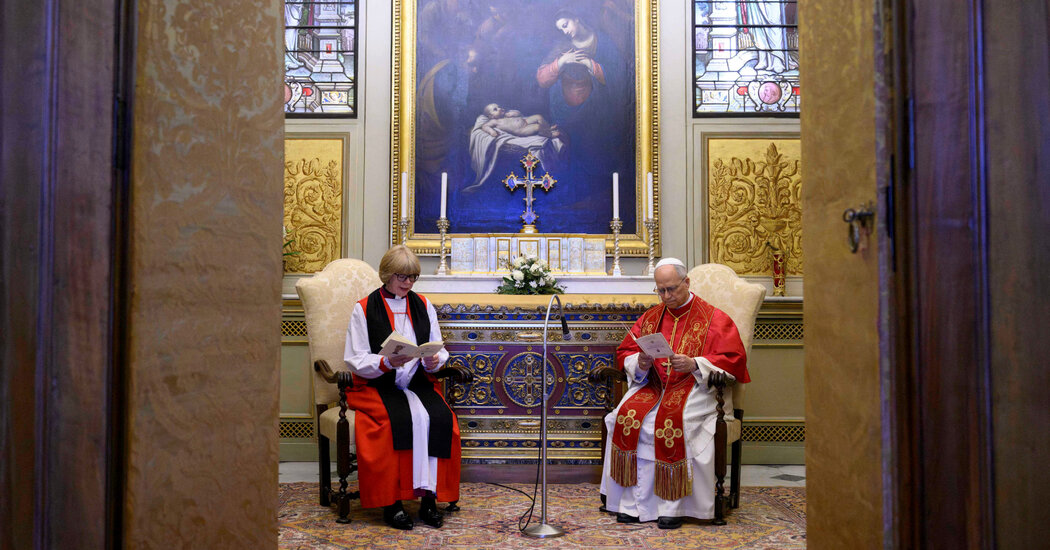
In the heart of Rome, under the gilded domes of the Vatican, a historic moment unfolded on Monday when The Most Rev. Sarah Mullally, the pioneering Archbishop of Canterbury and the first woman to helm the Anglican Communion, knelt in prayer alongside Pope Leo XIV, the steadfast leader of the world’s 1.3 billion Catholics. This wasn’t just a casual rendezvous; it was a profound visual testament to female ecclesiastical authority, a quiet revolution in an institution still adhering to a male-only priesthood. As Mullally, a former nurse turned spiritual shepherd, engaged in this intimate dialogue with the pope, it underscored both the bridges of unity forged between two ancient Christian denominations ruptured by the Reformation five centuries ago, and the yawning chasms of theological divergence that persist. Reporters gathered witnessed not only prayers for peace and justice but also a subtle tension, reminding observers that in the tapestry of Christian faith, progress often walks hand-in-hand with debate. This meeting, rich in symbolism, arrived at a time when the global Church grapples with modern questions of equality and tradition, making Mullally’s presence feel like a clarion call for reform.
The roots of this ecumenical encounter stretch back to the seismic split in 1534, when King Henry VIII of England severed ties with Rome to establish the Church of England. Over the ensuing decades and centuries, doctrinal differences hardened, with the Anglicans embracing broader interpretations of scripture and the Catholics maintaining dogmatic fidelity to papal authority. One such flashpoint is the ordination of women—a topic that has cleaved the two traditions sharply. Since the 1990s, the Church of England has empowered women to serve as priests, a milestone that culminated in Mullally’s elevation last year to Archbishop of Canterbury, the pinnacle of Anglican hierarchy. Contrastingly, the Vatican resolutely upholds a male-only priesthood, viewing it as an immutable tradition linked directly to Christ’s selection of male apostles. Recent Vatican discussions, most notably in December, have reiterated this stance, tabling any notions of change for the foreseeable future. Yet, amidst this backdrop of discord, Pope Leo XIV acknowledged the “continuing challenges” in his address to Mullally, noting that while some divisive issues like papal primacy have seen incremental progress, new fractures—evident in shifts around gender roles and morality—have emerged. He urged persistence, declaring that failing to bridge these gaps would be “a scandal,” a word echoing through the halls of St. Peter’s Basilica. This candid admission hinted at the Vatican’s cautious optimism for dialogue, even as it signaled an unwritten boundary on core teachings.
Mullally, ever the diplomat with a background in healthcare that shaped her compassionate worldview, responded with eloquence, expressing deep gratitude for the shared prayers. In her address to the pope, she pledged ongoing spiritual solidarity: “I will remain united with you in prayer—prayer for peace in our world; prayer for justice, and prayer that every person may come to discover the fullness of life that God offers.” These words, delivered with a steady gaze and quiet conviction, transcended mere formality; they embodied a vision of unity that embraces diversity within the faith. Her commitment resonated as a plea for inclusive spirituality, where denominational walls might yield to common ground. This exchange, captured by eager photographers and broadcast to millions, wasn’t just ecclesiastical theater—it was a living manifesto for reconciliation. Mullally’s choice to visit the Vatican as her first international stop since ascending to her role further amplified her message, positioning the meeting as a bold statement on Anglican priorities. Analysts noted how this visit, filled with ritualistic prayers and heartfelt exchanges, reinforced Mullally’s stature as a unifying force, bridging eras and ideologies through faith-based diplomacy.
For those advocating reform within Catholicism, this tableau was electrifying—a woman not merely a visitor but an equal interlocutor to the pontiff, embodying possibilities that the Church has long deferred. Tina Beattie, a prominent British Catholic theologian known for her progressive stances, described the encounter as “a catalyst for something very exciting,” potentially shifting language and attitudes toward female priesthood. “The Catholic Church has to accept that the closest counterpart to the Pope in the Christian Church is now a woman,” she insisted, her words sparking discussions in academic circles and online forums alike. The symbolism was undeniable: here was Mullally, poised and authoritative, representing a denomination where women lead congregations and councils, interacting with a pope whose institution excludes them from ordained roles. Yet, this potent image wasn’t universally hailed as harbinger of imminent change. Skeptics pointed out Leo’s consistent track record since his 2023 election, including interviews where he vowed no alteration to doctrine on ordination. The pope’s diplomatic warmth, while genuine, masked a firm adherence to tradition, leaving reformers to ponder if this meeting was triumph or tease—a tantalizing glimpse rather than a turning point.
Opposition to female priests in Catholicism draws heavily from scripture and historical precedent, arguments that resonate deeply with many faithful. Scholars and devotees often point to biblical narratives, such as Jesus choosing twelve male apostles, framing it as divine design rather than cultural artifact. Teresa Tomeo, an influential American Catholic talk show host and vocal defender of orthodox teachings, articulated this viewpoint succinctly: “The Catholic Church teaches women and men are equal in their dignity but that doesn’t have to mean sameness.” Her words, broadcast on radio and podcasts, underscored a rationale that equality thrives in complementary roles, not identical functions—a philosophy that has sustained the Vatican’s stance amid global tides of gender parity. This perspective, rooted in centuries-old theology, views Mullally’s presence not as a challenge but as a reminder of Anglican’s divergence, one that Catholics observe with measured distance. While some critics decry this as antiquated, proponents see it as timeless, aligning church practice with apostolic roots. The debate, simmering beneath the surface of the pontifical meeting, highlights how scriptural interpretation shapes real-world policy, fueling ongoing dialogues within and between faiths.
Beyond the immediate headlines, this encounter illuminated a broader thaw in relations between Roman Catholicism and Anglicanism, a rapprochement decades in the making. Just the day after Mullally’s installation in March, a service commemorated the 60th anniversary of the first formal ecumenical statement uniting the two churches, a moment of reflection on shared heritage. Even more poignantly, last October’s meeting between Queen Camilla, King Charles III—the titular head of the Church of England—and Pope Leo marked the first public joint prayers since the Reformation, a rarity that signaled royal and ecclesiastical goodwill. Mullally and Leo’s interactions have echoed this spirit; cordial letters and Catholic attendance at her ceremonies underscored mutual respect, despite theological divides. Mullally, a staunch advocate for women’s roles in the Church, has garnered more papal acceptance than some fellow Anglicans who opposed her ascent, amid rifts within the 85-million-strong Anglican Communion over issues like female clergy and same-sex marriage. By venturing to Rome first, she potentially strengthened her legitimacy against detractors, particularly ahead of a July trip to Africa, where conservative bishops question her role due to her gender. Church expert Catherine Pepinster, writing for the National Catholic Reporter, observed that the pope’s willingness to host Mullally “in effect shows some level of endorsement,” amplifying her global stature as images of her beside the world’s foremost spiritual leader circulate widely. This strategic pivot, analysts suggest, transforms a contentious figure into a symbol of dialogue, planting seeds for future harmony even as debates endure. As the sun set over Vatican City, the meeting concluded not with resolutions but with renewed commitment—a testament to Christianity’s enduring quest for unity in a fractured world.