


Ceasefire in the Gulf: Trump’s Retreat and Iran’s Resilience in a High-Stakes Standoff
In the shadow of ominous threats and bitter exchanges, President Donald Trump and Iranian leadership had been locked in a perilous dance resembling a game of high-stakes chicken. As whispers of peace talks loomed—meant to quell the raging conflict between their nations—the rhetoric escalated, with insults flying across the seas like mortar shells. Leaders on both sides hurled accusations and warnings, testing the limits of patience and resolve. Yet, by late Tuesday, the anticipated second round of negotiations in Pakistan fizzled out before it could begin. No Iranian or American mediators made the journey to Islamabad. Instead, Trump announced an indefinite ceasefire, granting Tehran time to ponder Washington’s demands. This pause, he declared, would endure “until discussions are concluded, one way or the other,” a phrase echoing the uncertainty that hung over the Gulf like a gathering storm.
From Iran’s vantage point, Trump’s move appeared as a concession, a grudging blink in the face of unrelenting pressure. Analysts close to the situation interpreted this not as weakness but as a strategic retreat, validating Tehran’s belief in its superior endurance. Despite relentless U.S.-led airstrikes that have ravaged infrastructure and scarred the landscape, Iranian officials assert they can outlast the economic stranglehold imposed by American forces. Central to this calculus is the Strait of Hormuz, that vital artery through which a fifth of the world’s oil once flowed freely, alongside substantial natural gas supplies. By choking it off, Iran has crippled global energy flows, driving up crude prices and straining supply chains for everything from cooking gas to high-tech helium used in semiconductors. Domestically, soaring fuel costs in the U.S. pose a political headache for Trump, particularly with midterm elections on the horizon. As Ali Vaez, director of the Iran project at the International Crisis Group, observed, Tehran measures its timeline in months, while it anticipates Trump and the global economy might buckle in mere weeks.
The ceasefire stems from a breakdown in initial talks held in Pakistan earlier this month, which unraveled without progress. An Israeli strike had deepened the rift, seizing an Iranian-flagged vessel and detaining its crew. Iran condemned this as a blatant act of aggression, a “violation of the ceasefire” in the words of Foreign Minister Abbas Araghchi, who lashed out on social media. “Blockading Iranian ports is an act of war,” he wrote, adding that seizing commercial ships and taking crews hostage demanded a robust response. Araghchi vowed Iran “knows how to neutralize restrictions, how to defend its interests and how to resist bullying.” Meanwhile, Trump blamed the collapse on a “seriously fractured” Iranian leadership, insiders say, pointing to infighting that left negotiators unable to unify before talks resumed. This mutual finger-pointing highlights a fundamental impasse: both sides view the other’s actions as provocations, yet neither will cede ground.
Even as the ceasefire bought a tenuous calm, tit-for-tat escalations simmered beneath the surface. On Wednesday, Iran’s Islamic Revolutionary Guards Corps seized two cargo ships near the Strait of Hormuz, a move Iranian state media framed as retribution. “An eye for an eye, a tanker for a tanker,” quipped Ebrahim Rezaei, spokesperson for the Iranian Parliament’s national security committee, capturing the regime’s defiant stance. Social media buzzed with Iranian memes and videos mocking Trump, portraying him as a blustering figure humiliated in empty negotiating rooms, his threats dismissed with a curt “Shut up.” These digital jabs underscore Tehran’s efforts to project superiority and indifference. Experts like Abdolrasool Divsallar, an Iran specialist at Milan’s Catholic University, note that the obstacle remains fundamentally unchanged: each party believes it holds the upper hand, able to dictate terms without compromise. Iran sees its blockade as a win, forcing Washington into retreat, while the Pentagon eyes a middle path—maintaining naval pressure without plunging back into full-scale conflict.
Globally, the repercussions are profound, a testament to how intertwined economies have become in this era of volatile geopolitics. Lufthansa’s decision to slash 20,000 flights exemplifies the ripple effects, as fuel shortages disrupt aviation and commerce worldwide. For Iran, the toll is even heavier, with analysts warning of irreversible damage. U.S. Treasury Secretary Scott Bessent predicted that the blockade would soon overload Iran’s storage capacities, potentially causing long-term harm to its oil fields if production outpaces export routes. With sanctions already crippling the economy—exacerbated by pre-war crises—the regime faces a dire outlook. Economist Mahdi Ghodsi from the Center for Middle East and Global Order estimates $270 billion in war-related losses, potentially slashing Iran’s productive capacity by 15 percent. Job cuts have hit roughly two million workers, or 7-8 percent of the workforce, while shortages in medicine and petrochemicals plague daily life.
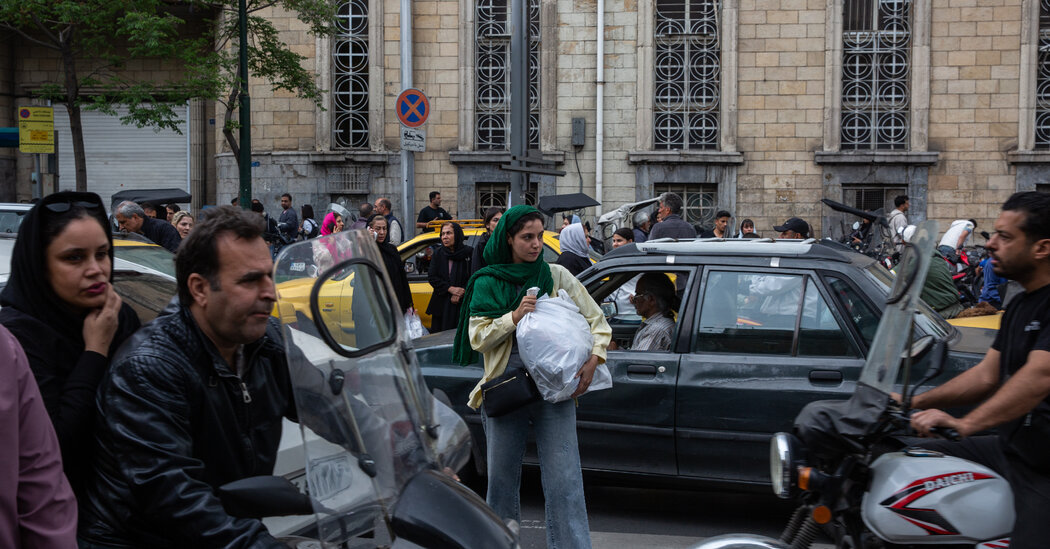
Yet, for ordinary Iranians, the human cost paints a harrowing picture, one that transcends diplomatic chess moves. At the Kapikoy border crossing between Turkey and Iran, stories unfold of quiet desperation. Moji, a 38-year-old woman returning from Europe to Urmia, spoke of devastated factories in her hometown and friends scraping by on meager earnings. “Everyone wants something better,” she said, her eyes reflecting resignation. “But the path for our people leads only to more suffering—mentally, financially.” Despite these hardships, experts like Vaez doubt they will sway Tehran’s hardline regime, which prioritizes its survival over public welfare. As the standoff drags on, the question lingers: Can economic ruin force a breakthrough, or will pride and power prevail? For now, the Gulf remains a powder keg, with the next diplomatic spark—and its aftermath—keeping the world on edge.
Reporting contributed by Yeganeh Torbati and Sanam Mahoozi.