



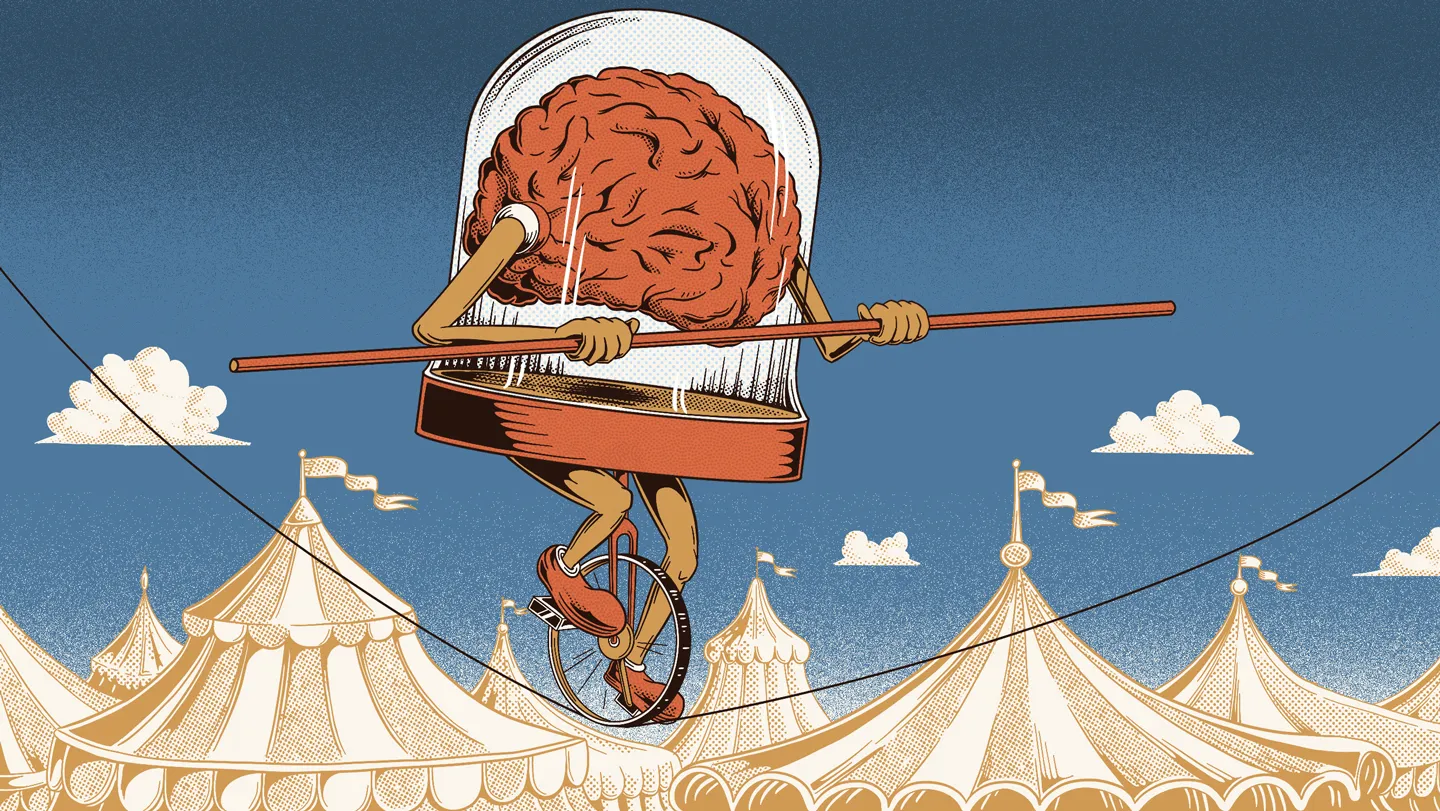
Imagine a tiny clump of mouse brain cells, no bigger than a peppercorn, sitting on a computer chip in a lab. It’s not just any lab setup; these are brain organoids, miniature versions of a brain grown in a petri dish, mimicking the dense networks of neurons that make our own minds tick. Recently, scientists managed to teach these little bundles a trick that’s surprisingly human-like: balancing a virtual pole on a moving cart, like holding a ruler upright on your palm while walking. It’s the kind of task that demands constant adjustment, a split-second decision-making that feels almost playful, but reveals something profound about how brains learn. This isn’t science fiction anymore; as reported in the journal Cell Reports on February 24, these organoids pulled it off after some digital encouragement, offering a glimpse into the mysteries of memory and cognition that have puzzled humans for centuries.
Picture yourself in a quiet research lab at the University of California, Santa Cruz, where cognitive neuroscientist Ash Robbins and his team are at work. They’ve connected these mouse brain organoids to a computer program simulating the classic “cartpole” problem from engineering—a virtual cart that shudders along a track, with a pole perched atop it, threatening to topple at the slightest wobble. The organoids aren’t just passive blobs; electrodes embedded in the chip let them “sense” the game’s action through electrical signals, and in return, the system translates their neural activity into commands that steer the cart left or right. It’s like giving a baby brain cells a video game controller, but without hands or eyes. Through a process called reinforcement learning, the researchers deliver tiny electrical zaps as rewards or corrections, guiding the organoids to stabilize that pole. It’s training, pure and simple, but on a microscopic scale—think of it as a gentle nudge for cells that don’t have ears to listen or voices to cry out in frustration.
As the days pass, something remarkable happens. The organoids start getting the hang of it. Robbins describes it as watching a friend faust with a game: you see the pole stand tall for a moment, then wobble, and finally crash down—or miraculously stay upright. With coaching, these clumps of cells managed to keep the pole balanced for at least 20 seconds nearly half the time. That’s no small feat; without the structured feedback, their success rate dropped to under 5 percent, like trying to juggle blindfolded versus with a helpful coach whispering hints. The experiments ran in short 15-minute bursts, followed by breaks, and the organoids would need retraining each time, suggesting their “memory” was fleeting, like forgetting a phone number after a night’s sleep. Yet, this short-term triumph is a huge leap forward, proving these mini-brains can adapt in real-time, reacting to challenges just as we do when learning to ride a bike or solve a puzzle.
But here’s where it gets human: the organoids couldn’t hold onto that skill for long. Robbins notes they played in short sessions with breaks, and after 45 minutes off, it was back to square one, like how you might struggle to recall a new language phrase if you haven’t practiced in weeks. Neurobiologist Lena Smirnova from Johns Hopkins University sees this as a stepping stone toward true long-term learning, a process built on the brain’s ability to solidify memories. She and her team have already shown that these organoids possess the basic ingredients for adaptation, but this new study highlights the gaps. David Haussler, another Santa Cruz neuroscientist, points out that more evolved setups—like assembloids, where multiple organoids team up—might help. Imagine one clump handling the task while another mimics the brain’s dopamine system, doling out “rewards” to reinforce good behavior, much like how parents praise a child for tying their shoes correctly.
It’s not the first time scientists have entertained brain cells with games. In 2022, sheets of human neurons mastered Pong, the retro ping-pong simulator, and recently, they’ve tackled Doom, the action-packed shooter, though that work isn’t published yet. Those experiments were impressive waves on the ocean of neuroscience, but the Pune neurons weren’t trained—they just reacted instinctively. This mouse organoid study flips the script by adding coaching, turning passive reaction into active learning, like teaching a toddler to stack blocks versus watching them knock down a tower on their own. Robbins emphasizes that the cool factor of “brain cells playing video games” is just the hook; the real value lies in understanding the machinery of learning. For instance, how does a healthy brain wire itself for skills, and what breaks when diseases like Alzheimer’s muddle those connections?
Looking ahead, the hope is to scale this up with human brain organoids, which could mirror human cognition and disorders more accurately than animal models. Smirnova notes that mice and humans share many neural traits, but our complex physiology—prone to Alzheimer’s tangles and memory lapses—means human-derived organoids might reveal insights no lab rat ever could. This research isn’t just about tricks in a dish; it’s about unraveling the essence of what makes us think, remember, and adapt. As Robbins puts it, these tiny clusters open doors to explore how diseases disrupt learning, potentially paving the way for therapies that help real brains bounce back from strokes, traumas, or age-related declines. In a world where AI learns from data, these organoids remind us that even the smallest networks of cells can teach us about resilience, making science feel a bit more like a shared human story of triumph over trial. And who knows? In the not-so-distant future, we might look back on this as the moment we truly began to understand the mind, one precarious pole at a time. The team’s paper in Cell Reports didn’t shy away from the excitement, chronicling how a simple game became a window into the brain’s secrets, encouraging readers to imagine the possibilities. For researchers like Haussler, the path forward involves more sophisticated simulations, perhaps integrating visual cues or sensory inputs, transforming this into a fuller mimicry of real-world learning. It’s ambitious, sure, but that’s what makes it feel alive—like following a map through an uncharted forest, where every rustle could be a discovery.
Ultimately, this breakthrough whispers of a broader narrative about intelligence, whether biological or artificial. By teaching organoids to learn, scientists are blurring lines between the organic and the programmed, questioning what constitutes “understanding.” But beyond the philosophy, there’s practical promise: therapies for cognitive impairments rooted in observed learning mechanics. Robbins and his colleagues envision a future where organoid experiments inform treatments for neurodegenerative diseases, giving patients tools to rebuild lost skills. It’s a reminder that behind every lab innovation is a human quest for connection—connecting cells to create knowledge, knowledge to heal minds. As we ponder these peppercorn-sized wonders, we’re reminded that learning, at its core, is a wonderfully human endeavor, one that these tiny brain-clones are just beginning to echo in their digital playgrounds. The journey from a wobbling pole to profound insights continues, and it’s worth every word of exploration.