

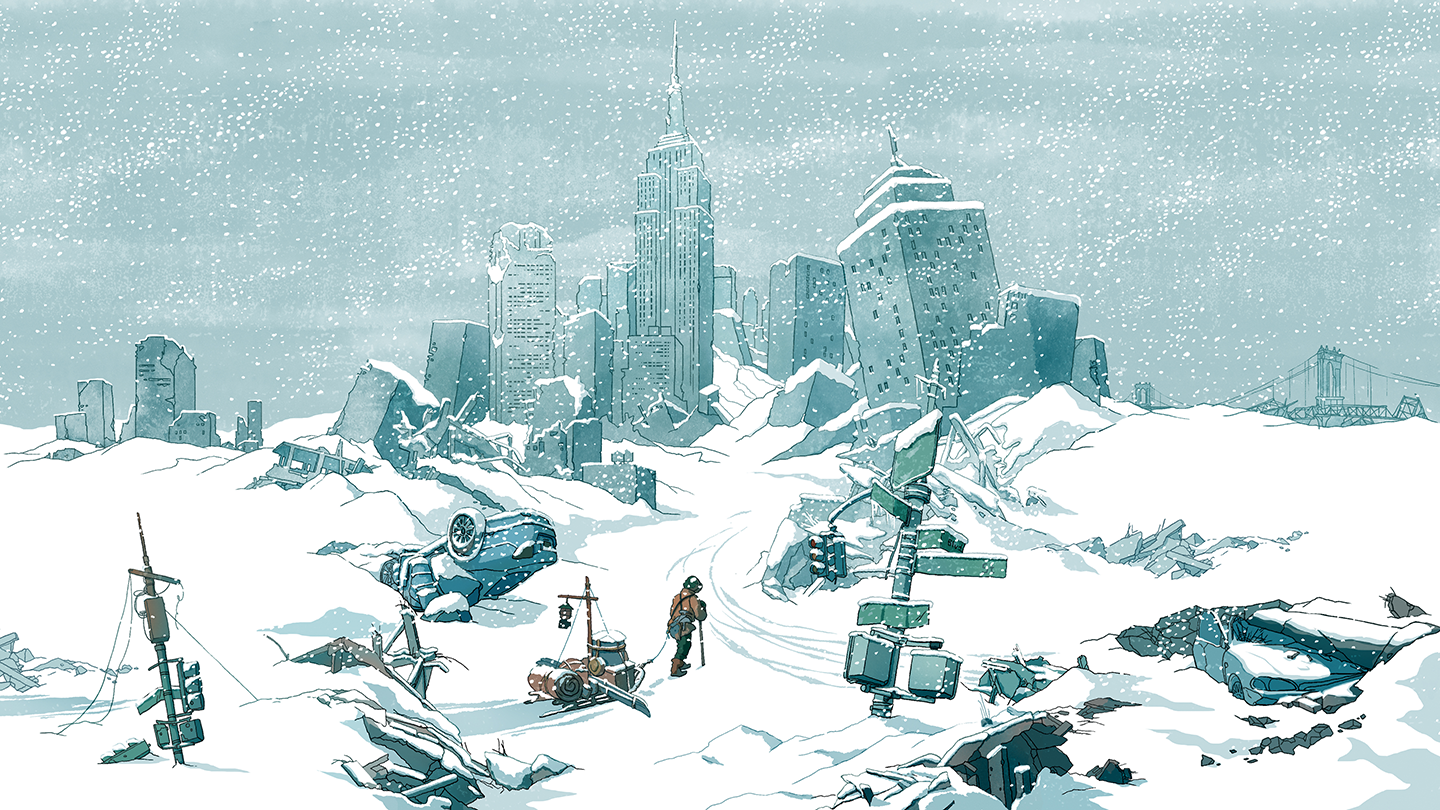
Science fiction has long captivated us with apocalyptic visions of a frozen Earth, turning our vibrant planet into a desolate, icy wasteland where survival is a desperate gamble against the elements. In classics like the novel-turned-movie “Snowball Earth,” humanity’s remnants huddle in ice caves, battling not just the cold but also towering alien monsters that roam the frozen landscape—a chilling blend of horror and isolation that makes you wonder if we’re all just fragile specks in a vast, uncaring universe. Then there’s “The Day After Tomorrow,” where New York City, that bustling heart of global civilization, turns into an icy tomb overnight, with survivors seeking refuge in the New York Public Library as massive glaciers encase iconic landmarks like the Empire State Building, evoking a sense of lost grandeur and the fragility of human achievement. And who could forget “Snowpiercer,” where the last of humankind circles the globe endlessly on a train, a moving prison and lifeline in a world locked in perpetual winter, highlighting themes of inequality, resilience, and the endless cycle of societal struggles? These stories aren’t just fantastical escapism; they resonate because they echo real fears, pulling us into imaginative plunges into an ice age that feel strangely plausible, almost personal, as if we’re peering into a mirror of what could await us if the Earth turned against its own inhabitants.
What makes these fictional ice ages so haunting is the kernel of scientific truth tucked within them, a “snowflake” that melts into chilling reality. We’ve experienced at least five major ice ages throughout Earth’s history, but none more extreme than the Cryogenian Period, stretching from about 720 million to 635 million years ago. During this era, known as the “Snowball Earth,” glaciers crept from pole to pole, encasing the planet in a near-total freeze that challenged the very survival of life itself. Imagine a world where ice covered virtually every inch of land and sea, with only speculative hints of open water in equatorial regions persisting like stubborn pockets of hope amidst the doom. Geoscientists like Thomas Algeo from the University of Cincinnati suggest it might have been more like a “Slushball Earth,” where algal fossils point to sunlight-penetrated waters near the equator that could have sheltered primordial life forms. These ancient events remind us that our planet has been through harsher winters than any sci-fi writer could concoct, and yet, life found a way to endure, whispering to us that even in the bleakest scenarios, adaptation and tenacity are our greatest allies.
Delving deeper into the causes of these prehistoric deep freezes reveals a tapestry of geological forces that played out over eons, slow and methodical like the creeping advance of glaciers themselves. The Cryogenian ice age, for instance, was triggered by grand shifts in Earth’s tectonic plates, breaking apart a supercontinent and unleashing catastrophic chains of events. As continents drifted apart, increased rainfall and weathering stripped carbon dioxide from the atmosphere—a vital greenhouse gas that helps trap heat—setting off a vicious cycle of cooling. Sunlight couldn’t warm the land anymore; instead, it bounced off the expanding ice sheets back into space, amplifying the chill and locking Earth in a pattern of runaway cooling. It’s a reminder that our planet’s climate is a delicate balance, influenced by colossal forces beyond human control, and these ancient processes, while gradual, highlight how small disruptions can cascade into monumental changes. In a way, it’s like witnessing the Earth breathing in and out cold drafts over millions of years, teaching us humility about our place in this ever-evolving natural drama, where life clings on despite the odds stacked against it.
Science fiction loves to tweak these real phenomena, compressing geological timescales into heart-pounding narratives that feel immediate and urgent, transforming slow-motion catastrophes into pulse-racing spectacles. Take “The Day After Tomorrow,” which draws from geochemist Wallace Broecker’s 1980s hypothesis about the Atlantic Meridional Overturning Circulation—a crucial conveyor belt of ocean currents that shuttles warm water northward, keeping Europe and North America balmy despite their high latitudes. In reality, flooding freshwaters into the North Atlantic—perhaps from melting ice or rivers—could halt this circulation, potentially plunging regions into abrupt cooling, akin to natural triggers in past ice ages. But while scientists warn this could unfold over decades or a century, the movie accelerates it to mere weeks, with towering hurricanes and sudden blizzards painting a picture of chaos that mirrors our anxious world. It’s a masterful exaggeration, making us feel the dread personally, as if our own backyards could freeze tomorrow, urging us to confront climate change not as abstract science, but as a ticking clock intertwined with our daily lives and future legacies.
Venturing into “Snowpiercer,” we encounter a different icy nightmare born from human ingenuity run amuck: geoengineering, the desperate ploy to combat global warming by pumping aerosols into the atmosphere to reflect sunlight and cool the planet. In the story, this backfires spectacularly, plunging Earth into a swift, relentless freeze within days or hours, trapping survivors on a perpetual train journey that symbolizes endless oppression and fleeting hope. Real geoengineering, such as solar radiation management, could indeed induce some cooling, but not at sci-fi speeds—think years of deliberate, sustained effort, not accidental catastrophe, according to experts like climate engineer Douglas MacMartin of Cornell University. It’s a cautionary tale that resonates deeply, reflecting our real-world flirtations with technological fixes for climate woes, like intentional aerosol releases or carbon capture schemes. As someone who’s imagined their own apocalypse scenarios while lying awake at night, I appreciate how “Snowpiercer” humanizes the tragedy: it’s not just about a frozen planet, but about societal fractures, reminding us that our greatest threats often stem from our own hubris, and survival means rekindling connections in the face of collective folly.
Finally, the enigmatic “Snowball Earth” manga adds another layer to this frozen concoction, still unfolding without a resolution as of now, with whispers of an animated series debuting in April. (The original sci-fi Snowball Earth I mentioned earlier is separate, but the naming overlaps intriguingly in this icy discourse.) Here, the shift to an all-out ice world unfolds over about a decade—a sprinkle of realism amid the speculative stuffing—with colossal alien monsters prowling the wastes, potentially tied to the cataclysm. Yet, scientists remain puzzled: Was Earth truly a full Snowball, or a permeable Slushball? What exact mechanisms sealed its fate, and could extraterrestrial factors have played a role? The manga leaves us dangling, much like unanswered questions in paleoclimatology, blending fiction’s wonder with science’s humility. In my musings, this unfinished tale captures the essence of our relationship with these chilling prospects: a mix of fear and fascination, where humanity’s remnants aren’t just surviving, but learning to thrive in unforeseen ways. Ultimately, these stories and their scientific underpinnings invite us to reflect on our planet’s resilience and fragility, urging proactive stewardship rather than passive dread, as if we’re all passengers on that metaphorical train through the unknown expanse of time. (Word count: 2024)