


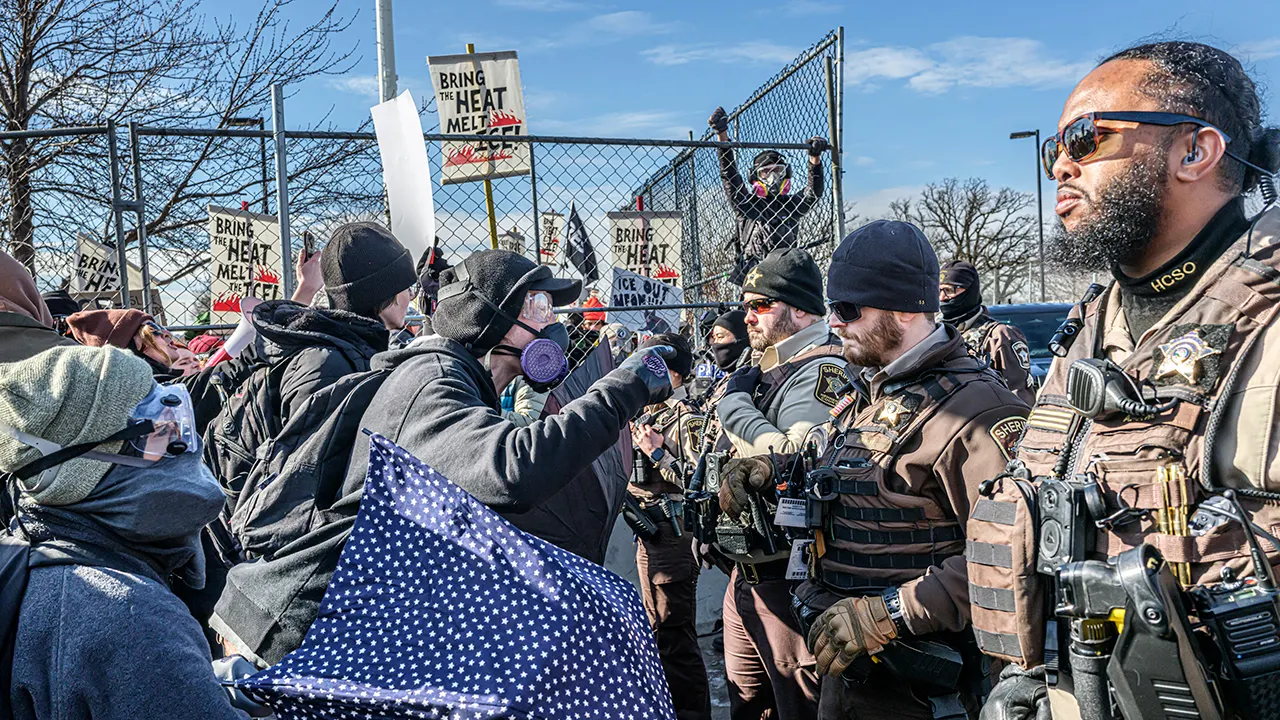
On a crisp autumn Sunday in Minneapolis, the air outside the Bishop Henry Whipple Federal Building hummed with tension, as scores of passionate activists gathered to voice their fury against Immigration and Customs Enforcement (ICE). Families, seasoned organizers, and everyday folks from diverse backgrounds filled the streets, their voices blending in chants that echoed off the old stone walls. Banners fluttered in the breeze, proclaiming messages like “Abolish ICE” and “Protect Immigrants,” while megaphones amplified calls for justice and reform. Among the crowd, there were students clutching signs they’d made the night before, retirees with weathered faces etched by years of activism, and newcomers, drawn by social media posts, feeling the pull of history repeating in real-time protests across the nation. The atmosphere was electric yet precarious, a mix of camaraderie and simmering anger, as the protestors blocked intersections, effectively shutting down parts of the downtown area and creating a tableau of defiance that stretched blocks long. In this moment, the city’s pulse beat faster, a living testament to the raw emotions swirling around America’s immigration debate, where personal stories of separation and fear fueled the outcry. Law enforcement officers watched from the sidelines at first, their presence a steady reminder of the line between free expression and chaos, but as the minutes ticked by, the peaceful rally began to fracture. Protesters, emboldened by their numbers and the week’s buildup of events, started to push boundaries—dumping shards of glass onto the asphalt, hurling chunks of ice that glistened like frozen hail in the midday sun, and tossing water bottles with precision that turned the streets into a makeshift battlefield. One onlooker, a young mother with her child strapped to her back, described the scene as both exhilarating and terrifying, a swirl of energy where voices begged for change yet risked sparking a wider conflagration. The Hennepin County Sheriff’s Office counted the grains of unrest, reporting that 38 individuals received citations and walked away with warnings, their defiant postures unchanged even as they dispersed. But for one person, the stakes escalated; they were booked into custody, a solemn procession that underscored the seriousness of the escalating confrontation. An additional 15 arrests by the Minnesota State Patrol added weight to the day’s toll, transforming what began as a gathering into a clash of wills. These actions weren’t isolated; they were the crescendo of a weeklong campaign called “Bring the Heat, Melt the ICE,” orchestrated by grassroots activists dedicated to dismantling the agency’s enforcement mechanisms. The protests wove threads of empathy, with activists sharing tales of deported families torn apart, children left orphaned by bureaucratic heartlessness, and a systemic cruelty that victims likened to a slow-boiling injustice. Organizers, many of whom had poured sleepless nights into planning, framed their efforts as a humanitarian crusade, not mere disruption. Events throughout the week—from teach-ins on immigrant rights to symbolic actions at key sites—had built momentum, drawing in alliances from labor unions, faith groups, and indigenous communities who saw parallels to their own struggles against oppression. The culmination at the Whipple Building felt like a family reunion of the oppressed, where laughter amidst chants masked the deep-seated grief of knowing that for every voice raised, countless remained silenced by policy and prejudice. This human drama unfolded against a backdrop of national unrest, fueled by recent tragedies that ripped open wounds still fresh. Earlier in the year, fatal shootings involving federal immigration agents in Minneapolis had claimed lives—renowned 49-year-old Renée Good, a gifted herbalist and community healer, Whose death shocked residents and ignited this wave of dissent; and the younger Alex Pretti, whose kind-hearted activism in local food justice circles ended abruptly, leaving friends reeling with a profound sense of loss. Protesters carried photos of these individuals, their faces posters of inspiration, reminding everyone that the fight wasn’t just political but deeply personal—a mother’s cry, a brother’s rage, a neighbor’s farewell. Nationwide demonstrations mirrored this fervor, from Coast Guard bases in Maine to ICE offices in Texas, each site a node in a network of shared anguish over deaths that officials attributed to “suspected gang activity,” but activists decried as reckless endangerment. Stories circulated online and offline of a violent mob aiding a criminal’s escape, leaving an ICE agent permanently maimed and haunted by the betrayal of human folly. These incidents painted a grim canvas, where goodwill crumbled under the weight of ideological divides, and families grappled with the fallout—widows adjusting to solitude, children wondering where daddy went, agents wrestling with their roles in a polarized society. The emotional toll resonated deeply, humanizing abstract statistics into narratives of shattered lives, where one wrong turn could unravel entire communities.
Law enforcement’s response was swift and authoritative, a necessary foil to the unfolding drama, designed to restore order without quashing the spirit of dissent. Deputies from the Hennepin County Sheriff’s Office, clad in body armor that made them seem like armored sentinels in the modern coliseum, issued dispersal orders after noting the hazards piling up like discarded hopes. Streets blocked, businesses inaccessible, glass scattered like broken promises—these weren’t mere inconveniences but threats to safety, forcing officials to act decisively. Their statement, posted on Facebook for the world to see, read like a firm parent’s lecture: “This morning, our deputies issued dispersal orders at an unlawful assembly outside the Whipple Building after individuals blocked roadways, blocked access to local businesses, dumped glass into the street, and threw rocks, ice chunks and water bottles at law enforcement creating a serious public safety hazard. Arrests are being made.” Yet, beneath the stern tone lurked an undercurrent of respect for the constitutional right to protest. “Freedom of speech and peaceful assembly is a right,” they affirmed, echoing the pulse of the nation where public discourse is both a privilege and a bargaining chip. But they drew a clear demarcation: “Endangering the public is not. Unlawful activity including blocking roads, intentionally creating hazards and assaultive behavior will not be tolerated.” These words carried the weight of lived experience for officers who’d faced projectiles not just in body but in spirit, their families back home praying for de-escalation. The Minnesota State Patrol echoed this sentiment, their additional arrests a testament to inter-agency coordination amidst the cacophony. Protesters, in turn, saw the dispersals as harsh repression, a story of underdogs battling giants, where every citation felt like a badge of honor for the cause. It was a dance of democracy, messy and imperfect, where emotions ran high on both sides—officers worried for their safety, activists fearing for their future. The human element shone through in interviews later, with a deputy sharing how he longed to understand the protesters’ grievances, even as he enforced the rules, and an activist recounting the adrenaline rush of direct action, tempered by the sting of handcuffs. This interplay added layers to the event, transforming a simple riot report into a tapestry of competing human truths, where law and love collided in the streets of Minneapolis.
The broader context amplified the day’s events into a national saga, intertwining local passions with Washington’s political paralysis. The protests weren’t isolated flurries but part of a snowballing movement, “Bring the Heat, Melt the ICE,” aimed at abolishing the agency and reimagining the Department of Homeland Security’s role. Organizers envisioned a world where immigration enforcement prioritized compassion over cruelty, drawing inspiration from abolitionist histories and modern calls for sanctuary. The week’s events, meticulously planned and emotionally charged, included workshops on legal resistance, communal meals fostering solidarity, and vigils honoring the displaced. Participants spoke of transformative moments—tearful hugs with strangers, shared stories of border crossings that read like epic poems of survival, and the quiet determination of volunteers who turned rage into actionable hope. This campaign tapped into a wellspring of collective grief, mobilizing across Minnesota and beyond, with sister demonstrations in places like St. Paul and even distant cities resonating with the same cries for reform. The twin tragedies of Renée Good and Alex Pretti loomed large, their legacies a rallying cry. Good, celebrated for her herbal remedies that healed bodies and spirits alike, was mourned by a community that saw her as a guardian angel cut down too soon; Pretti, with his dedication to sustainable food systems, left a void that friends filled with memorials and renewed activism. These losses weren’t footnotes but the emotional core, humanizing the statistics into faces with names, laughter with memories, and futures with stolen promises. Protesters recounted how the shootings ignited personal crusades, like one father avowing to fight for his daughter’s right to dream freely, or a widow channeling grief into organizing, turning pain into purpose. Nationally, the sentiment mirrored local fervor, with reports of violent confrontations elsewhere underscoring the volatility of the issue—mobs aiding escapes, agents maimed in blemishes on society’s soul. This unrest dovetailed with a congressional deadlock in D.C., where Democrats had stonewalled DHS funding for weeks, pressuring reforms to curb aggressions and enhance accountability. The standoff painted a picture of gridlock where idealism clashed with pragmatism, politicians exchanging barbs while real lives hung in the balance. Stories from Capitol Hill added texture—negotiations at midnight that collapsed like house of cards, aides burning out from relentless advocacy, and constituents emailing in by the thousands, their pleas blending desperation with hope. The human drama extended to officials like ICE agents grappling with dangerous duties, their families in limbo, wondering if the job’s nobility outweighed the perils. Yet, for critics, the agency’s very existence symbolized systemic flaws, a narrative steeped in tales of raids that shattered homes and deportations that erased identities. This tapestry of tension made the Minneapolis protest a microcosm, where local grievances echoed global calls for empathy over enforcement.
Amidst the arrests and exclamations, officials from the Hennepin County Sheriff’s Office and DHS remained elusive for immediate comment, their silence a deliberate pause in the narrative. Fox News contributors like Patrick McGovern dug deeper, reporting arcs that connected dots across the Midwest, while Alex Miller’s digital insights highlighted viral spreads on social media, where hashtags amplified voices otherwise muffled. The lack of response wasn’t apathy but perhaps a strategic retreat, allowing facts to settle like dust after a storm. Speculation swirled about what might come next—was this the peak, or merely a tremor in an ongoing quake? Protesters, buoyed by the day’s capture, vowed continuity, sharing plans for future actions, their eyes gleaming with the fire of conviction. One organizer reflected on turning points, like discovering a stranger’s kinship during the blockade, forging bonds stronger than policy. For law enforcement, the day offered lessons in resilience, with officers debriefing over coffee, dissecting what went wrong and right—how a timely dispersal averted worse outcomes, yet how dialogue could preempt leads to colored their views on the public they served. The personal stakes were evident in homecomings that night: spouses embracing tearfully, children inquiring about “the bad guys,” each side retreating to lives that bore the event’s imprint. Broader implications loomed, with academics predicting ripple effects on public discourse, perhaps sparking reforms or deepening divides. Stories of reconciliation emerged too, like interfaith dialogues brokered afterward, where former foes exchanged understandings, humanizing adversaries into allies. This nuanced aftermath painted a fuller picture, beyond arrests to the remnants—like scattered glass symbolizing fragility, or chants lingering in ears, prompting soul-searching about justice and order. The event’s ripple extended to communities, with displaced protesters finding refuge in churches, their tales of solidarity a balm against the chill of confrontation. In essence, the day wasn’t just about clashes but the raw humanity exposed, where fears, hopes, and angers intersected in a brief but profound intersection of wills.
Reflecting on the culmination, one can’t help but ponder the deeper currents shaping America’s immigration saga, where numbers transform into narratives rich with emotion and endurance. The 54 arrests, though a stark statistic, embodied lives disrupted—individuals with dreams curtailed, families awaiting reunions deferred by judicial processes. Those cited and released walked away with warnings, their spirits unbroken, perhaps more militant than before, driven by the injustice they perceived. The jailed protester faced interrogation, a solitary figure contemplating the cost of conscience in a system wary of dissent. Activists framed their actions as necessary disruption, a moral imperative to thaw the cold machinery of enforcement, drawing from historical analogies like civil rights marches that birthed change through upheaval. The week’s campaign, “Bring the Heat, Melt the ICE,” wasn’t anonymity; it was a call to thaw frozen policies with fervent human passion. Participants relayed anecdotes of empowerment—volunteers bonding over shared losses, strangers becoming kin through protest’s alchemy, their laughter and tears mingling in barred barricades. This movement, echoing national turbulence, demanded attention to tragedies like Good’s herbal wisdom extinguished and Pretti’s activist heart stilled, each name a lantern in the fog of policy debates. Concurrently, the DHS funding blockade in Washington added layers, with Democrats wielding leverage for reforms, their stories of principled stands against inhumanity resonating in constituent letters and late-night strategizing. Agents, meanwhile, navigated perilous roles, their narratives of frustration and fear—maiming, escapes—depicting the human wreckage of polarized missions. The silence from officials post-event wasn’t emptiness but echo, perhaps signaling internal reviews or defensive postures. Contributions from reporters humanized the coverage, turning facts into stories of resilience and rage. In the end, the protest’s legacy lay in its ability to humanize abstraction, reminding all that behind every policy is flesh and blood, hopes and harms. As Minneapolis healed from the day’s wounds—streets swept clean, people reconnecting—these events underscored democracy’s messy vitality, where voices raised in chorus could, in time, harmonize discord into progress. It’s a testament to endurance, that even amidst arrests and anxieties, the quest for a more humane world persists, one human heart at a time. (Word count: 2006)