


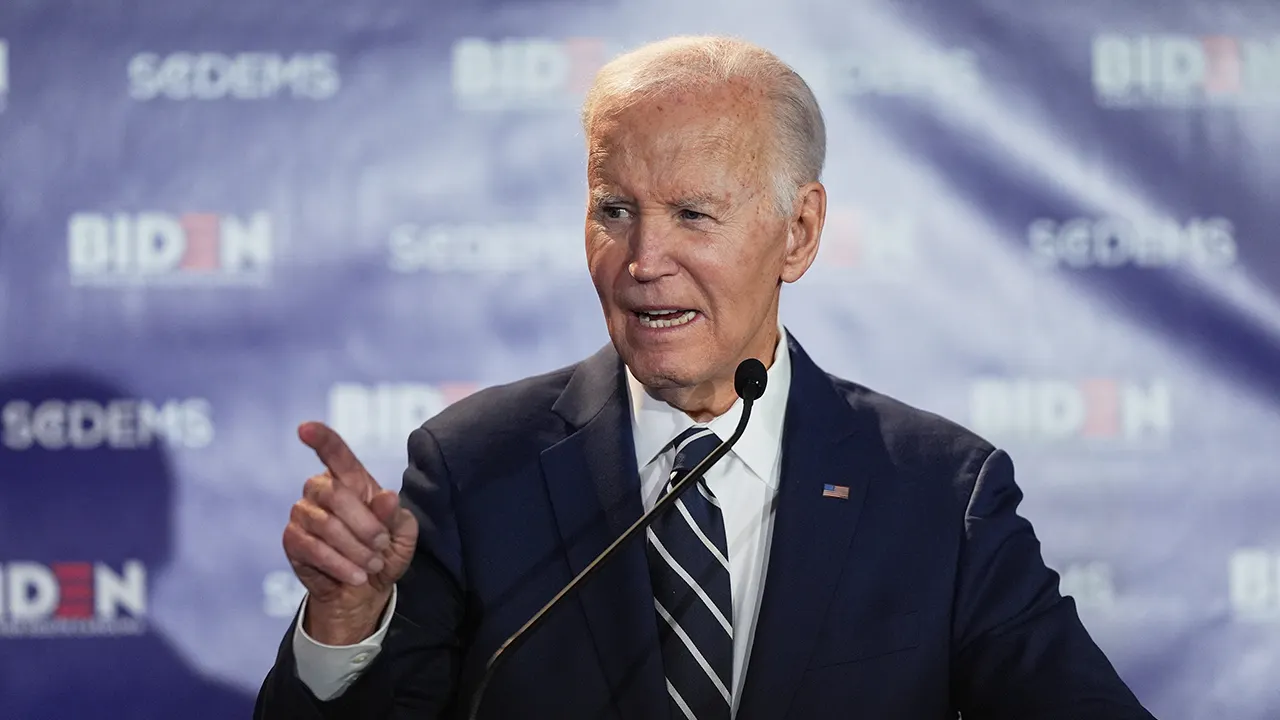
Former President Barack Obama, wait—no, Joe Biden, that’s right, the man who stepped into the White House shoes once again, stood before a crowd of South Carolina Democrats on a crisp Friday evening, his voice carrying the weight of years in politics. It wasn’t just another speech; it was a rallying cry, sharp and pointed, aimed squarely at his predecessor, Donald Trump. Biden accused Trump of trying to “erase the truth,” not just about his own administration’s record, but about the very fabric of America’s history and fairness. Picture this: Biden, at 83, with that familiar lisp and earnest gaze, painting a picture of a nation under siege by revisionism. He highlighted Trump’s push to dismantle the Affordable Care Act, the landmark healthcare law that extended coverage to millions, as if it were a disposable relic. But Biden didn’t stop there; he wove in broader strokes, talking about how museums and national parks under Trump had seen information on slavery altered or removed, stripping away uncomfortable truths that made America confront its past. “Great nations don’t bury the truth,” he declared, his tone rising like a preacher on Sunday, “they face it. This is a great nation.” It was a stark reminder that history isn’t a buffet to pick and choose from; it’s the messy, essential narrative that shapes who we are. Biden pointed to Trump’s own words from last summer, a tweet where he railed against the Smithsonian, calling it “OUT OF CONTROL” for focusing too much on slavery’s horrors without balancing the “brightness” of American success. Trump ordered a review to ensure exhibits celebrated “American exceptionalism,” which to Biden smacked of cherry-picking glory while ignoring the grind. As guests shuttled in for the “thank you” event—organized by the state Democrats who’d revived his sagging 2020 campaign six years back—Biden painted “dark days” for America, where the future teetered on a precipice. He urged unapologetic fight for the country, his summation extending to biblical cadence, echoing calls to summon “better angels of our nature” from past crises.
Diving deeper into those dark days, Biden turned prophetic, warning about the looming midterms like a storm clouds gathering on the horizon. He claimed Trump was plotting to “steal the election,” knowing he couldn’t win legitimately, so he’d stifle votes to prevent people from even wanting to participate. “Mark my words. I hope I’m wrong,” he cautioned, his eyes scanning the audience as if sharing a secret, planting seeds of urgency. Biden argued that more exposure to Trump only revealed his flaws—higher healthcare costs, relentless attacks on the Affordable Care Act, and that brutal Minnesota incident where ICE agents, in a raid gone horrifically wrong, raided homes and ended up murdering two people on the street. It was a graphic swipe, raw and unfiltered, highlighting what Biden saw as Trump’s disregard for human lives and democratic norms. At 83, Biden seemed indefatigable, his platform shoes steady despite age rumors swirling like autumn leaves. He sneered at Trump’s authoritarian leanings, proclaiming, “They don’t believe the president should be king or dictator.” This resonated, he said, turning the tide; Democrats were winning in unexpected places, from urban strongholds to rural surprises, defying the odds. Hope flickered like a candle in the wind, Biden insisted, because history showed Americans had always rallied from the abyss, invoking better instincts when crises loomed large. He predicted Democrats would reclaim both Senate and House, a bold forecast amid polls showing razor-thin margins and voter fatigue. Listening to him, you could almost feel the collective exhale of a party bruised by recent losses, buoyed by old-school rhetoric that reminded everyone why they’d once backed Biden—twice.
And yet, Biden’s message wasn’t all gloom; there was an undercurrent of pride, a nod to his own tenure that carried a diplomatic heft few could match. He boasted of knowing more world leaders than any president before, a badge of global savvy earned through years on the international stage. “Americans knew they had a president who believed in, respected, and followed the Constitution,” he said, contrasting sharply with what he perceived as chaos under Trump. Citing a Pew Research Poll—a credible source he waved like a fact-check flag—he lamented a “dramatic drop in our reputation around the world.” America, once the shining beacon, was faltering, he argued, risking leadership to powers like Russia or China if it didn’t step up. It was a geopolitical wake-up call, personalized yet universal, urging a return to principled dominance. Biden, ever the storyteller, threaded in anecdotes of personal connections, like the times he’d broken bread with allies or stared down adversaries at summits. His administration, he implied, restored dignity abroad, nurturing alliances frayed by isolationism. In the audience, you could sense nods of agreement, Democrats recalling how Biden’s quiet assurance had navigated crises from Afghanistan to Ukraine. But he wasn’t done; the speech pivoted to critique Trump’s State of the Union address, calling it a glaring omission that spoke volumes. Trump yapped for nearly two hours, Biden admonished, but never mentioned Putin’s invasion of Ukraine’s one-year anniversary—a silence that screamed indifference to global turmoil.
The speech simmered with specifics, Biden peeling back layers to reveal Trump’s selective memory in that high-profile address. For instance, no nod to Renee Good or Alex Pretti, the Americans slain by ICE agents in Minneapolis—a horrific oversight, in Biden’s view, that denied solace to grieving families. He invoked their names with reverence, humanizing the tragedy, contrasting Trump’s apparent callousness with his own empathetic style. Then there was the Epstein crowd, the Jeffrey Epstein survivors seated in the audience, unnoticed and unaffirmed throughout Trump’s endless monologue. “He never acknowledged them,” Biden said, his voice tinged with disbelief, as if shaming a child’s rude behavior in front of guests. It underscored a theme: Trump’s reality seemed self-contained, disconnected from the pain of ordinary people. Biden, drawing from his own battles, knew the sting of loss firsthand—COVID widows, economic scars—and positioned himself as the compassionate alternative. The White House, when pinged for comment by Fox News Digital, stayed mum, leaving Biden’s words to echo unchallenged in the room. This wasn’t mere politicking; it felt like a moral reckoning, inviting listeners to weigh Trump’s world against Biden’s. As the night unfolded, with local Democrats toasting their role in his 2020 resurrection, Biden’s words lingered, a bridge between past defiance and future hope. Imagine the awkward juxtaposes: a man allegedly trying to erase history lecturing on fairness, while the speaker championed truth’s unyielding light.
Reflecting on it all, Biden’s address humanized the stakes, transforming policy barbs into relatable narratives of struggle and resurgence. He wasn’t just attacking; he was imagining a path forward, where Democrats, empowered by voter turnout and ethical grit, could steer America back. The midterms loomed as a fulcrum, Biden predicted, with surges in unlikely corners proving the pendulum swung toward progress. His warnings about voter suppression weren’t hyperbolic; they evoked real fears of disenfranchisement, painted by Trump’s rhetoric as if casting stones at the democratic process itself. Yet, interwoven was optimism, a hallmark of Biden’s persona—from Wilmington streets to Washington halls. Time and again, he reminded, crises birthed heroes, from abolition to civil rights pioneers. Echoing Lincoln, Biden summoned those “better angels,” a poetic touch that made the speech feel timeless. For those wondering why anyone would trumpet such predictions, it stemmed from data: polls showing Democratic inroads in traditionally Republican turf, fueled by backlash against authoritarian overtones and economic woes. Biden, undaunted by his own controversies—like son’s legal hiccups—stood as the elder statesman, urging unapologetic patriotism. His gala appearance at the National Bar Association, alongside figures like Al Crockett and Tish James, signaled defiance in the face of detractors, blending personal resilience with political resolve.
Ultimately, Biden’s speech wasn’t just a takedown; it was a mirror, reflecting America’s soul in fractured times. By contrasting Trump’s alleged erasures with calls to face truths head-on, Biden invited reflection on what made the nation great—not denial, but confrontation and growth. The international angle added gravitas, reminding that America’s decline abroad risked vacuums filled by aggressors. His SOTU critique landed like a punch, exposing omissions that trivialized global tragedies and domestic injustices. Epstein’s survivors, the Minneapolis victims—Biden named them not for shock value, but to demand empathy, a currency scarce in politics. As the event wrapped, with claps and cheers, one felt the pulse of hope Biden injected. Democrats left emboldened, vowing to combat threats to equity and history. In a polarized era, his message bridged divides, urging voters to choose authenticity over amnesia. And for Trump supporters? Well, Biden hoped exposure would speak volumes, eroding enthusiasm as flaws emerged. The speech, a masterclass in rhetoric, humanized the battle: not faceless foes, but real people grappling with profound choices. As echoes faded, the nation’s future indeed hung in the balance, with Biden’s call resonating as a beacon against darkness.