



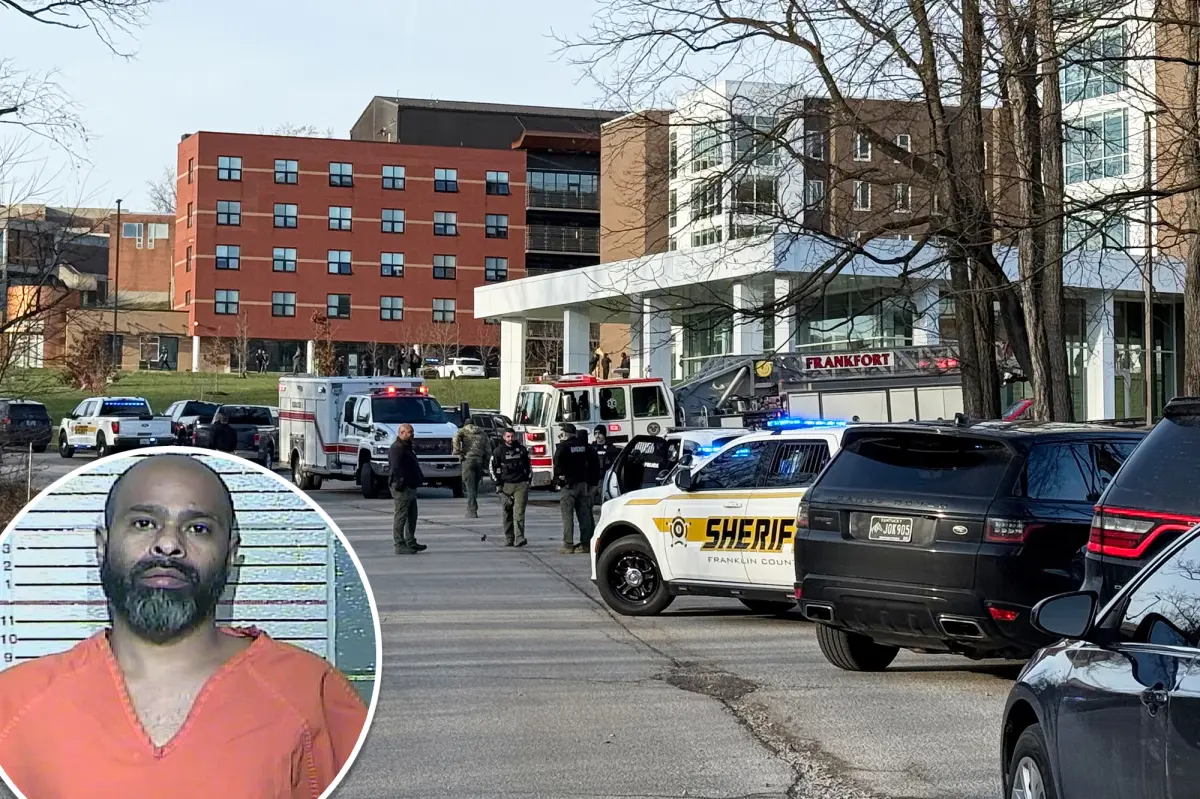
A Father’s Defense: Understanding the Kentucky State University Campus Shooting
In a significant legal development, a grand jury has decided not to indict Jacob Lee Bard, the father of two Kentucky State University students who was charged with murder following a campus shooting on December 9. This shooting resulted in the death of 19-year-old De’Jon Fox of Indianapolis and critically injured another student. According to Bard’s attorney Scott Danks, who shared the news via social media after Tuesday’s hearing, the grand jury’s decision has led to Bard’s release from jail. This case has drawn attention not only for its tragic outcome but also for the complex circumstances surrounding the incident, including allegations of prior threats and violence against Bard’s sons that ultimately led to the family’s decision to withdraw both students from the university.
The shooting occurred during what should have been a routine move-out day, with Bard’s legal team presenting a narrative that sharply contrasts with the initial murder charge. According to his attorneys, the family was in the process of moving their younger son out of campus housing with two armed campus police officers present for protection. This precaution came after what they described as “multiple armed, violent” incidents against their sons and other students in the preceding days. The defense claimed that as the family and an officer reached the dormitory entrance, they were ambushed by a group of 20 to 30 masked individuals who violently attacked them, allegedly beating one son’s head against the pavement. Bard’s attorneys have firmly maintained that his actions were “absolutely justified under the law” and represented “the only measure that prevented his son’s death or serious injury” during what they characterized as a life-threatening assault.
The events leading up to this tragic confrontation appear to have roots in earlier incidents. According to Bard’s legal team, his younger son had reported a dormitory burglary to campus police in October, after which he received threats of violence. These ongoing safety concerns allegedly escalated to the point where the family made the decision to withdraw both sons from the university entirely. The defense portrayal suggests a situation that had deteriorated over time, with the family feeling increasingly unsafe despite attempts to involve campus security. Following the shooting and subsequent legal proceedings, the attorneys stated that both sons are now staying at an undisclosed location due to continued death threats, highlighting the persistent tension surrounding the case even after the grand jury’s decision not to indict their father.
While investigators have characterized the shooting as an isolated incident, they have been notably reserved in publicly sharing details about the circumstances or potential motives involved. This information vacuum has left space for competing narratives about what transpired that December day. Kentucky State University officials, responding to the grand jury’s decision, stated they “will cooperate with law enforcement and investigators as appropriate” while emphasizing their focus on student safety and well-being. In their message to the campus community, university administrators acknowledged that the legal outcome “does not lessen the pain our community continues to feel, nor does it change our priorities,” reaffirming their “commitment to supporting our students and ensuring Kentucky State University is a safe place to learn, live, and work.”
This incident unfortunately wasn’t the first violent episode near the residence hall in recent months. Just four months earlier, on August 17, multiple shots were fired from a vehicle, striking two people whom the university identified as non-students. Frankfort police reported that one victim sustained minor injuries while another suffered serious injuries. Additionally, the dormitory building and at least one vehicle were damaged by gunfire in that earlier incident. These recurring safety issues raise questions about security measures at the historically Black university, which serves approximately 2,200 students and has a history dating back to its legislative authorization in 1886. The proximity of these violent events has undoubtedly contributed to concerns about campus safety among students, families, and the broader university community.
The case of Jacob Lee Bard, a 48-year-old from Evansville, Indiana—about 150 miles west of Frankfort—illuminates the complex intersection of parental protection, campus safety, and legal determinations of self-defense or justified use of deadly force. Initially charged with both murder and first-degree assault, Bard’s legal vindication through the grand jury process represents a significant reversal from the initial allegations. However, the resolution of legal proceedings cannot erase the human cost: a young life lost, another student seriously injured, and a university community left to grapple with the aftermath of violence on their campus. As Kentucky State University moves forward, balancing accountability with healing will remain a critical challenge for an institution whose primary mission is education and student development, not navigating the aftermath of deadly violence.