

Cosmic Collision Illuminates Planetary Birth Around Nearby Star
In a groundbreaking astronomical discovery, scientists have documented evidence of a massive collision between two asteroid-sized objects orbiting Fomalhaut, a star located just 25 light-years from Earth. This cosmic crash, captured by the Hubble Space Telescope and reported in the journal Science on December 18, provides astronomers with a rare glimpse into the violent processes that shape planetary systems – including what likely occurred during the formation of our own solar system. “It’s the first time we’ve ever seen colliding planetesimals outside of our own solar system,” says Jason Wang, an astronomer at Northwestern University who participated in the research. This discovery is particularly significant as it offers direct observational evidence of the planetary formation theory that scientists have long proposed but rarely witnessed in action.
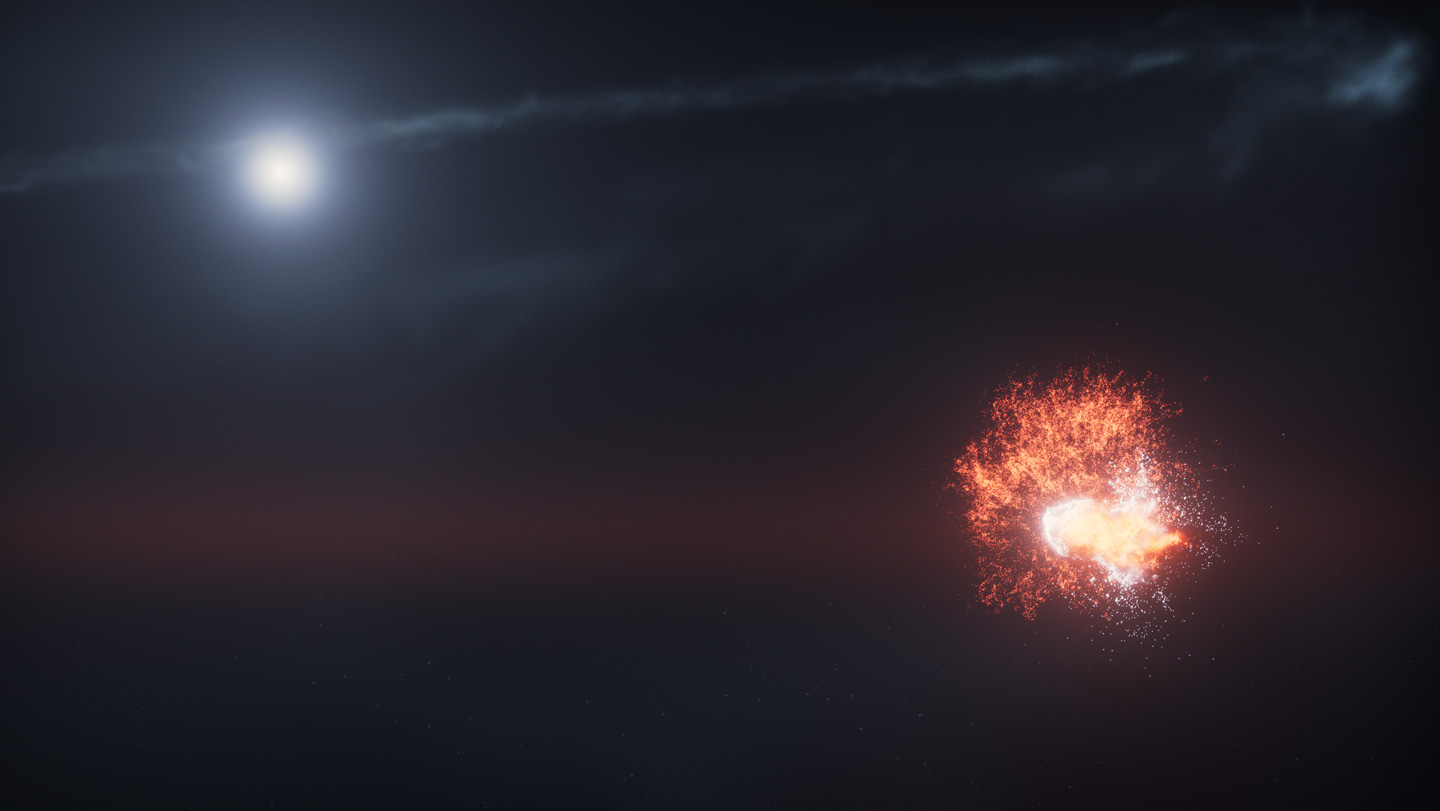
The collision occurred within Fomalhaut’s prominent debris disk, a region well-known to astronomers as an active zone of planet formation. When the two planetesimals – building blocks of planets measuring approximately 30 kilometers in diameter (slightly larger than Mars’ moon Phobos) – collided, they released an expansive cloud of dust visible as a bright blob in Hubble’s images. This dramatic event not only confirms theoretical models of planetary system development but also potentially solves a longstanding astronomical mystery. The infamous “planet” Fomalhaut b, initially celebrated in 2008 as the first exoplanet directly imaged in visible light, later disappeared from view, causing scientists to question its existence. The new data strongly suggests that Fomalhaut b wasn’t a planet at all, but rather another expanding dust cloud from a similar planetesimal collision that gradually dissipated over time.
The discovery process wasn’t straightforward for the researchers. When Wang and his colleagues first observed the new dust cloud, they were initially confused about what they were seeing. “It took us a while to kind of match all those lines of evidence,” Wang explains. The team meticulously analyzed multiple Hubble observations to confirm the nature of the phenomenon. This patience paid off with an unprecedented scientific reward – the ability to observe a protoplanetary disk actively changing. As Tim Pearce, an astrophysicist from the University of Warwick who wasn’t involved in the study, notes: “What’s cool about this paper is that for the first time ever we are seeing one of these disks change over time.” This dynamic view stands in stark contrast to the typical static nature of astronomical observations, where celestial structures “basically look the same for a human lifetime.”
The significance of witnessing these collisions extends beyond just confirming theoretical models. By observing these events in action, astronomers can directly test their ideas about planetary birth processes. The size of the dust cloud provides an indirect way to measure the size of the colliding objects, which are typically too dim to observe directly. Furthermore, detecting two such collisions (the new one and the event that created “Fomalhaut b”) within a 20-year timeframe allows scientists to begin establishing frequency patterns for these impacts. This frequency serves as a valuable indicator of object abundance in the system, as higher population densities of planetesimals would naturally lead to more frequent collisions. This quantifiable data helps astronomers refine models of how frequently these massive impacts occur during a solar system’s formation.
The research team plans to continue monitoring the Fomalhaut system to track the evolution of this newly formed dust cloud. However, this ongoing observation faces a significant challenge as the aging Hubble Space Telescope has become increasingly unreliable. A failure in one of Hubble’s pointing gyroscopes in 2024 has compromised its ability to steadily observe the star system. Fortunately, the more advanced James Webb Space Telescope also possesses the capability to observe Fomalhaut, offering researchers a powerful alternative tool to continue their study of this dynamic debris disk and potentially witness additional impacts as they unfold in real-time.
The implications of this discovery reach far beyond just understanding Fomalhaut’s system. By observing the messy, violent process of planet formation around a nearby star, astronomers gain valuable insights into the chaotic beginnings of all planetary systems, including our own solar system. The cosmic collision reveals that the birth of planets is not a gentle, orderly process but rather one marked by catastrophic impacts and dramatic transformations. As scientists continue to monitor this system, each new observation helps piece together the complex puzzle of how planets are born, evolve, and ultimately form the stable systems we observe today. This window into planetary formation represents one of astronomy’s most significant recent contributions to our understanding of cosmic evolution and our own origins in the universe.