

From Protocol to Politics: How World Cup Draws Became Presidential Showcases
The evolution of World Cup draws from straightforward administrative events to high-stakes political theater reveals much about soccer’s growing influence in global affairs. What began as a simple sorting of teams has transformed into an opportunity for power projection, personal branding, and international diplomacy—sometimes at the expense of the sport itself.
In December 1993, the United States revolutionized the World Cup draw concept when it hosted the ceremony for the 1994 tournament in Las Vegas. Gone were the staid proceedings of previous draws, replaced by genuine entertainment: Robin Williams delivering impromptu comedy, James Brown bringing soulful energy, and Stevie Wonder closing with musical brilliance. This innovation established a new template—World Cup draws could be spectacular events that transcended mere administrative necessity. The marriage of sport and showbiz seemed natural, elevating soccer’s cultural importance while maintaining focus on the tournament itself. Little did anyone know this would later evolve beyond entertainment into overt political theater.
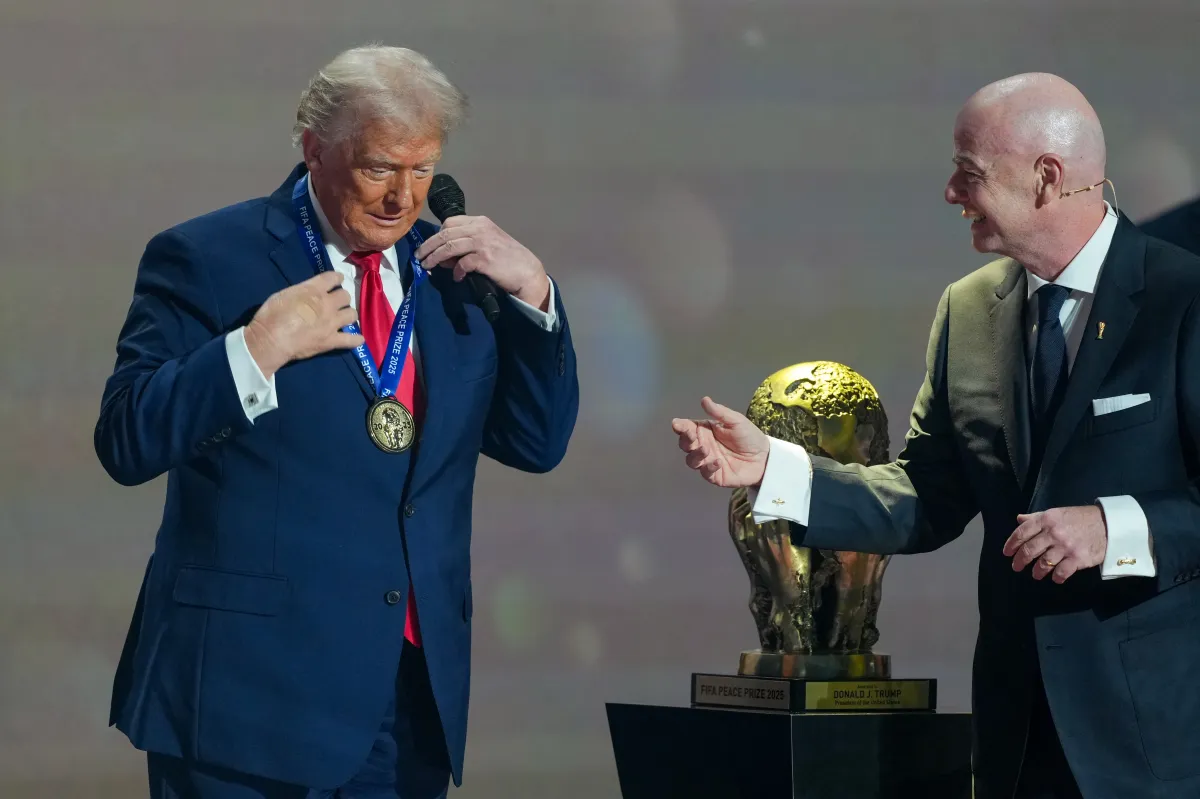
Nearly three decades later, with the World Cup returning to North American soil in 2026, the draw ceremony has undergone another profound transformation. Originally planned for Las Vegas, FIFA officials relocated the event to Washington, D.C., reportedly at President Donald Trump’s request. What unfolded at the Kennedy Center was less about soccer and more about presidential politics. Trump delivered a featured speech, personally drew the United States into its group, and—most controversially—accepted FIFA’s inaugural “Peace Prize,” a new honor seemingly created specifically for him by FIFA President Gianni Infantino without formal council approval. The ceremony was tailored to Trump’s preferences, featuring performances by Andrea Bocelli (a personal favorite who had recently visited the Oval Office) and concluding with The Village People, whose hit “Y.M.C.A.” has become a staple at Trump rallies. While sports celebrities like Wayne Gretzky, Tom Brady, Shaquille O’Neal, and Aaron Judge participated in drawing the groups, the event’s political undertones dominated.
FIFA’s embrace of Trump extended well beyond the ceremony itself, raising eyebrows within soccer’s governing circles. Earlier in the year, the organization leased office space in Trump Tower despite already maintaining U.S. headquarters in Miami. Infantino also permitted Trump to hold the World Cup trophy during a White House visit—an honor typically reserved for FIFA officials and champions—and later agreed to provide Trump with a replica of the Club World Cup trophy at his request. Throughout the draw ceremony, Infantino showered Trump with praise, calling him “a leader that cares about the people” and promising “you can always count on my support—on the support of the entire soccer community.” For his part, Trump used the platform to position himself as a global peacemaker, claiming his administration had helped resolve conflicts from Gaza to Ukraine and that together with Infantino they had “saved millions and millions of lives.” This mutual admiration society played out while the tournament’s co-hosts, Canada and Mexico, were visibly sidelined, their leaders making only brief, prompted appearances despite the event ostensibly celebrating a three-nation World Cup.
The political nature of the ceremony did not go unchallenged. Civil rights organizations and members of FIFA’s own leadership criticized Infantino’s creation of a special “Peace Prize” for Trump without proper authorization from FIFA’s governing council. The American Civil Liberties Union issued a pointed statement warning that FIFA was “risking becoming a stage for authoritarianism” and suggested the organization should be leveraging its influence to address human rights concerns rather than “whitewashing and capitulating” to political figures. The ACLU specifically highlighted the Trump administration’s immigration policies, including sweeping raids, mass detentions, and National Guard deployments in World Cup host cities—matters that went unaddressed during the ceremony despite their potential impact on participating teams and fans. When questioned about visa issues for certain delegations, Trump offered a vague reassurance on the red carpet: “We’re gonna make it easy for everyone.” The Iranian federation, after initially deciding to skip the event when several officials were denied visas, ultimately did attend, while Haitian officials expressed hope that solutions could be found for their travel challenges.
Within FIFA’s ranks, Infantino’s close relationship with Trump has generated growing concern and opposition. Six international soccer officials across three continents revealed widespread frustration with what they see as Infantino’s excessive courtship of Trump, particularly as White House policies potentially create complications for World Cup-bound teams, fans, and local organizers. This internal dissatisfaction represents a potential weakening of Infantino’s position despite his apparent consolidation of power through a third term as FIFA president. The situation is especially ironic given Infantino’s arrival at FIFA in 2016 following the “FIFAGate” corruption scandal, when he promised to clean up an organization tarnished by years of bribery and influence-peddling. Critics now point to a pattern of accommodation toward controversial leaders, including Russian President Vladimir Putin and Saudi Crown Prince Mohammed bin Salman, both of whom have leveraged major soccer events to enhance their global image—a practice often described as “sportswashing.”
The politicization of World Cup ceremonies reflects soccer’s evolution from simple sport to geopolitical tool. While Trump is hardly the first leader to use soccer for political advancement, the Washington draw ceremony represents a significant escalation in how explicitly the world’s most popular sport can be co-opted for personal and political gain. From Infantino’s unilateral creation of a “Peace Prize” to the sidelining of co-hosts Canada and Mexico, the event demonstrated how far the World Cup draw has traveled from its origins as a straightforward sorting of teams. As FIFA prepares for future tournaments—including the 2034 World Cup in Saudi Arabia—questions persist about whether the organization can balance its relationships with powerful leaders while maintaining its commitment to being truly global and inclusive. Trump himself, when asked about the symbolism of hosting a World Cup during America’s 250th anniversary, simply called it a “nice coincidence”—perhaps the most straightforward statement in an increasingly complicated relationship between soccer and state power.