Yemen’s Southern Transitional Council Emerges as a Dominant Force Amid Regional Tensions
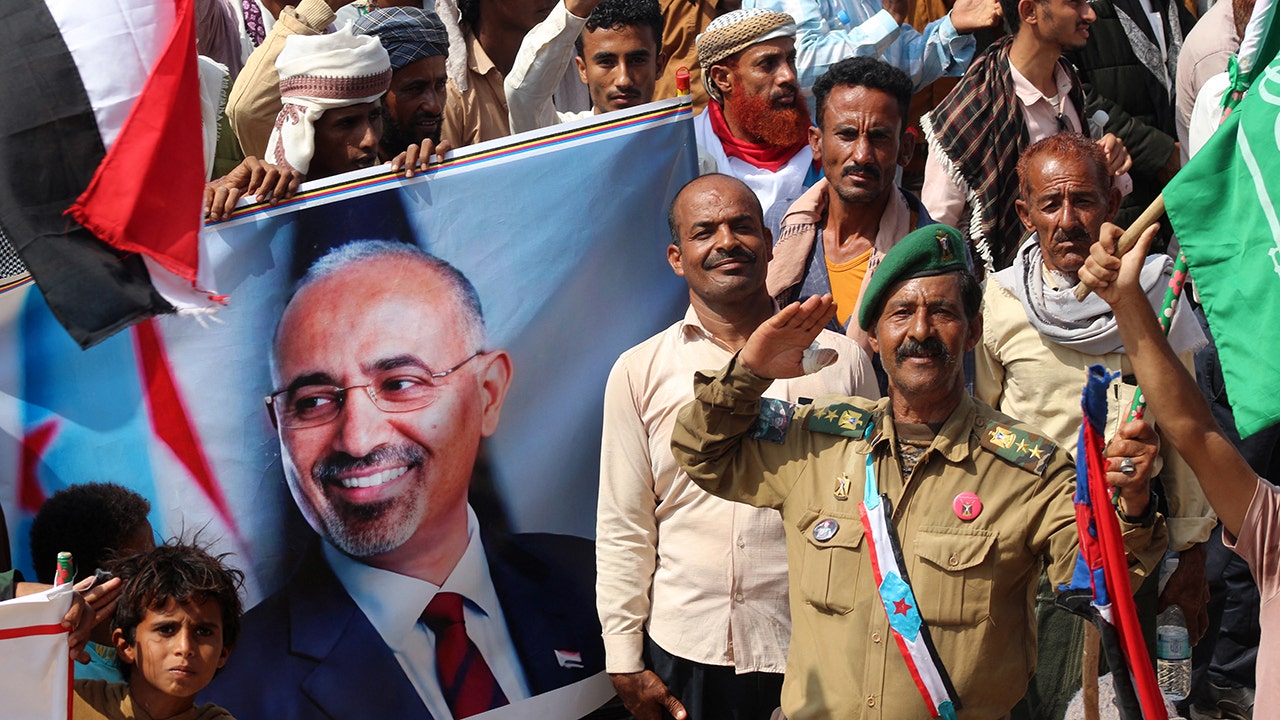
In a rapidly evolving political landscape, Yemen’s Southern Transitional Council (STC) has emerged as a powerful player, claiming control over all eight southern governorates while positioning itself as a potential partner for the United States against Iran-backed Houthis and extremist groups. Speaking to Fox News Digital, Ahmed Atef, the STC’s representative to the United States and United Nations, expressed hope for expanded cooperation with Washington on multiple fronts. “All kinds of support are welcome,” Atef stated, adding that “President Trump is very courageous and very strong, and we are really looking forward to his support.” This development comes at a critical juncture as Yemen’s complex civil conflict continues to reshape power dynamics in the region, with the STC—backed by significant Emirati funding and military support—seeking to reestablish an independent South Yemen, reminiscent of the state that existed from 1967 until unification in 1990.
The situation has raised significant international concern, with UN Secretary-General António Guterres warning that Yemen faces a dangerous new escalation following the STC’s recent advances in the eastern governorates of Hadramawt and al-Mahra. Guterres cautioned that such unilateral actions risk deepening divisions and accelerating fragmentation, with potential spillover effects on regional security across the Red Sea, the Gulf of Aden, and the Horn of Africa. Meanwhile, Yemen’s internationally recognized government has called on the STC to withdraw from territories they have recently captured. This creates a complex diplomatic situation for the United States, which officially supports the internationally recognized Yemeni government. Bridget Toomey, a researcher at the Foundation for Defense of Democracies, noted that for the U.S. to support southern secession would be “at odds with the stated policy of the internationally recognized government of Yemen, which currently exists for one Yemen,” though she acknowledged that backing the STC as a partner in counterterrorism missions might be compatible with existing frameworks, particularly because the STC and its leadership are part of the current governing structure.
Yemen’s war has effectively split the nation in two: in the north, the Houthis rule Sanaa and much of western Yemen with support from Iran and ties to Hezbollah, while in the south, STC-aligned forces dominate Aden (the temporary capital) and surrounding regions. The internationally recognized government, formally based in Aden, remains fragmented, with the Saudi-backed Presidential Leadership Council relying on a coalition of competing factions, including the STC, to govern. This government has struggled with serious economic and capacity challenges, failing to deliver basic services amid the ongoing humanitarian crisis. The STC’s recent expansion has prompted warnings that unilateral moves could undermine the political process and destabilize the fragile balance in the south. Atef, however, rejects this characterization, describing the Hadramout operation as a success demonstrating the STC’s ability to fight what he calls hostile forces operating in coordination with the Houthis.
Atef portrays the Houthis as a destabilizing force extending well beyond Yemen’s borders, citing their slogan of “death to America, death to Israel” as “really very unacceptable.” He warns that as long as the Houthis maintain control of Sanaa, they will “continue threatening maritime traffic in the Red Sea, continue threatening us in the South and Saudi Arabia, and continue threatening the UAE and the Gulf region.” He also accuses Houthi factions of cooperating with extremist groups, including Somalia’s al-Shabab, and receiving training and support from Iran and Hezbollah. STC President Aidarous Al-Zubaidi has pledged assistance to northern Yemeni forces seeking to “re-liberate Sanaa,” with Atef dismissing prospects for a negotiated political settlement as “impossible,” declaring, “We will talk the language that the Houthis understand.”
Throughout the interview, Atef repeatedly framed the STC as a natural U.S. partner on counterterrorism and regional stability. He praised former President Trump for designating the Houthis as a foreign terrorist organization and for efforts targeting branches of the Muslim Brotherhood. “In Yemen, we have Muslim Brotherhood. We believe that they are terrorists. We believe that they sponsor terrorism,” Atef stated, adding that he supported recent legislative efforts to classify certain Muslim Brotherhood chapters abroad as terrorist entities. He went further, arguing that the organization is “extremist everywhere, even in the United States. Not only in these chapters.” Beyond security cooperation, Atef highlighted economic opportunities, saying the STC intends to open southern Yemen’s oil, agriculture, fisheries, and tourism industries to American companies as a path toward long-term self-sufficiency, inviting U.S. companies to “come and explore the oil fields and help us in getting revenues to develop our people.”
The STC’s ultimate objective, according to Atef, is an independent, pro-Western South Yemen capable of securing its territory while helping counter Iran’s regional influence. “Once we have got this front against the Houthis strengthened and emboldened with the support of the international community and the United States,” he emphasized, “that is going to help us very much on the ground to continue our fight and bring stability and peace to the region.” As these developments unfold, they represent not just a local power struggle but a significant reshaping of regional alliances and power balances in a geopolitically vital area. The STC’s growing influence and territorial control, combined with its outreach to Washington, signals a potentially significant shift in Yemen’s political landscape and in broader Middle Eastern dynamics, particularly as various powers continue to compete for influence in this strategically important region.