




Venezuelan Opposition Leader María Corina Machado Makes First Public Appearance in 11 Months in Norway
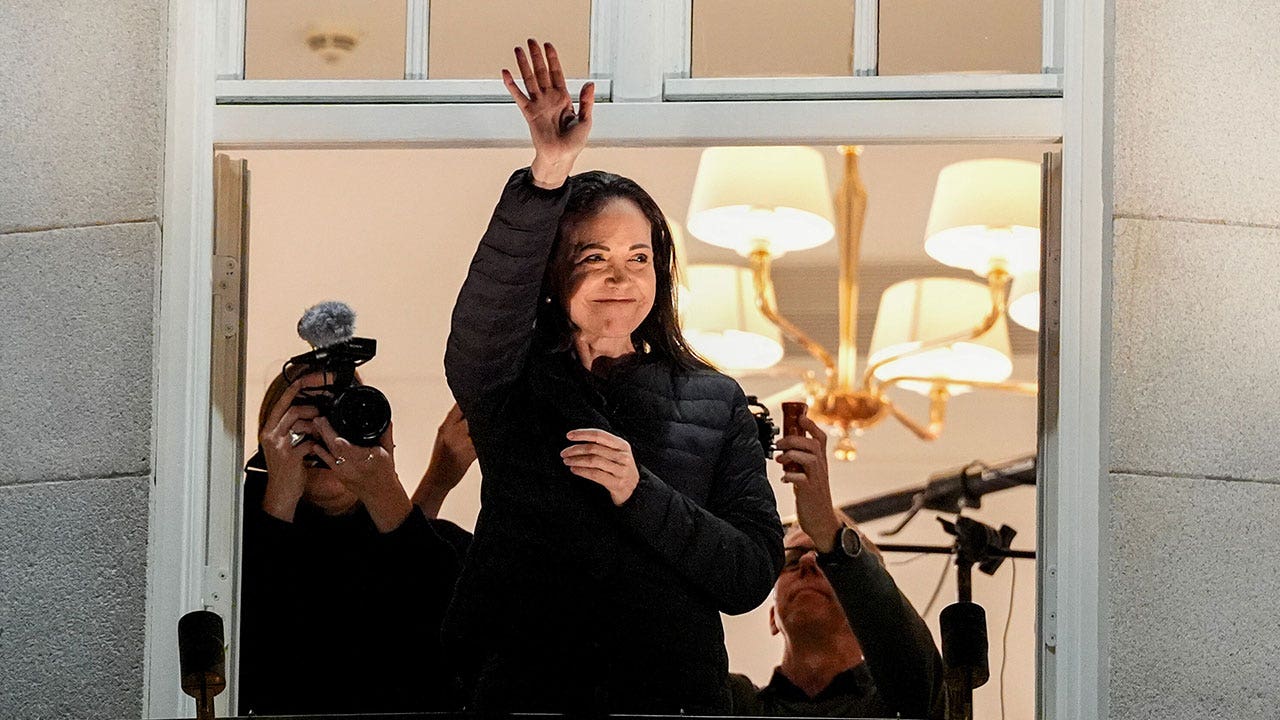
After eleven months in hiding, Venezuelan opposition leader María Corina Machado emerged publicly in Oslo, Norway, where she appeared on a hotel balcony to the sounds of supporters chanting “Freedom!” This marked her first public appearance since January 9, when she was briefly detained in Venezuela’s capital, Caracas, after participating in a rally with her supporters. Machado has become an international symbol of peaceful resistance against President Nicolás Maduro’s government, which has been widely criticized for its authoritarian tactics and economic mismanagement. As she waved to the crowd from the balcony, supporters joined her in singing Venezuela’s national anthem, creating a powerful moment of solidarity for those advocating for democratic change in the troubled South American nation.
Though Machado herself couldn’t attend the Nobel Peace Prize ceremony in time, her daughter, Ana Corina Sosa, accepted the prestigious award on her behalf. In an audio recording shared on the Nobel website, Machado explained that many people had “risked their lives” to help her reach Norway, which she described as “a measure of what this recognition means to the Venezuelan people.” Her daughter’s acceptance speech reflected her mother’s unwavering commitment to democracy, stating that Machado “wants to live in a free Venezuela” and “will never give up on that purpose.” Ana Corina expressed confidence that her mother would return to Venezuela “very soon,” despite the risks such a move would entail given the current political climate. Outside the hotel, supporters gathered to celebrate Machado’s appearance, taking photos and affectionately chanting “President! President!” as she interacted with the crowd, embracing supporters and expressing her hope: “I want you all back in Venezuela.”
Machado’s appearance in Norway coincides with escalating tensions between Venezuela and the United States. Just a day before her public emergence, President Donald Trump announced the seizure of a Venezuelan oil tanker, a rare action that could further strain relations with Maduro’s government. This move adds to the extensive U.S. sanctions already targeting Venezuela’s oil sector, the country’s primary source of revenue. Since September, U.S. military operations have conducted at least 22 strikes targeting alleged narcotraffickers near Venezuela, resulting in 87 deaths. Trump has recently suggested that Maduro’s “days are numbered” and has not ruled out the possibility of a ground operation in Venezuela, signaling a potentially more aggressive approach toward the South American nation.
Some policy experts see Machado’s international visit as an opportunity to garner broader support for democratic change in Venezuela through non-military means. Steve Yates, a senior research fellow at The Heritage Foundation, suggested on “Fox News @ Night” that Machado’s overseas appearance could help secure “greater international support” for her cause. He also noted that Trump might benefit from having more European allies support a “non-invasion” approach to addressing Venezuela’s crisis. This perspective aligns with efforts to find diplomatic solutions to the country’s ongoing political and humanitarian challenges while maintaining pressure on the Maduro regime. Machado herself has been vocal in her support for Trump administration actions against Maduro’s government and Venezuela’s narcotrafficking networks, indicating alignment with U.S. policy objectives regarding her country.
When Machado was announced as the Nobel Peace Prize recipient in October, she dedicated the award to both former President Trump and the “suffering people of Venezuela,” highlighting the complex international dynamics surrounding Venezuela’s crisis. This dedication reflects her strategic approach to building international support for democratic change in her country while acknowledging the role of U.S. policy in pressuring the Maduro regime. During a “Fox & Friends Weekend” interview last month, Machado expressed optimism about Venezuela’s future, stating that the country was standing at the “threshold of freedom.” She also highlighted her newly released “freedom manifesto,” which outlines her vision for Venezuela’s future without the Maduro regime, emphasizing democratic governance and economic recovery.
The Nobel Peace Prize recognition and Machado’s appearance in Norway represent significant moments in Venezuela’s ongoing struggle for democratic governance. As the opposition leader continues her campaign against Maduro’s government, international attention remains focused on Venezuela’s political crisis and humanitarian situation. With millions of Venezuelans having fled the country due to economic collapse, political repression, and widespread shortages of basic necessities, the stakes of this conflict extend far beyond political power struggles to affect the daily lives of ordinary citizens. Machado’s peaceful resistance and international recognition highlight alternative pathways to change in a country where democratic institutions have been systematically undermined. As tensions with the United States escalate and international pressure mounts, the coming months may prove decisive for Venezuela’s political future and the welfare of its people.