





U.S. Forces Withdraw from Ain al-Asad Airbase as Part of Regional Consolidation Strategy
In a significant military development, U.S. troops have completed their withdrawal from Ain al-Asad Airbase in Iraq, Fox News has learned. This pullout, finalized by Friday, represents a key milestone in the broader American strategy to consolidate forces in the region—a plan that was first announced last fall. According to Central Command (CENTCOM) sources, this redeployment reflects the substantial progress made against ISIS in Iraq. “We’re able to consolidate because of the significant progress made there—ISIS in Iraq doesn’t pose a threat beyond Iraq’s capacity to handle on their own,” explained a U.S. official. This transition speaks volumes about both the success of American counter-terrorism efforts and the growing capabilities of Iraqi security forces to maintain stability independently. Rather than signaling a reduction in counter-terrorism commitments, officials clarified that U.S. forces are being strategically repositioned outside federal Iraqi territory, allowing them to concentrate more effectively on combating ISIS remnants in neighboring Syria.
The regional military landscape has grown increasingly complex, with CENTCOM Commander Admiral Brad Cooper publicly calling for enhanced cooperation among Syrian partners in coordination with American and coalition forces. “We welcome ongoing efforts by all parties in Syria to prevent escalation and pursue resolution through dialogue,” Cooper stated on social media. His message emphasized the need for Syrian government forces to cease offensive actions in areas between Aleppo and al-Tabqa, underscoring that effectively pursuing ISIS requires teamwork among various Syrian partners. Admiral Cooper’s statement reflects the delicate balancing act faced by American forces in Syria, where multiple actors with competing interests operate in close proximity. “A Syria at peace with itself and its neighbors is essential to peace and stability across the region,” he noted, highlighting the broader regional implications of the Syrian conflict beyond just counter-terrorism operations.
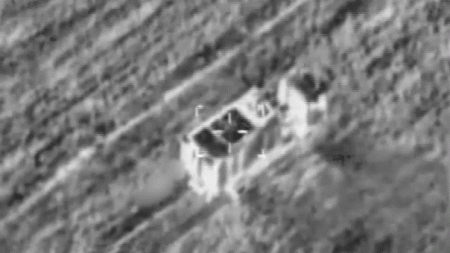
Recent weeks have seen a significant escalation in U.S. military operations against ISIS in Syria. On January 10, CENTCOM announced large-scale strikes against ISIS targets as part of Operation Hawkeye Strike—a campaign launched on December 19, 2023, under President Donald Trump’s direction. These strikes were explicitly characterized as a direct response to a deadly ISIS attack on U.S. and Syrian forces in Palmyra. The military operations coincided with diplomatic initiatives, as U.S. Special Envoy for Syria Tom Barrack met with Syria’s new leadership in Damascus. “Today, on behalf of President Donald J. Trump and Secretary of State Marco Rubio, I met with Syrian President Ahmed al-Sharaa, Foreign Minister Asaad al-Shaibani, and members of their team,” Barrack reported on social media. These talks reportedly focused on recent developments in Aleppo and broader strategies for Syria’s transition, with Barrack expressing American support for the country’s new government under President al-Sharaa.
The military response against ISIS intensified significantly following a December 13 attack that claimed American lives. War Secretary Pete Hegseth characterized Operation Hawkeye Strike not as “the beginning of a war” but rather as “a declaration of vengeance.” The operation’s scope was substantial—on December 19 alone, American forces employed over 100 precision munitions against more than 70 suspected ISIS sites across Palmyra in central Syria. The December 13 attack had resulted in the deaths of Sgt. Edgar Brian Torres-Tovar, 25, of Des Moines, Iowa; Sgt. William Nathaniel Howard, 29, of Marshalltown, Iowa; and interpreter Ayad Mansoor Sakat of Michigan. These service members were conducting a key leader engagement as part of their counter-terrorism mission when they were killed, with the attacker subsequently neutralized by partner forces.
President Trump had personally vowed retribution following the attack, taking to social media to announce that “the United States is inflicting very serious retaliation, just as I promised, on the murderous terrorists responsible.” This statement came after Trump participated in a dignified transfer ceremony for the fallen Americans. The intensity of the U.S. response underscores the administration’s stance on ISIS and signals its approach to protecting American forces abroad. Despite the withdrawal from Ain al-Asad Airbase, the broader campaign against ISIS appears to be entering a new phase rather than winding down, with resources being redirected to areas where the terrorist group maintains a more significant presence.
The developments in Iraq and Syria reflect the evolving nature of U.S. counter-terrorism strategy in the Middle East. While the withdrawal from Ain al-Asad represents a vote of confidence in Iraqi security forces’ capabilities, the intensification of operations in Syria demonstrates continued American commitment to preventing an ISIS resurgence. The parallel diplomatic initiatives suggest a multi-faceted approach that combines military pressure with political engagement. As U.S. forces consolidate their positions and refine their operational focus, the situation highlights both the progress made against ISIS since its territorial defeat and the persistent challenges posed by the group’s insurgent tactics. The balance between maintaining counter-terrorism pressure and allowing local partners to assume greater responsibility remains delicate, particularly amid the complex web of regional conflicts and competing interests that characterize today’s Middle East.