




A Rare Dialogue Across the Straits: Xi and Taiwan’s Opposition Leader Meet After a Decade
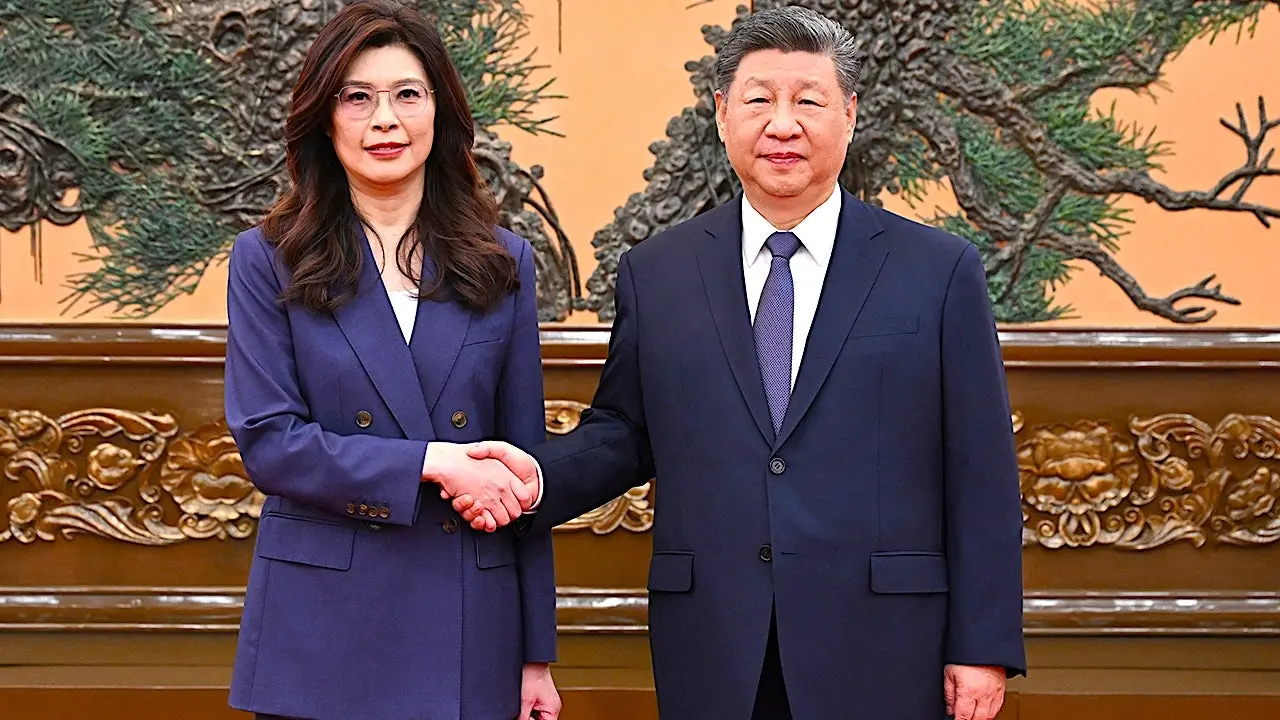
In the bustling city of Kaohsiung, where the humid air carries the salty scent of the ocean and the rumble of container ships echoes through the port, life goes on amid tensions that feel both distant and intimately close. But halfway across the world, in the gleaming halls of Beijing, a historic meeting unfolded that sent ripples through Taiwan’s political waters. For the first time in nearly a decade, Xi Jinping, China’s supreme leader and head of the Communist Party, sat down with Cheng Li-wun, the chairwoman of Taiwan’s main opposition party, the Kuomintang (KMT). The encounter, held behind closed doors on a crisp Friday, was a nod to old alliances and simmering divisions. As cameras flashed, the two posed for photos, smiles carefully curated against a backdrop of mistrust. Xi, ever the statesman in his crisp suit, reiterated China’s long-held narrative: Taiwan is an “inalienable” part of China, a claim rooted in history and backed by the party’s unwavering scripts. He spoke of the “rejuvenation of the Chinese nation” as an unstoppable force, a vision of China rising to global prominence by 2049, the centennial of the People’s Republic. It’s the kind of talk that’s rehearsed in state media broadcasts, delivered with the certainty of dogma, even though the communist regime has never governed Taiwan since its founding in 1949. Their discussion wasn’t between governments—China pointedly refuses to engage Taiwan’s democratically elected administration, led by President Lai Ching-te from the Democratic Progressive Party (DPP). Instead, it was a party-to-party affair, a diplomatic sidestep that highlights the fractures across the Taiwan Strait. Lai’s DPP has won the presidency three times in a row—2016, 2020, and 2024—solidifying Taiwan’s tilt toward identity and independence from China. Yet, in last year’s parliamentary elections, the DPP narrowly lost control to a coalition dominated by the KMT and its allies. This meeting, then, felt like a quiet recalibration, with Xi and Cheng exchanging views on the shared heritage of the “Chinese nation,” leaving onlookers to wonder if it was bridge-building or just another layer of political theater in a region where words can ignite debates or defenses.
China’s Firm Stance and Taiwan’s Defensive Posture Amid Budget Battles
As Xi articulated his vision, the weight of China’s power loomed large, not just in rhetoric but in the shadows of its military might and economic leverage. He emphasized that Taiwan’s status as part of China isn’t negotiable—it’s a historical truth, he said, impervious to external meddling. State-run outlets in China amplified this message, portraying the meeting as a natural reunification chat between brothers separated by ideology. But in Taiwan, where people cherish their freedoms, this sounded more like an ultimatum. President Lai Ching-te, who took office amid heightened cross-strait tensions, voiced his skepticism hours before the meeting. On social media, he warned that compromising with authoritarian regimes could erode Taiwan’s hard-won sovereignty. His words resonated in households like the one in Kaohsiung, where everyday fears mingle with pride. Just hours later, Lai addressed the nation without directly naming the encounter, but his message was clear: Taiwan stands firm against coercion. This backdrop is complicated by internal politics. Taiwan is currently embroiled in a heated dispute over defense spending, a topic that’s become a barometer for the island’s resolve. President Lai proposed a $40 billion special defense budget to bolster military capabilities against potential threats from China. But the opposition coalition, led by the KMT, has blocked it in parliament. This gridlock has drawn international attention, including from U.S. Senator Jim Banks, a Republican from Indiana, who visited Taipei recently. He urged approval, arguing it’s a clear signal of Taiwan’s commitment to “peace through strength.” As Banks put it during his trip, investing in defenses isn’t just smart; it’s a way to deter aggression without firing a single shot. Yet, with the budget stalled, whispers of unease grow. There’s concern that Taiwan’s ability to buy U.S. weapons could waver if President-elect Donald Trump, set to meet with Xi in May, strikes a deal favoring Beijing. For many in Taiwan, this isn’t abstract geopolitics—it’s a real risk to their way of life, where young people lobby for more military funding while older generations remember the chill of cross-strait standoffs.
Echoing Xi’s Words: The KMT’s Role and Rising Controversy
Enter Cheng Li-wun, the KMT chairwoman, who echoed Xi’s calls for national rejuvenation in ways that stirred both applause from some and outrage from others. In the more than century of tangled history between the KMT and China’s Communist Party, she claimed, the goal has always been to lift China from decline. “The great Chinese rejuvenation involves people on both sides of the strait,” Cheng said, invoking “reawakening and resurgence of Chinese civilization.” Her words, mirroring Xi’s, positioned the KMT as stewards of a unified cultural narrative. For those who favor closer ties with the mainland—and there are still pockets in Taiwan who dream of economic benefits—they saw this as pragmatic continuity. But for many, it felt like a betrayal, especially in a society where identity is evolving. Taiwan’s shift toward a distinct national consciousness has made such rhetoric divisive. Pro-independence voices slammed the meeting as undermining democratic principles. How could a party leader cozy up to a regime that views Taiwan as ripe for takeover? The DPP’s media savvy didn’t waste time, framing Cheng and the KMT as willing to “sell out” Taiwan for personal gain. Social media buzzed with memes and debates: Was this a path to peace, or just appeasement? The incident evoked memories of rare cross-strait summits, like in 2015 and 2016 when previous KMT leaders met Xi in Beijing, and Ma Ying-jeou’s handshake with Xi in Singapore. Yet, those moments, once heralded, now seem archaic in a Taiwan that’s grown more assertive. Back in Kaohsiung, retirees sipping tea in parks argued over family dinner tables. Some reminisced about the old days when KMT rule promised stability through nominal ties to China. Others, shaped by DPP victories and pro-independence rallies, saw the meeting as a step too far, fearing it weakens Taiwan’s global alliances.
Voices from the Ground: A Mother’s Resolve for an Independent Taiwan
To humanize this tale, picture Rose Chou, a 45-year-old administrator at one of Kaohsiung’s largest primary schools. Her days are filled with the laughter of children and the clang of school bells, but lately, her thoughts drift to the broader storms brewing east of the strait. Rose isn’t just a observer; she’s lived the shift in Taiwan’s soul. “Yes, I want a Republic of Taiwan,” she told me, her voice steady yet laced with the quiet passion of a parent protecting her future. With an 18-year-old son approaching adulthood, Rose confronts the harsh possibilities. “I realize we may have to fight. I’m willing to fight,” she admits, her eyes reflecting the resolve of generations who’ve clawed for autonomy. Rose knows the pulse of her community. Most folks she talks to favor the status quo—a delicate balance since the end of the Chinese civil war in 1949, when Taiwan became a refuge for nationalists fleeing Communist rule. Officially called the Republic of China, Taiwan maintains this name to appeased Beijing, but in practice, it’s a vibrant democracy, worlds apart from the mainland’s authoritarian grip. Rose admits unification appeals to a “very small number,” though she’s unsure under what terms—maybe if China democratized, but that’s a fairy tale. Xi’s era has shattered any illusions; Beijing now demands outright submission, squeezing Taiwan economically and militarily. Rose’s story mirrors countless others: families weighing peace against principle, youth rejecting old labels. In Kaohsiung’s bustling streets, where night markets hum with street food and street vendors hawk everything from bubble tea to political stickers, conversations turn to survival. Rose’s willingness to defend stems from fear—fear of losing the freedoms her son enjoys, like free speech and fair elections. It’s personal now; Xi’s meet-and-greet isn’t just headlines—it’s a reminder that Taiwan’s fate hangs in the balance.
Expert Insights: Shifting Sands of Public Opinion and Global Stakes
Delving deeper, experts like Elizabeth Freund Larus, a Taiwan Fellowship Scholar based in Taipei, offer a sobering lens on the meeting’s ripples. “KMT Chair Cheng’s trip is trying to replicate Ma Ying-jeou’s approach to cross-strait relations,” Larus explains, her tone one of cautious analysis from years observing Taiwan’s evolving psychology. That old-school strategy, blending dialogue with economic ties, worked decades ago, but today’s Taiwanese electorate, shaped by social media and global awareness, finds it outdated. Many criticize Cheng’s Beijing visit, seeing it as out of touch with their pro-independence leanings. Larus warns that Beijing will spin the meeting for domestic propaganda, painting Taiwan as culturally aligned with the mainland while vilifying the DPP as “outliers.” Yet, back home, the KMT might pay a price—mid-term polls loom in 2024, and presidential races in 2028 could see voters turn away. “Cheng may be welcomed in Beijing,” Larus notes, “but her party may receive a less enthusiastic reception” in Taiwan’s ballot boxes. This isn’t just politics; it’s about identity. Taipei-based analyst Ross Feingold, an assistant professor at Tamkang University, echoes the sentiment. The DPP’s media prowess has long influenced public opinion, casting China as the villain. Now, he predicts, Cheng and the KMT will be labeled “traitors” for cozying up to Xi. “Ultimately,” Feingold says, “the success or failure hinges on Taiwan’s voters.” But external forces loom. The U.S., through its unofficial embassy, the American Institute in Taiwan, issued a statement emphasizing peaceful dialogue without coercion or preconditions. They encourage broader exchanges, including engagement with Taiwan’s elected leaders— a subtle reminder that democracy matters. For the incoming Trump administration, priorities are pragmatic: Taiwan must approve billions in U.S. arms sales and fulfill a $250 billion investment pledge to America. As China ramps up invasion-style drills near Taiwan, the stakes feel personal.
Reflections on a Divided Nation and Uncertain Futures
In wrapping this up, the Xi-Cheng meeting crystallizes Taiwan’s dilemmas—between tradition and transformation, dialogue and defiance. Xi’s “rejuvenation” mantra symbolizes China’s ambitions, a grand narrative that Cheng embraced, yet one that alienates many in Taiwan. President Lai’s resolve, Rose Chou’s grit, and expert cautions paint a landscape of cautious optimism tempered by realism. Will voters in Taiwan embrace reconciliation, or push harder for independence? As global powers like the U.S. watch, urging restraint, Taiwan’s people hold the balance. From Kaohsiung’s lively streets to Beijing’s formal chambers, the story unfolds as one of human resilience. Families debate over dinner, politicians maneuver, and dreams of peace clash with realities of power. In the end, Taiwan’s path—peaceful or punctuated—will be shaped by its people, not just leaders across the strait. It’s a reminder that behind geopolitics lies the heartbeat of ordinary lives, striving for a future free from fear. (Word count: 2,001)