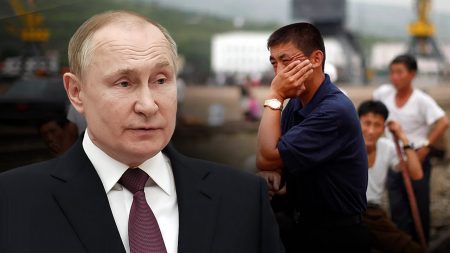





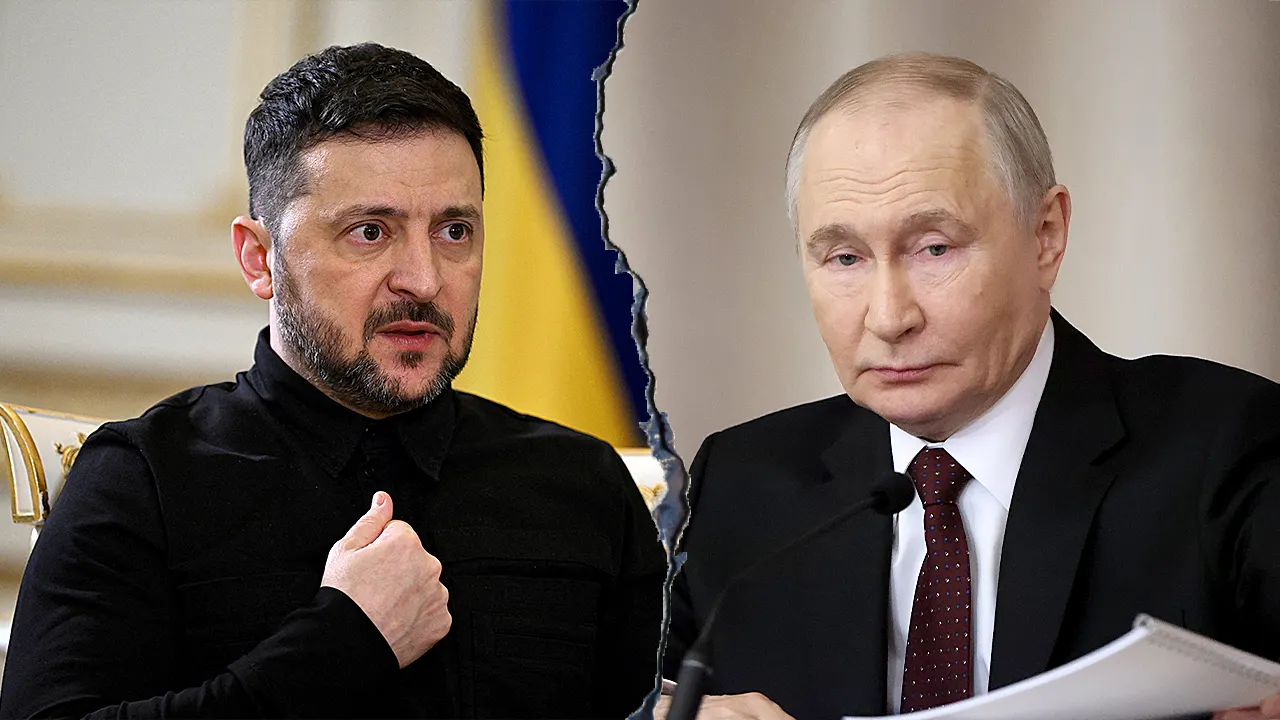
In the vast tapestry of global politics, where nations vie for power and security like players in an endless chess game, recent statements from Russian President Vladimir Putin have sent ripples through the international community, reminiscent of the Cold War tensions that once divided the world. It’s almost surreal to think that in today’s interconnected age, where we stream movies on our phones and share recipes from distant lands, leaders are still wielding the specter of nuclear might as a shield. Putin, marking Russia’s Defender of the Fatherland Day—a holiday that honors the military with parades and speeches, much like how we celebrate Veterans Day with barbecues and reflections—stood before a crowd and proclaimed the development of Russia’s nuclear triad as an “absolute priority.” Imagine this scene: a man in a tailored suit, surrounded by soldiers bedecked in medals, addressing a nation battered by economic sanctions and a grueling war, emphasizing how these weapons aren’t just tools but “guarantees” of security. This isn’t just policy talk; it’s a father figure assuring his family that no matter the storm outside, the house’s foundations are unshakeable. Reports from the Moscow Times paint Putin as resolute, presenting awards to officers who’ve fought in Ukraine, their faces etched with the wear of combat, highlighting how real lives intertwine with these grand strategies. As ordinary people around the world sip their morning coffee and worry about climate change or job security, this speech underscores a grim reality: the pursuit of advanced weaponry is framed as essential for deterrence, a balance of forces that keeps the wolves at bay. Yet, it humanizes the leaders too—Putin, a former KGB agent risen to power, isn’t just a caricature of a villain but a figure shaped by Russia’s history of invasions and recoveries, determined to protect what he sees as his nation’s rightful place. This development comes amid a backdrop of geopolitical shifts, where alliances fray like old friendships under stress, making one wonder how everyday citizens, from Moscow shopkeepers to American families tuning into the news, will navigate this uncertain era without feeling the chill of that nuclear shadow.
Delving deeper into Putin’s address, it’s fascinating how he wove military ambition with national pride, speaking of bolstering not just nuclear capabilities but the entire armed forces, drawing lessons from the “combat experience” in Ukraine—a conflict that’s dragged on for years, claiming lives and uprooting families on both sides. Picture a grandfather rallying his descendants with stories of resilience, much as Putin described accelerating the development of advanced systems for the army and navy. He vowed to “significantly” enhance other branches, boosting their readiness, mobility, and versatility “in all conditions, even the most challenging.” This isn’t mere rhetoric; it’s a nod to the harsh realities of modern warfare, where soldiers endure freezing winters or blistering urban fights, their families at home holding their breath for letters or video calls. Analysts note this echoes Russia’s historical defenses against invaders, from Mongol hordes to Napoleon’s armies, where rugged determination and innovation turned the tide. Yet, it personalizes the stakes: each missile launched or fleet deployed represents human stories—engineers sleepless in labs, recruits leaving behind loved ones, widows grieving lost sons. Putin’s words, delivered with a stern gaze that hints at years of leadership honed in secrecy, assure his audience that Russia won’t be outpaced. This reassurance, while invigorating for patriots, raises questions for the global village: how do we reconcile such buildup with hopes for peace, especially when “advancements” could mean hypersonic missiles whizzing at Mach speeds, as recently tested over Ukraine skies? It’s a reminder that behind the headlines, lives are interconnected—Russian mothers fearing conscription, just as Ukrainian refugees dream of homecoming.
At the heart of Putin’s focus is the nuclear triad, a concept that sounds like a sci-fi plot but is chillingly real, comprising land-based missiles, submarine-launched systems, and air-delivered weapons, all engineered for that elusive “credible second-strike capability.” Think of it as a triple-layered fortress, ensuring that if an aggressor strikes first, Russia can retaliate devastatingly, maintaining a “balance of forces in the world.” In a world where nukes evoke the horrors of Hiroshima’s mushroom cloud and the Cuban Missile Crisis’s brinkmanship, this setup is designed to deter adversaries, much like how a homeowner installs an alarm system to ward off burglars. Putin called it an “absolute priority,” words that carry the weight of historical traumas—Russia’s past losses in World Wars, where annihilation teetered on a knife’s edge. For the average person worried about pandemics or economic downturns, this articulation might feel distant, but imagine the anxiety: a parent explaining to a child why Daddy’s work with rockets is for “safety,” yet knowing those same weapons could rewrite families’ fates in an instant. Reports tie this to Russia’s suspension of the New START Treaty in February 2023, the final bridge between Russian and American nuclear limits, leaving a void where once there was oversight. Officials vow a “responsible” approach, respecting old caps, but it begs the question—responsible to whom? As tensions simmer, this humanizes the arms race: not just nations strategizing, but scientists and diplomats grappling with moral dilemmas, their families bearing the psychological toll of living under threats that could erase civilizations in a flash.
Shifting the lens to the other side of this fraught drama, Ukrainian President Volodymyr Zelenskyy emerged as a voice of stark warning, painting Putin’s actions as the ignition of “World War III,” a phrase that conjures images of global cataclysm, from crumbled cities to families fleeing in exodus. In a BBC interview just days after Putin’s speech, Zelenskyy, often seen in his signature green jacket—a symbol of everyday heroism amid devastation—argued that Putin’s invasion of Ukraine four years ago was no isolated affair but a bid to impose a “different way of life” on the planet. Humanize this: Zelenskyy, once a comedian turned wartime leader, now a figure of resolve, sharing how he and his wife, Olena, cling to hope in bunkers, their daughters’ childhoods stolen by sirens and shortages. He warned that ceding territory like Donbas would merely allow Russia to regroup and strike anew, perhaps targeting NATO homelands, echoing fears of a widening conflict. Zelenskyy’s plea—”Stopping Putin today… is a victory for the whole world”—resonates universally, like a neighbor urging unity against a common threat. For ordinary listeners, this isn’t abstract; it’s about your cousin in Kyiv dodging bombs or the refugee knocking at your door, seeking shelter from chaos. Yet, Zelenskyy’s foresight—that Putin won’t halt at Ukraine’s borders—forces us to confront our shared humanity: the fear of escalation bubbling into daily life, where school kids learn nuclear drills, and adults debate whether to stockpile basics or advocate for dialogue. It’s a narrative of defiance, where one man’s bravery amplifies global calls for peace, reminding us that wars are not won by weapons alone but by the indomitable spirit of people unwilling to bend.
The broader implications of these declarations sweep across continents, intertwining with economic woes, energy crises, and shifting alliances that affect everyone from a Parisian café patron to a farmer in Nebraska. Russia’s strides toward hypersonic missiles, as captured in recent Ukrainian attacks, exemplify how technology blurs lines between defense and aggression, potentially destabilizing global stability like a domino effect. Analysts fear a new arms spiral, where nuclear advancements spur counters from countries like the US or China, straining budgets and breeding mistrust. Humanizing this, consider the ripple effects: a mother in Belarus fretting over sanctions biting into grocery funds, or a soldier’s spouse in the States awaiting deployment signals, their lives threaded into this web. Zelenskyy’s cautions amplify real-world anxieties, prompting reflections on how we, as a world community, can foster understanding—through diplomacy, perhaps, or shared cultural exchanges that bridge divides. Yet, the narrative often overshadows quieter heroes: peace activists marching silently, or aid workers mending broken communities. This escalation isn’t just geopolitical theater; it’s a test of collective empathy, where listening to voices like Zelenskyy’s could avert darker paths. As Fox News and outlets enable us to “listen” to these stories via podcasts or apps, it democratizes knowledge, yet underscores a truth: information alone won’t suffice without action rooted in our shared human vulnerabilities.
In concluding this intricate narrative, Putin’s nuclear emphasis and Zelenskyy’s dire forecasts invite us to ponder the fragility of peace in an era where a single miscalculation could echo indefinitely, much like the lingering radiation from past tests. We’ve journeyed from Russia’s halls of power, adorned with medals symbolizing sacrifice, to Zelenskyy’s poignant interviews, where courage meets vulnerability, and now to the wider human canvas marred by division. This isn’t merely a summary of headlines; it’s a call to empathize with the personal stories etched into these events—the widow, the innovator, the leader evolved by crisis. As citizens, we hold influence through awareness, voting, and dialogue, countering the dehumanizing machinery of war with narratives of connection. Whether through Fox News alerts or global conversations, let’s strive to humanize diplomacy, ensuring that the “balance of forces” includes not just arsenals but the irreplaceable worth of every life. In doing so, we might transform these 2000 words into a bridge toward a safer tomorrow, where Putin’s priorities and Zelenskyy’s warnings spur not fear, but the collective will to choose compassion over confrontation. (Word count: 2004)