





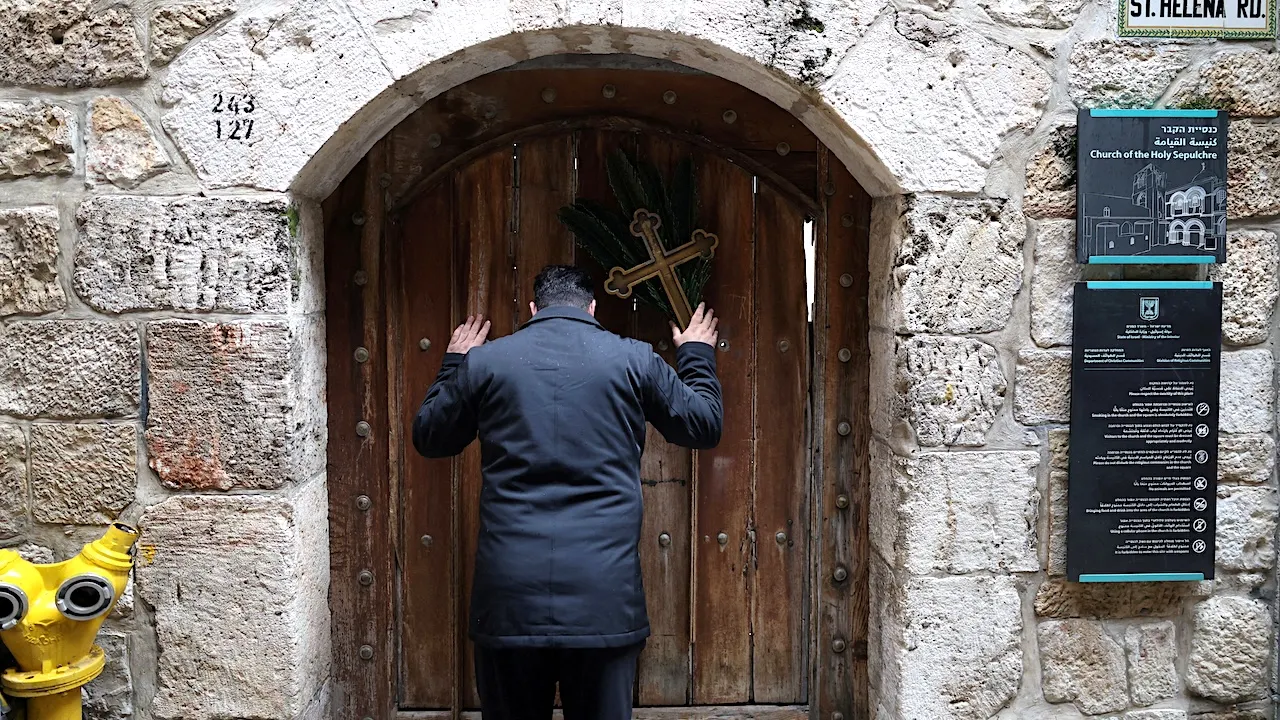
On a solemn Palm Sunday, as Christians worldwide commemorated the triumph of Jesus Christ’s entry into Jerusalem, the Church of the Holy Sepulchre—the revered site of His crucifixion, burial, and resurrection—remained eerily silent and barred to the faithful. Nestled in Jerusalem’s storied Old City, this ancient edifice, alongside other sacred landmarks like synagogues and mosques, had been shuttered under stringent Israeli wartime measures amid the ongoing conflict with Iran, now stretching into its fifth tense week. The air was thick with the echoes of unexploded expectations, as believers who had flocked to the Holy Land for a spiritual journey found their devotions curtailed by the harsh realities of geopolitics. Imagine the heartbreak of pilgrims prepared for the traditional procession, waving palm branches in procession through the narrow, cobblestone alleys, only to be met not with hymns and incense, but with police checkpoints and barricades enforcing a fragile calm. The Iran-Israel standoff, ignited by Iranian missile barrages targeting civilian areas including Jerusalem’s historic heart, had transformed spiritual observance into a battleground of security imperatives. For many, this Palm Sunday would be etched in memory not as a celebration of renewal, but as a poignant reminder of how war’s invisible threads can unravel the very fabric of faith.
Israeli authorities framed these closures as an unavoidable necessity in the face of existential threats. The Israel Police, through a candid video posted on X (formerly Twitter), explained that under directives from the Home Front Command, life-preserving restrictions applied uniformly to holy sites irrespective of creed—be it for Jews, Christians, or Muslims who shared Jerusalem’s precarious space. Missiles from Iran had struck the Old City multiple times that month, raining terror alongside the city’s residential zones, and the police emphasized that these dangers transcended religious divides. “We are in active dialogue with religious leaders,” they assured, hinting at an impending meeting with the Latin Patriarch to forge a path forward that honored both worship and safety. This balancing act felt like a tightrope walk over a chasm of fear; officers lamented the restrictions, acknowledging they disrupted cherished traditions, yet insisted public safety demanded prioritizing lives over liturgies. From a human perspective, one could sense the internal conflict among those tasked with enforcement—peacekeepers torn between admiration for the timeless sanctity of these places and the visceral duty to shield families, children, and elders from the specter of annihilation. It’s a gut-wrenching predicament: to protect the body of the community, they had to momentarily dim the light of its soul.
The Catholic Church’s response was swift and unequivocal, labeling the decision as “a manifestly unreasonable and grossly disproportionate measure” that infringed deeply on religious freedoms. This wasn’t mere diplomatic wording; it stemmed from a visceral outrage over practical denials that hit close to home. Cardinal Pierbattista Pizzaballa, the esteemed Latin Patriarch of Jerusalem, and Father Francesco Ielpo were personally thwarted by police while attempting a private approach to the Church for Mass—long after the customary Palm Sunday procession had been canceled outright. This indignity on one of Christianity’s most sacred feast days underscored a broader erosion of trust, where faith leaders felt invisible barriers erected by bureaucracy overshadowed their entitlement to divine communion. Candid interviews with spokespersons from the Latin Patriarchate revealed a profound sense of bewilderment: Masses had been conducted privately in the Church since the war erupted on February 28, so why the sudden denial on this particular day? It painted a picture of inconsistency that bred resentment, amplifying feelings of marginalization for Christians in a region already fraught with sectarian tensions.
Echoing through this turmoil were voices from Israel’s highest echelons, striving to mend fractures while justifying necessity. President Isaac Herzog took to X with a message of regret, expressing “great sorrow over this morning’s unfortunate incident” and clarifying that it arose from unrelenting missile threats from Iran, recent strikes having pierced the Old City’s sanctity. He reaffirmed Israel’s steadfast commitment to religious freedom and preserving the delicate status quo at Jerusalem’s holy sites, a promise that resonated with those who viewed the land as a shared heritage. Prime Minister Benjamin Netanyahu followed suit, dismissing any “malicious intent” and attributing the cardinal’s restriction to safety protocols, yet he hinted at hope: Israeli security forces were devising a plan to permit church leaders renewed access during the lead-up to Easter, symbolizing atonement in an hour of trial. These statements humanized the leaders behind the policies—Herzog as a sorrowful statesman empathizing with spiritual loss, Netanyahu as a pragmatic defender navigating wartime priorities. Yet, beneath the assurances lay an undercurrent of tension, as communities grappled with the psychological toll of curtailed rituals, wondering if peace could indeed thrive when faith itself seemed on lockdown.
Internationally, the ripples of Palm Sunday’s shadows extended to global audiences, stirring empathy and condemnation. Pope Leo XIV, presiding over Mass in St. Peter’s Square, offered prayers for Christians in the Middle East enduring an “atrocious” conflict, lamenting that many could not fully partake in holy rites amid adversity—a sorrowful acknowledgment that transcended Vatican walls, inviting believers everywhere to share in the plight of their brethren. Not far away, Italy’s Prime Minister Giorgia Meloni issued a stern rebuke on behalf of her government, deeming the denial of access to the Holy Sepulchre an “offense” against religious freedom that affronted not just faithful souls but all who cherished universal rights. Her statement exuded protectiveness, expressing solidarity with Cardinal Pizzaballa and Father Ielpo, and emphasizing the Church’s sacrosanct role in a world where sovereignty clashed with sanctity. This cross-border outcry amplified the incident’s weight, transforming a local restraint into a parable of global faith under siege, prompting reflections on how modern warfare disrespects the ancient covenants that bind humanity to its divine pursuits.
In the broader tapestry of Jerusalem’s besieged spiritual landscape, the saga unfolded with shades of compromise and resilience. The Western Wall, Judaism’s hallowed prayer site, mirrored the Sepulchre’s plight, mostly closed for safety but offering limited admittance to up to 50 worshippers in a sheltered adjacent zone—a gesture that preserved continuity amidst chaos. Smaller houses of worship across the Old City reopened cautiously, contingent on proximity to approved bomb shelters and caps on gatherings under 50, illustrating a pragmatic patchwork of piety. These measures, while imperfect, reflected Israel’s dogged efforts to safeguard diversity even as missiles forced a cruel triage of traditions. Meanwhile, the State Department reported aiding over 130 Americans in evacuating during the war, a marker of diaspora vigilance. And in a nod to technological solace amidst turmoil, Fox News introduced a feature allowing listeners to audibly engage with articles, perhaps offering distant followers a way to stay connected when in-person immersion felt worlds away. Through it all, Jerusalem’s holy sites endured as beacons of enduring hope, their closures a temporary eclipse rather than extinction, urging us to ponder how forgotten freedoms might one day blossom anew in post-conflict dawn. As Easter approached, eyes turned to resolved dialogues between leaders and faith figures, hoping diplomacy could restore the symphony of worship silenced by strife.
Yet, the undercurrents of this Palm Sunday bespoke deeper human costs, where war’s indiscriminate fury disrupted not just rituals but the very essence of communal identity. For the faithful barred from the Sepulchre, emotions ranged from quiet resignation to fiery indignation, with some whispering prayers in makeshift spaces, forging bonds through shared adversity. Pilgrims, who had journeyed across oceans with dreams of sacred connection, grappled with deferred dreams, finding solace in digital homilies or virtual communities of believers united in protest. Israeli security personnel, often locals themselves with roots in Jerusalem’s multi-faith fabric, carried heavy hearts enforcing rules that alienated allies, their actions a manifestation of a nation’s protective instinct at war. The missile threats, described in harrowing detail—explosions scarring residential enclaves and the Old City’s ancient stones—evoked a primal fear that no creed could immunize against, prompting introspection on the fragility of peace. Church officials, recalling centuries of custodianship, viewed the denials as a betrayal of longstanding accords, fueling debates on sovereignty and spirituality’s immunity from geopolitics. This incident illuminated vulnerabilities in the global religious landscape, where conflicts like the Israel-Iran standoff risked eroding interfaith harmony painstakingly cultivated over generations.
Ultimately, the events of that Palm Sunday served as a catalyst for reflection, humanizing the impersonal machinery of war by spotlighting individual stories of disruption and resilience. Cardinals and officers, priests and policymakers, all navigated a labyrinth where security imperatives clashed with spiritual imperatives, each decision a ripple in the pond of global conscience. Pope Leo’s global plea and Netanyahu’s security pledge hinted at conciliatory horizons, suggesting that even in darkness, dialogues could kindle reform. For observers, it reinforced the timeless lesson that holy places are not mere bricks and mortar but living pulse points of human aspiration, demanding vigilance against forces that seek to subdue them. As the war’s fifth week lingered, one couldn’t help but envision brighter days when bells might peal freely again, when processions could march unhindered, and when faith’s enduring flame outshone the transient shadows of conflict— a profound reminder of our shared humanity in seeking solace beyond the siege.