



Iran’s Nationwide Unrest: A Country on the Brink of Change
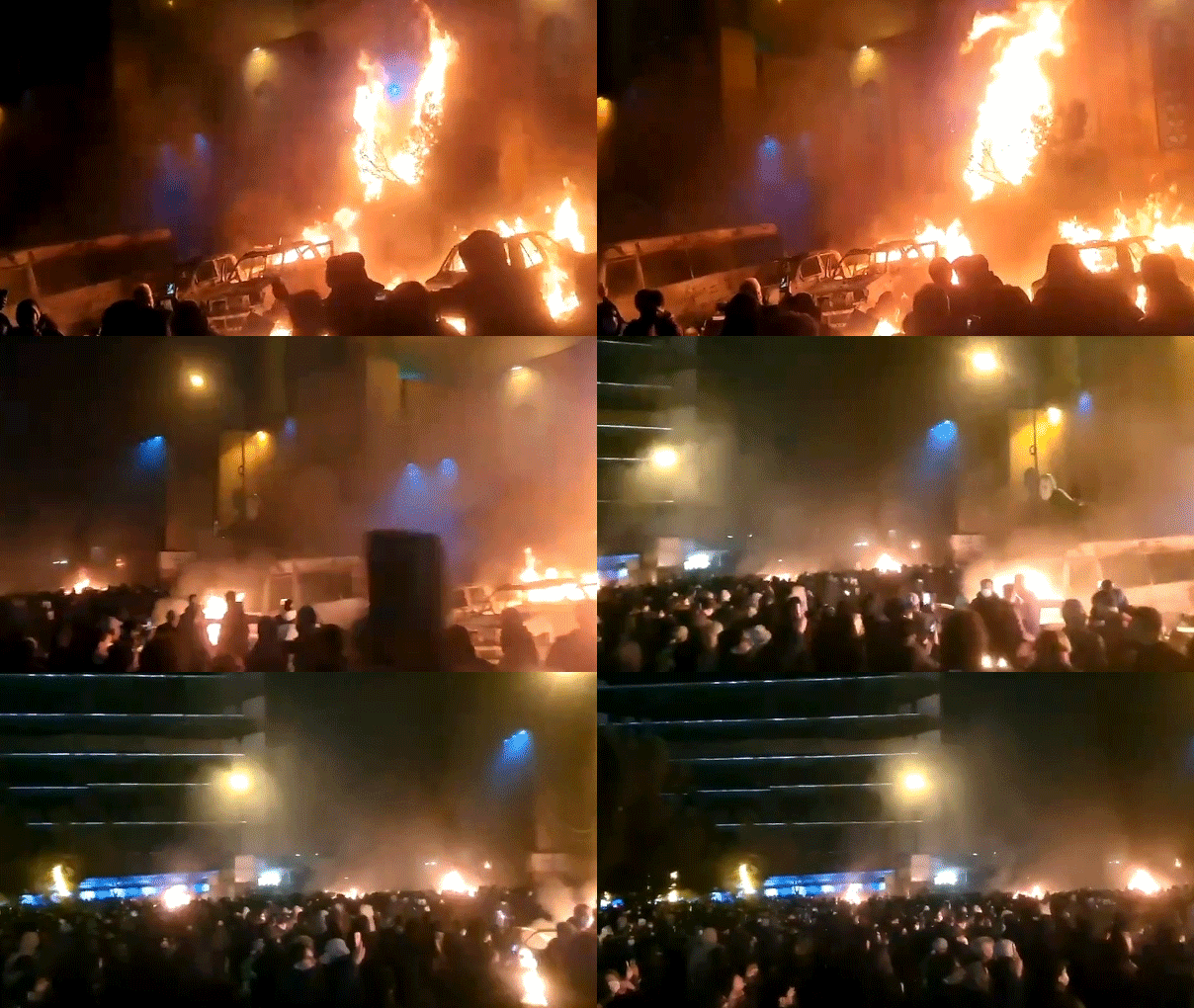
Iran has plunged into its thirteenth day of nationwide protests, with authorities imposing sweeping internet blackouts to isolate the country from outside eyes as demonstrations continue to spread. According to Iran Human Rights, at least 51 protesters, including nine children, have died in the unrest, with hundreds more injured in what many observers describe as unprecedented civil resistance against the Islamic Republic’s rule. The protests, which began with shopkeepers and merchants demonstrating against skyrocketing inflation and the collapse of Iran’s currency, have rapidly expanded to universities and cities across the country. Young Iranians are now openly confronting security forces in the streets, with some chanting slogans supporting the monarchy and others boldly shouting “Death to Khamenei!” Videos verified by international media show buildings and vehicles ablaze in several cities as the government struggles to maintain control.
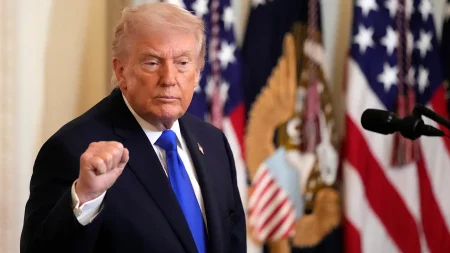
President Donald Trump addressed the situation during a press conference in Washington, noting that “Iran’s in big trouble” and that “the people are taking over certain cities that nobody thought were really possible just a few weeks ago.” Trump warned that the United States would respond forcefully if the regime resorted to mass violence, stating, “We’ll be hitting them very hard where it hurts. And that doesn’t mean boots on the ground, but it means hitting them very, very hard where it hurts.” He placed blame squarely on Iran’s leadership for the unrest, saying they had “done a bad job” and “treated the people very badly,” resulting in them now “being paid back.” Despite the gravity of his warnings, Trump made clear that the administration hopes such action will not be necessary, contrasting his approach with what he characterized as President Obama’s tendency to “[back] down” in similar scenarios.
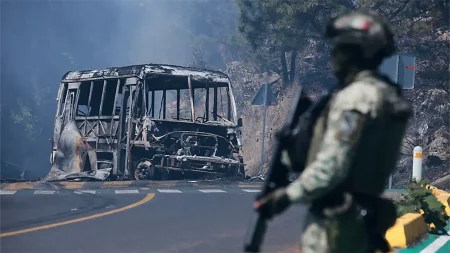
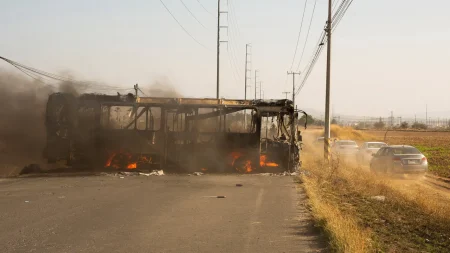
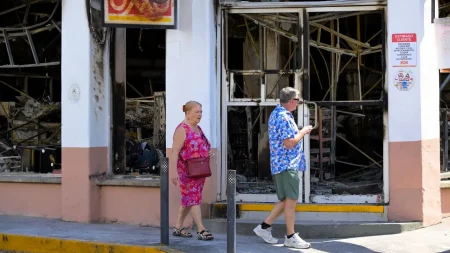
The economic conditions fueling the protests are dire. Iran’s rial lost approximately half its value against the dollar last year, and inflation topped 40% in December, creating unbearable pressure on ordinary Iranians. What began as economic protests quickly transformed into broader political demonstrations. Iranian state television has broadcast images of burning buses, cars, and motorbikes, as well as fires at underground railway stations and banks. In the Caspian Sea port city of Rasht, a state TV journalist standing amid flames described the scene as resembling “a war zone – all the shops have been destroyed.” The National Council of Resistance of Iran claims security forces killed a significant number of protesters overnight in several cities, particularly Tehran and Karaj, though these claims could not be independently verified. In one reported incident in the Fardis area of Karaj, security forces allegedly opened fire on civilians, leaving at least ten young people killed or wounded.
The Iranian government’s response has been to isolate the country through a near-complete internet shutdown, sharply limiting information flowing out of Iran. Phone calls into the country are failing, and numerous flights between Dubai and Iran have been canceled. Supreme Leader Ayatollah Ali Khamenei has vowed not to back down in a televised address, while state media reports that several police officers were killed overnight, highlighting the increasingly violent nature of the confrontations. The leaders of France, the United Kingdom, and Germany issued their first joint declaration on the situation, expressing deep concern about reports of violence by Iranian security forces and strongly condemning the killing of protesters. “The Iranian authorities have the responsibility to protect their own population and must allow for freedom of expression and peaceful assembly without fear of reprisal,” the statement read, urging Iranian authorities to exercise restraint.
Maryam Rajavi, leader of the opposition-linked National Council of Resistance of Iran, told Fox News Digital that recent developments have proven a fundamental truth: “Although the regime ruling Iran has been severely weakened and has suffered heavy blows, it will not collapse under the weight of its own failures. Its overthrow will not come from outside Iran, nor will it be delivered by the will of foreign capitals.” She emphasized that change can only be achieved by the Iranian people themselves, “through an organized and nationwide resistance that is present on the ground — one capable of confronting a ruthless dictatorship.” This perspective underscores the complex reality of Iran’s opposition landscape, which remains fragmented. Reuters noted that figures like Reza Pahlavi, the exiled son of the late Shah of Iran, have disputed levels of support inside the country. While Pahlavi urged Iranians to take to the streets in social media posts, President Trump indicated he would not meet with the exiled prince and was “not sure that it would be appropriate” to support him.
Despite the intensity of the current protests, analysts point out that the Islamic Republic has weathered repeated waves of nationwide unrest over the decades, including major protests in 1999, 2009, 2019, and 2022. The coming days will test whether the current uprising can sustain momentum under intensified repression or follow the pattern of previous movements that were ultimately suppressed. Iranian Foreign Minister Abbas Araqchi appeared to downplay international concerns, stating that the likelihood of foreign military intervention was “very low” and noting that Oman’s foreign minister would visit Tehran soon. However, Banafsheh Zand, an Iranian-American journalist, described the unrest as unprecedented in the Islamic Republic’s 47-year history, suggesting that demonstrations were expected to intensify despite the communications blackout. “People are going to be pouring out into the streets,” Zand told Fox News Digital. A senior U.S. official indicated that while there had been no change to the U.S. military posture in the Middle East in response to the unrest, U.S. Central Command was closely monitoring developments, particularly around Friday prayers and the regime’s response.