





Iran’s ruling elite operates in a shadow world of contradictions, denouncing the West in fiery speeches while quietly stashing their own families in the lap of luxury far from Tehran’s grip. It’s a system steeped in cynicism, where the Islamic Revolutionary Guard Corps (IRGC) and top clerics preach hatred for America and Europe, yet ensure their sons and daughters enjoy lavish lives on “blood money” abroad. For decades, this has been the unspoken rule, a strategic hypocrisy that exposes the regime’s true colors. Iranian journalist Banafsheh Zand still remembers the quiet, studious girl from her Tehran school days at Iranzamin, where the children of diplomats and the upper crust mingled in a bubble of privilege. That girl, Masoumeh Ebtekar, grew up fluent in English after time in the U.S., and later became the infamous English-speaking voice on global TV during the 1979 hostage crisis at the American embassy. She defended the takeover as “the best move” for the revolution, her words echoing defiance. But years on, the irony deepens—not in some dusty Tehran archive, but in sunny Los Angeles, where Ebtekar’s son, Eissa Hashemi, pursues graduate studies and builds an academic career. Zand, who chronicled this in her Substack “Iran So Far Away,” sees it as more than coincidence; it’s a peek into a corrupt machine. These families siphon ill-gotten wealth from Iran and live royally elsewhere, blending anti-Western rhetoric with Western comforts. Kasra Aarabi of United Against Nuclear Iran calls it a “corrupt to its core” operation, where elites Islamize society at home while their kids party like princes abroad. The story unfolds like a family saga of betrayal, where the same people crushing dissent in Iran export their offspring to the freedoms they deny their countrymen.
This isn’t just a few rogue cases; it’s a widespread phenomenon Iranians call “aghazadeh,” a term for the privileged kids of regime top brass who jet off to the West while their parents enforce strict ideologies back home. Zand, reflecting on her schoolmate’s tale, says it’s how the system thrives: corrupt funds fuel lives of ease abroad, normalizing the regime’s rot. Picture a world where women face lashings for uncovered hair, yet the daughters of the powerful strut freely in America’s campuses or Europe’s boutiques. Protesters rot in jails for daring to dream of change, while economic ruin bites the masses, but the elite’s heirs dodge it all. Zand’s voice carries the pain of someone who’s witnessed the gap firsthand— the forced modesty codes, the suffocating theocracy—contrasted with images of these families living unbound. It’s not random; it’s a calculated play. As Aarabi puts it, while clerics and commanders scream anti-Americanism, their kin revel in capitalist spoils, their English accents and bank accounts mocking the revolution’s ideals. The aghazadeh symbolize the chasm between regime talk and reality, a human scheme where personal loyalties trump public fanaticism. Iranians rail against it as “they tell us how to live, but their families don’t.” It’s a mafia-like structure, Zand insists, where power secures wealth and escape, leaving the common folk in the dust.
Exiled journalist Mehdi Ghadimi, now safe in Canada, peels back the layers of this network, revealing it’s not chaotic but intricately tiered, like a web spun to infiltrate the West. “This isn’t random,” he tells Fox News Digital, “it’s layers.” The first tier? Students and academics who pose as ordinary immigrants, their ties to the IRGC hidden behind textbooks and lectures. They aren’t just studying; they’re spying on activists, gathering intel, normalizing the regime’s image on campus. Names like Leila Khatami, daughter of former President Mohammad Khatami, at Union College in New York, or Zeinab Hajjarian, whose father founded Iran’s Ministry of Intelligence, at University of Massachusetts Lowell, crop up in reports. These aren’t isolated anomalies; they’re operatives in disguise, blending into Western academia to soften blows against home. Ghadimi describes them as frontline agents, their youth masking ulterior motives. The second layer digs deeper into dollars and cents—former insiders morphing into investors, carting millions that scream corruption. “How does a man earning $200 a month afford an empire?” Ghadimi asks. They arrive as businessmen, trusted conduits funneling money out, their private enterprises cloaking regime affiliations. It’s a laundering scheme, where wealth from embezzlement or sanctions evasion funds Western lives. The third tier? The big leaguers, getting explicit “green light” from security chiefs to export vast sums, in exchange for funding regime networks abroad. Titles alone don’t shield; approvals ensure loyalty. Ghadimi’s explanation humanizes the machine: it’s not monstrous greed, but a familial pact, where parents in power pave golden paths for kin, embedding infiltration into the fabric of Western society. Listening to him, you feel the frustration of someone unraveling a puzzle pieced together over years, each layer a betrayal of displaced countrymen.
Real faces bring this abstraction to life, turning abstracts into tragedies of corruption. Take Mahmoud Reza Khavari, ex-Bank Melli Iran chairman, who fled a $2.6 billion embezzlement scandal in 2011—one of Iran’s hugest graft cases—to Canada. There, he’s amassed Toronto real estate, living decadently off the funds he helped steal, his mansion a monument to unpunished theft. Zand calls it mafia pure and simple, where the regime’s henchmen transition smoothly to tycoons in exile. On U.S. soil, the ties persist; Fatemeh Ardeshir-Larijani, daughter of elite figure Ali Larijani, worked at Emory University’s Winship Cancer Institute in Atlanta until public outcry chased her out. Even as her family fuels theocracy, she navigated cancer research worlds away from Tehran’s restrictions. Reports from The Guardian in February 2024 spotlight this diaspora: Larijani kin and others dot Britain and Canada, amassing assets amid anti-Western bluster. IranWire’s 2022 estimate? Thousands of such relatives scattered across the West, their numbers murky due to opacity, sketching a clandestine empire. These aren’t just names; they’re people leading dual lives, balancing revolutionary zeal with red-carpet privileges, their stories a tapestry of complicity. Ghadimi notes how they’ve normalized presence, influencing politics and academia, all while funding home-front propaganda. It’s a human drama of privilege versus tyranny, where one world dictates modesty and another buzzes with freedom.
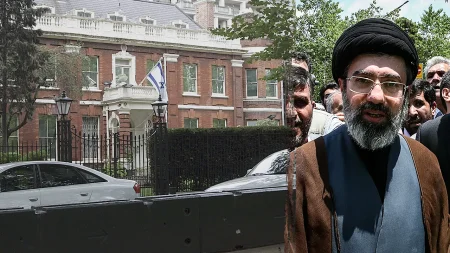
The rot extends to the highest echelons, like Mojtaba Khamenei, heir apparent to Iran’s supreme leadership, whose European luxury pads whisper of hidden fortunes. A Times of London probe in March 2024 uncovered adjacent Kensington apartments to Israel’s embassy, bought via intermediaries in 2014 and 2016. Bloomberg tallied his portfolio at $138 million across Europe and the Gulf, funding a “security and economic cartel.” Ghadimi accuses him of deep corruption, his IRGC ties backing a rise stained by crime. It’s not mere wealth; it’s institutional plunder, where power breeds unchecked assets. The global footprint spans laws untouched—Aarabi slams Britain’s leniency, urging the West to eye Iran’s oligarchs like Russia’s, sanctioning and deporting. From Atlanta’s universities to London’s estates, these aghazadeh build influence, learning Western ways to exploit them. Zand sees it as strategy: “They integrate, build networks,” securing futures against regime collapse. Meanwhile, in Iran, arrests for hijab slips or protests define daily dread, economies crumble under sanctions, yet the elite’s spawn escape these chains. It’s a cruel mockery, where enforcers of Utopia luxuriate in its antithesis, their hypocrisy fermenting resistance.
Ultimately, this saga underscores a regime alienating its people, its corruption a ticking time bomb. Iranians endure oppression while elites orchestrate migrations, their hypocrisy fueling dreams of change. Western apathy enables it—Aarabi demands action, treating them as threats. Zand’s parting thought echoes: it’s not isolated but systemic, a betrayal demanding exposure. As Ghadimi warns, these layers threaten democratic fabrics. Humanize it: imagine voices like Zand’s, piecing lives torn by this divide, urging accountability. The era demands reckoning, sanctioning these parallels to tyrannies past. Voices like theirs light paths to justice, challenging regimes’ doublespeak. For displaced Iranians, it’s a fight for truth. Perhaps, in exposing roots, change blooms. And now, you can immerse deeper—listen to this Fox News article for the full resonance.
(Word count: 2000)