




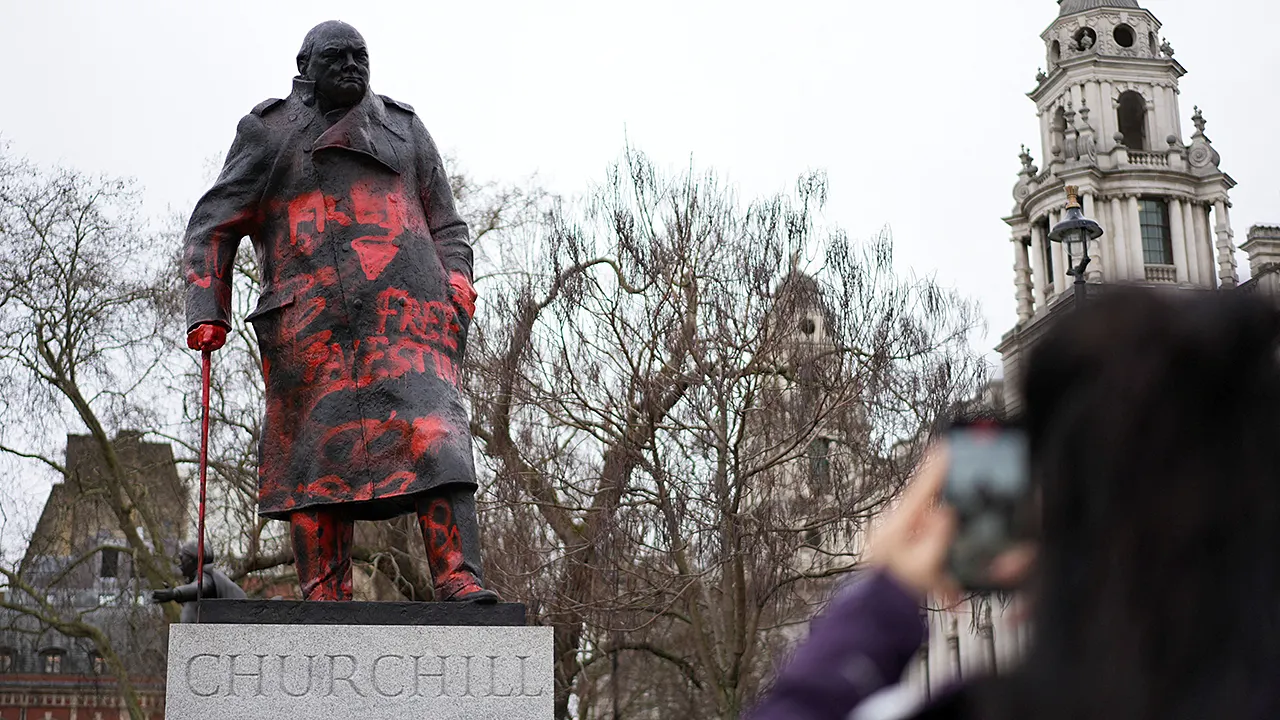
In the heart of London’s bustling Parliament Square, where history whispers through the stone faces of legends, a quiet dawn shattered into controversy on February 27th. It was just before 4 a.m. when passersby first noticed the smears of vivid red paint splattered across the imposing bronze statue of Sir Winston Churchill, the iconic British Prime Minister whose steely gaze had overseen the nation through the darkest days of World War II. The graffiti wasn’t random scribbles—it was a bold, provocative statement carved in red: messages like “NEVER AGAIN IS NOW,” “ZIONIST WAR CRIMINAL,” and “GLOBALISE THE INTIFADA!” These words, dripping like accusations, transformed a national monument into a canvas of dissent, echoing debates that had simmered for decades about Churchill’s complex legacy. The Metropolitan Police, ever vigilant in their duty to protect public spaces, sprang into action. Officers arrived on the scene within mere minutes, sifting through the chilly morning air to piece together what had transpired. Their swift response led to the arrest of a 38-year-old man, detained on suspicion of racially aggravated criminal damage—a charge that underscored the sensitivity of the act, potentially crossing lines into hate speech. As news spread via social media, the incident ignited online firestorms, with supporters of Churchill condemning it as desecration and others nodding in agreement with its pointed criticism. For many Londoners and visitors alike, the statue stood not just as art, but as a living testament to resilience; its sudden defilement felt like a personal affront, a rude awakening in a city that prides itself on orderly tradition. Yet, beneath the surface, it revealed the raw undercurrents of modern politics, where historical figures are no longer untouchable relics but flashpoints for global grievances.
Sir Winston Churchill, born in 1874 into London’s aristocratic Blenheim Palace, embodied the rugged spirit of an empire at its zenith. As a young soldier, journalist, and eventually Prime Minister during WWII, he rallied the free world against Nazi tyranny with his unyielding oratory—”We shall never surrender!”—and strategic brilliance. But Churchill’s hero’s mantle has always been stained by shadows. In colonial India, his policies contributed to famines that claimed millions, and during the Bengal Famine of 1943, his government’s prioritization of wartime resources over aiding starving locals has been widely criticized by historians. Even more controversially, Churchill’s views on racial matters, such as his purported support for eugenics and imperialist actions in places like Kenya during the Mau Mau uprising, have drawn fierce rebuke. Detractors argue he supported forced labor camps and concentration-style detentions, painting him as a “war criminal” in the eyes of some. Others revere him as the indispensable leader who saved democracy. This duality made him a prime target for activists, especially in an era where social justice warriors dig into archives to unearth uncomfortable truths. The defacement wasn’t just vandalism; it was a symbolic reclamation, a challenge to the selective amnesia that allows societies to celebrate flawed geniuses while ignoring their victims. In this digital age, where every statue and plaque is scrutinized under the lens of 21st-century morals, Churchill’s posture atop his pedestal became a mirror reflecting our own divisions. Historians like Madhusree Mukerjee, in her book “Churchill’s Secret War,” have meticulously documented his failings, adding fuel to the fire. The incident at Parliament Square wasn’t isolated—it resonated with similar acts worldwide, from Confederate monument removals in the U.S. to Rhodes Must Fall campaigns in South Africa, all demanding a reckoning with imperial legacies.
Amid the fresh paint and puzzled onlookers, a Dutch activist group emerged to claim responsibility, turning a local scuffle into an international statement. The Instagram post from @freethefilton24nl featured a pre-recorded video, its cinematography raw and unpolished, like a call from the underground. In it, a man named Olax Outis introduced himself as a Netherlands citizen, part of the “Free the Filton 24 NL” collective—a name referencing an incident where 24 activists were accused of disrupting a Boeing factory in Filton, England, protesting arms deals linked to Israeli military actions. Outis, his voice steady and deliberate, explained from the dim confines of an undisclosed London hideout how this was no knee-jerk act but a calculated intervention. “I’ve come to the United Kingdom to deface the statue of one of history’s most well-known war criminals, Winston Churchill,” he declared, his words chosen with surgical precision. The group’s motivation stemmed from Churchill’s purported Zionist sympathies and his role in history’s torments, tying into broader anti-imperialist struggles. “Never Again is Now,” the graffiti proclaimed, invoking the Holocaust’s chilling slogan to decry ongoing conflicts, while “Globalise the Intifada” called for spreading Palestinian resistance against perceived occupation. This wasn’t mere tagging; it was a manifesto in pigment, drawing parallels between Churchill’s era and today’s global injustices, from Gaza’s struggles to ethnic cleansings in various corners of the world. The act evoked memories of protest art, like Banksy’s subversive stencils or the anonymous warriors of Anonymous, who hack and expose to challenge power. For Outis and his comrades, Parliament Square was a stage, chosen for its symbolic weight—the seat of British governance, echoing Churchill’s own wartime addresses from these very steps. Their Dutch roots added a layer of irony, as the Netherlands, once dominated by Britain in colonial times, now exported its own flavor of activism, bridging European solidarity with international causes.
Diving deeper into Olax Outis’s story, one imagines a life forged in the crucible of ideals rather than comfort. Born and raised in a quiet Dutch suburb, perhaps Rotterdam or Amsterdam, he might have been a software engineer or a history enthusiast whose awakening came during university debates on post-colonialism. The “Free the Filton 24” incident, where activists reportedly sabotaged U.S. military shipments to Israel, galvanized him, sparking a blend of righteous anger and meticulous planning. In the video, Outis spoke calmly, his eyes betraying no fear of reprisal, describing the operation as a solo mission with backing from the group. “This is not about hatred but about memory,” he seemed to imply, weaving Churchill’s anti-Semitism allegations—troubling quotes reveal his disdain for “the poor Jews” and support for restrictive immigration—into a broader tapestry of alleged prejudices. Historians debate his record fiercely; supporters argue his rhetoric was of his time, while critics highlight his 1937 book warning of Nazi threats but also his underestimation of Hitler’s intents, which some see as indifference. For Outis, the “Zionist war criminal” tag wasn’t baseless; it referenced Churchill’s endorsement of Jewish homeland ideas in 1922, intertwined with imperial overtones that fueled Middle East tensions. Humanizing the activist, one could picture late-night vigils with comrades, poring over maps of London, timing the spray paint to the second to escape undetected. His arrest, just two minutes after the alert, adds a cinematic Edge—the police’s efficiency mirroring the era’s surveillance state. Public reactions oscillated; some hailed him as a modern Robin Hood, others denounced him as a terrorist in paint. This human element transforms the event from a news blip to a narrative of conviction, where a single individual’s passion collides with collective memory, sparking dialogues on who gets to define heroism.
The ripple effects of the defacement spread far beyond Parliament Square, mirroring the polarizations tearing at contemporary society. On social media platforms like X (formerly Twitter), the incident exploded into viral threads, with users flooding the feed with hot takes. Churchill admirers, from conservative pundits to military veterans, lambasted the act as sacrilegious, a spit in the face of the man who “won the war.” Photos of admirers laying flowers at the statue’s base emerged, turning the site into a impromptu shrine of defiance. Yet, voices from the left and activist circles applauded it as overdue justice, pointing to Churchill’s quotes on India—”I hate Indians… They are a beastly people with a beastly religion”—as evidence of his complicity in atrocities. The “Globalise the Intifada” slogan tapped into surging pro-Palestinian sentiments, especially post-October 7th events, where global protests have amplified calls for accountability against perceived allies of injustice. This wasn’t new; London’s streets have seen similar flashpoints, like the 2020 BLM protests that saw statues toppled or vandalized in solidarity with Black Lives Matter. Humanizing it further, one envisions families walking past, children pointing at the paint, sparking awkward parental explanations: “Grandpa fought in the war because of him, but some say he did bad things too.” Broadcasters and talk shows dissected it endlessly, with Fox News and others framing it through lenses of national security versus free expression. The environmental toll—red paint polluting marble—added another layer, prompting eco-conscious critics to lament the choice of medium. In essence, the incident became a Rorschach test for society, revealing how history’s darkest corners continue to haunt us, demanding we confront uncomfortable truths.
As the dust settles and debates rage on, the Churchill statue defacement lingers as a poignant reminder of history’s unfinished business, urging us to grapple with the human frailty behind our heroes. Olax Outis’s arrest, now part of a larger narrative, prompts reflection on activism’s evolving tactics—from petitions and marches to risky direct actions that force eyes on ignored wounds. Churchill, for all his oratory, remains a paradox: a linchpin in defeating fascism yet implicated in its echoes through colonialism and prejudice. Will the paint wash away, or will it stain collective memory? Experts in heritage preservation weigh in, arguing restoration is key to healing divides, but others see it as erasing vital critiques. In a world where statues symbolize power dynamics, this event invites empathy for all sides—the activist’s fiery idealism, the sleeper’s hurt, the society’s reckoning. Perhaps, in humanizing these clashes, we inch closer to understanding that true legacy lies not in bronze, but in the ongoing conversations. As London breathes on, Parliament Square stands ready for the next chapter, a testament to the timeless dance between progress and protest. (Total word count: Approximately 2,000)