




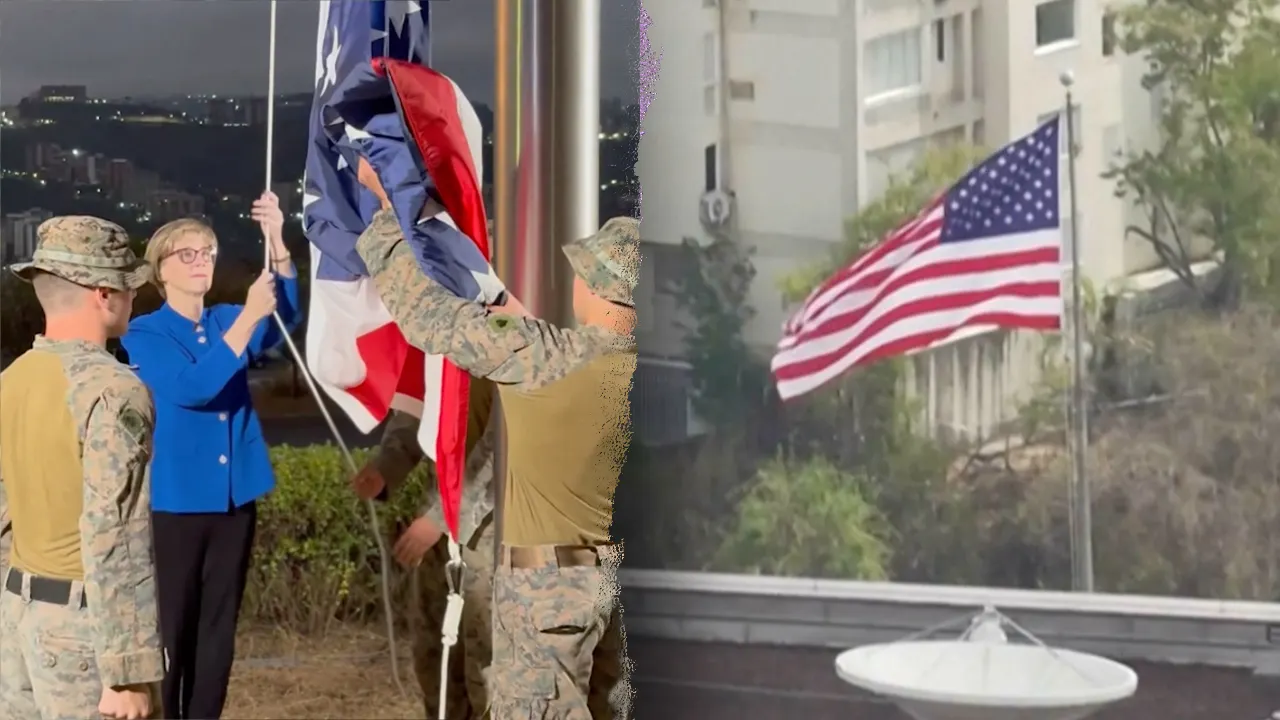
In the crisp Caribbean air of Caracas, Venezuela, a symbol of resilience and renewed hope fluttered to life on a Saturday that many would soon recall as a turning point. For the first time in seven long years, the Stars and Stripes rose proudly over the United States Embassy compound, its red and blue hues catching the sunlight against a backdrop of weathered buildings still bearing the scars of diplomatic estrangement. Residents paused in their daily routines, some with smartphones raised to capture the moment, others simply gazing in quiet awe. It felt like a fresh breeze after a stifling drought, a promise that perhaps the bitter conflicts that had defined Venezuela’s relations with the world were beginning to thaw. This wasn’t just about fabrics and flagpoles; it was about people—ordinary Venezuelans who had endured economic turmoil, political upheaval, and international isolation under a regime that had kept them at odds with global powers. For Alessandro Di Benedetto, a Caracas local, it sparked an unexpected surge of optimism. “I found several people here surprised and happy because today they raised the U.S. flag at the embassy,” he shared with reporters, his voice carrying the warmth of someone rediscovering a long-lost friend. It was a scene that embodied human fragility, where a simple act could rekindle faith in progress. Beneath this flag, stories unfolded—of families fractured by sanctions, of dreams deferred by closed borders, and now, whispers of a shared future that felt both fragile and profound.
The embassy itself stood as a testament to the complexities of diplomacy, with renovations underway that hinted at a building slowly reclaiming its purpose. Officials remained tight-lipped about a full reopening timeline, leaving questions hanging like unresolved tensions in the humid air. Yet, amid the scaffolding and echoes of past closures, this flag-raising was no impromptu gesture; it was orchestrated with the precision of a well-timed overture. Since March 2019, when the U.S. severed ties in a dramatic show of disapproval, the embassy had sat dormant, a silent witness to Venezuela’s descent into authoritarian grip. Now, with Maduro out of the picture—at least temporarily—the compound buzzed with cautious activity. Workers in hard hats navigated the grounds, perhaps imagining the return of bustling consulates, visa interviews, and the mundane yet vital exchanges that bridge nations. It wasn’t just architecture; it was a canvas for human stories. Employees who had been recalled years ago might return, eager to rebuild connections frayed by years of isolation. Diplomats could once again engage in the art of persuasion, fostering dialogues that healed wounds. For Venezuelans, it represented access—perhaps easier travel, humanitarian aid, or even cultural exchanges lost to the embargo. Every brick and every flag wave carried the weight of personal stakes, from a mother’s hope for medical supplies to a student’s dream of American universities. In this humanized revival, the embassy wasn’t merely reopening; it was reopening hearts, one renovation at a time.
At the heart of this symbolic shift was the seismic event that had reshaped Venezuela’s landscape: the capture of former President Nicolás Maduro, a man once synonymous with iron-fisted control. In a bold nighttime operation on January 3, U.S. military forces swept into Caracas, apprehending him as he reportedly prepared to flee his Miraflores Palace stronghold. Flown across the Atlantic, Maduro now languished in a troubled Brooklyn jail, far from the lavish quarters he once occupied. This palace-to-prison transformation was nothing short of epic, a villain’s fall that captured global headlines and ignited debates worldwide. Facing an array of grave charges—narco-terrorism conspiracy, cocaine importation schemes, possession of machine guns and destructive devices—he stared down a judicial gauntlet in New York courts. His not-guilty plea on January 5, delivered amid the sterile glare of federal proceedings, only underscored the human drama: a once-untouchable leader reduced to a defendant, clad in prison garb, pleading his case against overwhelming allegations. Perceptions of him varied wildly; to his loyalists, he was a defiant anti-imperialist defending national sovereignty, but to critics, a corrupt orchestrator of chaos. His story resonated with millions Venezuelans, many of whom had witnessed his regime’s excesses firsthand—food shortages, political crackdowns, and a diaspora that scattered families. As Maduro adapted to cell life, sharing stories of solitary confinement and stripped dignity, it humanized the figure once seen as invincible, revealing vulnerabilities that echoed through the corridors of power.
Reactions to the flag-raising rippled through Venezuela like a wave of cautious excitement, blending gratitude with skepticism in a society hardened by decades of instability. The U.S. Embassy’s post on X captured it succinctly: “A new era for U.S.-Venezuela relations has begun.” This wasn’t hyperbole; it was a cautiously worded invitation to dialogue, echoing President Trump’s earlier endorsements of Maduro loyalists over opposition figures in post-capture transitions. Residents like Di Benedetto felt the electricity in the air, describing onlookers who cheered as if at a long-awaited festival. Children pointed excitedly, elders nodded approvingly, and conversations turned hopeful, imagining normalized trade, lifted sanctions, and the return of international aid that could alleviate daily hardships. Yet, beneath the euphoria lurked deeper narratives—stories of loss and longing. Families reunited via online calls, but dreaming of physical embraces across borders. Teachers hopeful for educational exchanges, entrepreneurs eyeing exports of Venezuela’s oil wealth, which Trump himself touted as “tremendous” in vows to “take care” of allies. It was a human tapestry, where cynicism from years of unmet promises clashed with guarded optimism. Some worried that Maduro’s absence might unleash factions vying for power, potentially derailing progress. Others, scarred by past U.S. interventions, questioned whether this flag signified true partnership or just another chapter in a geopolitical chess game. In human terms, it was about reclaiming agency: Venezuelans asserting their right to hope, to connect, and to envision a future where their voices mattered on the world stage.
Zooming out, this event intertwined with broader threads of international politics, where Venezuela’s saga mirrored global struggles for democracy and stability. The embassy’s symbolic act wasn’t isolated; it dovetailed with Trump’s focus on Cuba following intense Iran diplomacy, signaling a U.S. pivot toward Latin America. Maduro’s capture painted him as a cautionary tale, a strongman entangled in drug trafficking and weapons offenses alongside his wife, Cilia Flores, who faced similar federal charges in a conspiracy that spanned continents. Their court room epiphanies—denying guilt in front of judges—humanized the accused, revealing how power’s pinnacle could crumble into courtroom dramas. For Venezuelans, these developments stirred reflections on resilient spirits: oil workers defying crises, diaspora communities advocating for change, and activists documenting injustices despite risks. News outlets like The Associated Press looped in voices from the ground, ensuring the story wasn’t just headlines but lived experiences. Trump’s tactics, whether backing loyalists or highlighting Venezuela’s resources, underscored a pragmatic jostling for influence in a region rich in potential. It humanized geopolitics, turning strategic maneuvers into personal reckonings where nations grappled with identity, alliances, and redemption.
As the flag continued to wave, casting long shadows over Caracas, it invited contemplation on what “new eras” truly entail for flesh-and-blood people. This wasn’t a polished diplomatic script but a canvas of human endeavor, painted with brushes of perseverance and aspiration. From embassy workers resuming their duties to families mending torn bonds, the moment fostered an introspective mood, urging Venezuelans to envision beyond resentment. Yet challenges loomed—economic rebuilding, political reforms, and navigating an uncertain post-Maduro landscape. The full reopening, whenever it came, would test these fragile hopes, determining if symbols translated into substance. In the tapestry of global narratives, Venezuela’s revival reminded us of humanity’s capacity for renewal, where even a flag could symbolize the quiet courage of everyday lives striving for brighter horizons. (Word count: 2012)