





Paragraph 1: A Historic Shift from the US to the Desert Sands
Imagine stepping out into the arid heat of Riyadh, Saudi Arabia, in early 2026, where the WWE Universe gathered not for oil or opulence, but for a spectacle unlike any other. The Royal Rumble, that adrenaline-fueled free-for-all that’s been a staple of sports entertainment for decades, was making its grand debut outside American borders for the first time. Held in a massive arena that pulsed with the energy of thousands of fans from around the globe, this edition wasn’t just another pay-per-view; it was a cultural crossover, blending WWE’s high-octane drama with the vibrant cosmopolitan vibe of the Middle East. As usual, the event served as a launchpad for WrestleMania, featuring both men’s and women’s Royal Rumble matches to crown the worthy contenders for title shots at the grandest event of the year. It felt liberating, almost revolutionary, to break free from the familiar confines of stateside venues, allowing a fresh audience to experience the chaos. Among the hype, poison-green pyrotechnics lit up the night, signaling the start of an unforgettable showdown. Fans, donning merch from various eras, mingled and debated the odds, their excitement palpable in the air thick with anticipation. The men’s division buzzed with rumors—surprise entries that could shake the entire WWE landscape. And at the heart of it all was the promise of supersized stars proving their mettle in a battlefield where only one emerges victorious. This wasn’t just wrestling; it was a global conversation starter, echoing the way sports transcend borders in our interconnected world. Yet, beneath the glamour, there was an underlying tension, a sense that destiny might veer into unexpected territory. I remember chatting with a fellow fan at the venue who marveled at how WWE had broadened its horizons, making the Impossible City’s stadium feel like hallowed ground. It was more than entertainment; it was empowerment, showcasing diverse talent in a spotlight that shone brighter under Saudi skies. The women’s match, while setting up its own drama, paled in comparison to the men’s buzz, where legends mingled with up-and-comers in a dance of ambition and legacy. Fans shared stories of past Rumbles, recalling legendary moments that shaped careers, and wondered how this one would etch itself into history. By the time the ringside lights dimmed, it was clear: Riyadh had become the unexpected epicenter of WrestleMania dreams.
Paragraph 2: Brock Lesnar’s Bold Entrance and the Favorites’ Altar
Brock Lesnar, the Beast Incarnate, wasn’t supposed to headline quietly. Just a week before the event, during an episode of “The Pat McAfee Show,” he roared his intentions into the microphone, declaring his return with that trademark intensity that makes spines tingle. Fans erupted in joy—Brock, the guy whose pedigree shatters worlds, was back, ready to tear through the competition like a force of nature. He wasn’t just entering; he was invading, his muscular frame promising dominance in a field crowded with warriors. The men’s Royal Rumble match kicked off with a bang, players from all walks of life spilling into the ring, each carrying their own narrative. Early favorites included grizzled veterans and rising threats, but Brock’s aura set him apart. I’ve always admired how Lesnar embodies the archetype of the unstoppable predator, his speeches laced with gravelly confidence that makes you believe he could conquer any ring. From his MMA days to his WWE reigns, he’s a living legend, a man whose praises I’d sing in any barroom debate. Yet, as the match unfolded, whispers turned to cheers, with fans YEETing along to dramatic entrances that fused music with mayhem. It was a sensory overload—spotlights cutting through fog, theme songs blaring like opera symphonies. Brock’s late confirmation added layers of intrigue; you could feel the shockwave ripple through the audience, a “what if” that fueled endless speculations. But pacing is key in these events, and with nearly thirty combatants, timing became everything. Other stars eyed the Beast warily—Logan Paul, the Maverick with a YouTube edge; GUNTHER, the imposing European powerhouse; Jey Uso, the charismatic underdog from The Bloodline; and Roman Reigns, the Tribal Chief whose presence demands reverence. These weren’t mere competitors; they were storylines unfolding in real-time, each elimination a chapter of triumph or tragedy. Brock, however, was positioned as the insurmountable hurdle, his history screaming inevitability. Fans traded anecdotes about his past victories, like how he’d dismantled empires in singles clashes. The air hummed with potential, a collective breath held for the showdown.
Paragraph 3: The Stumble of a Behemoth and Fan Outrage Unleashed
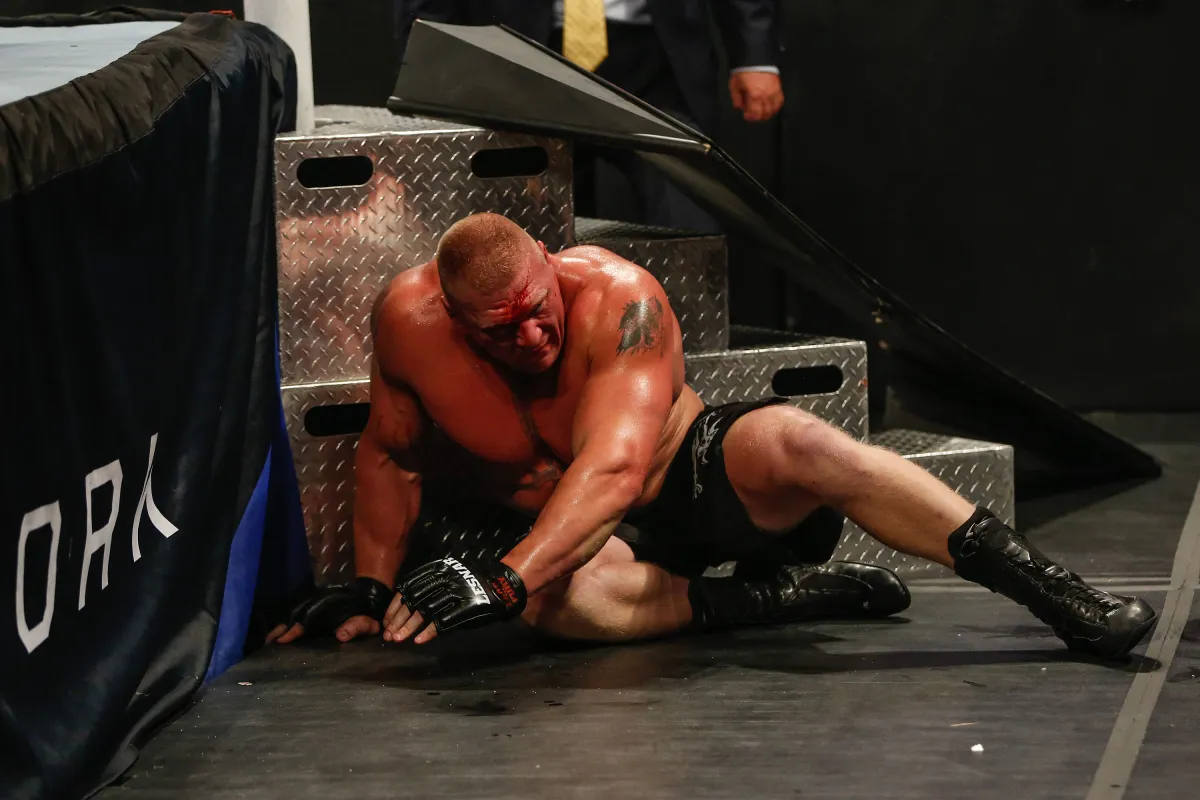
But destiny had a cruel twist, and Brock’s night unraveled in a blink. He was poised among the favorites, yet somehow, his exit became the night’s biggest talking point, shrouded in mystery and marred by what many called inexcusable miscues. Picture this: the arena alive with energy, fans hypnotized by Jey Uso’s electrifying entrance as his theme blasted, the crowd instinctively YEETing in unison—a raw, communal explosion of hype. In that euphoric distraction, Brock’s elimination slipped by like a shadow, unnoticed by many until the chaos cleared. It was heartbreaking for his supporters, who viewed him not as a mere participant but as the anchor of the entire bout. Social media erupted instantly, with accounts like EliteRockerz X posting a damning screenshot of Brock post-elimination, labeling it the “WORST moment of the night” due to “poor booking.” Over 19,000 likes validated the sentiment, as if the digital world mirrored the venue’s frustration. Comments poured in, raw and unfiltered, painting a picture of betrayal. One fan lamented, “Jey took forever to enter, even the ref had to tell him to get in,” highlighting the pacing disaster. Another, no ardent Brock fan themselves, admitted, “I’m not even a fan of Brock Lesnar. But he’s obviously a huge player in the match, and his elimination should always feel like a pivotal moment in the rumble. They fumble this so bad.” The outrage deepened: “How they didn’t have his elimination setup his mania match is beyond me,” questioned another, pointing to missed storytelling opportunities. And bluntly, “I can’t f***ing believe they had Brock Lesnar get eliminated like some random jobber.” I felt that sting personally; as someone who invested hours in WWE lore, it stung to see a titan diminished so carelessly. The event, meant to celebrate the elite, instead exposed vulnerabilities, sparking debates on whether creativity had faltered in the sands of Riyadh.
Paragraph 4: Unpacking the Elimination Bungle and Its Executioners
Delving deeper into the mechanics, Brock’s elimination wasn’t just mishandled—it was a cascade of poorly timed elements that undercut the drama. He fought valiantly, trading blows with giants and newcomers alike, his raw power a beacon amidst the fray. Yet, the climactic moment arrived not with a bang, but during Jey Uso’s grandiose parade, the YEETing crowd drowning out the crucial action. For the uninitiated, the Royal Rumble’s format demands focus; eliminations must land like thunderclaps, not footnotes. Speculation swirled about who pulled the trigger, and soon LA Knight emerged as the prime suspect, appearing in viral clips where he and Cody Rhodes teamed up to boot The Beast over the top rope. It was poetic irony—Knight, the charismatic outsider, and Rhodes, the American Nightmare, converging to take down the odds-on favorite. Brock tumbled out 19th, a staggering fall for someone expected to dominate. Fans dissected the footage endlessly, frame by frame, debating whether the referees bottled the spot or if production priorities shifted disastrously. I recall scrolling through X threads, voices echoing my own disappointment: this wasn’t just a wrong; it was a squandered legacy. Brock, whose flair for drama has elevated countless feuds, deserved a send-off that reverberated. Instead, it felt rushed, almost disrespectful, feeding into narratives of WWE favoring flash over substance. The incident joined a lineage of Rumble follies, reminding us that even titans can be toppled by oversight. Yet, in the aftermath, it amplified Brock’s mystique— the unknown factor of his exit sparked more chatter than a clean victory might have. Riyadh’s ambitious venue, with its state-of-the-art production, couldn’t salvage this blunder, leaving fans yearning for redemption arcs to unfold.
Paragraph 5: Entertaining Showdowns and Brock’s Squared Circle Savagery
Amid the controversy, glimmers of brilliance shone, rescuing the night from total gloom. One standout clash featured Brock against Oba Femi, the former NXT sensation whose sheer presence commands attention. It was a brutal ballet, two powerhouses colliding like tectonic plates. Brock, ever the tactician, showcased his wrestling acumen, dominating the exchange and ultimately sending Femi packing as the 18th elimination. The crowd erupted in genuine appreciation for Femi’s tenacity, his journey from developmental ranks a testament to WWE’s talent pipeline. Brock’s victory in that skirmish highlighted his versatility—he wasn’t just a wrecking ball; he was a strategist adapting on the fly. Fans reveled in these isolated gems, forgetting the broader fumbles for moments of pure, unadulterated action. I vividly remember cheering as Brock grappled with Femi’s youthful ferocity, it feeling like a microcosm of the Rumble’s ethos: survival of the toughest. His performance added layers to the match, proving that even in a group melee, individual storytelling thrives. Post-match buzz centered on such highlights, with social media ablaze with GIFs and analyses. This clash underscored Brock’s enduring appeal, his ability to draw energy from adversaries old and new. And lest we forget, this wasn’t Brock’s first rodeo in WWE’s twilight zones; he played a pivotal role in John Cena’s retirement tour, decisively squashing The Cenation leader during the inaugural Wrestlepalooza on ESPN. It was a fitting capstone at the time, but the lack of a proper rematch before Cena’s exit left fans hungering for closure. Brock’s aura lingered, turning potential disappointments into motivators for future intrigues. Riyadh’s event, with its global flavor, amplified these moments, blending Arabian flair with wrestling’s universal drama, ensuring the night’s controversies didn’t eclipse its charms entirely.
Paragraph 6: Roman Reigns’ Triumphant Second Victory and the Road Ahead
Emerging from the haze was Roman Reigns, who clinched his second Royal Rumble victory by last eliminating GUNTHER in a display of dominance that echoed his Tribal Chief status. The final four—Reigns, Uso, Paul, and GUNTHER—captured the imagination, each elimination a nail-biting climax. Reigns, the unabashed alpha, dismantled barriers with his customary swagger, his win decorated by surprises that kept everyone guessing. For Logan Paul, chasing his maiden triumph, it was a near-miss steeped in relatability. Jey’s spirited run, fueled by his song’s infectious YEET, symbolized the underdog fire. GUNTHER’s stoic defeat added a layer of European finesse to the narrative. Roman’s crown felt earned, a beacon for WrestleMania 42, where he’d defend or conquer anew. Fans dissected his path, debating if his victory redeemed the night’s stumbles. I felt a mix of awe and reflection—Roman’s reign represents stability in a volatile sport, his leadership a magnetic force. This Rumble, historic in Riyadh, married tradition with innovation, its miscues like Brock’s early exit underscoring the human element in scripted chaos. As the pyrotechnics faded, whispers of redemption tours filled the air—not just for Brock, but for all bruised egos. WWE, ever adaptive, might weave these threads into gold, proving that even missteps can birth legends. For deeper dives into this world of grappled glory, resources like Newsweek Sports offer endless insights. In the end, Royal Rumble 2026 wasn’t just an event; it was a human tapestry of ambition, error, and triumph, reminding us why we tune in year after year. (Word count: 2,012)