





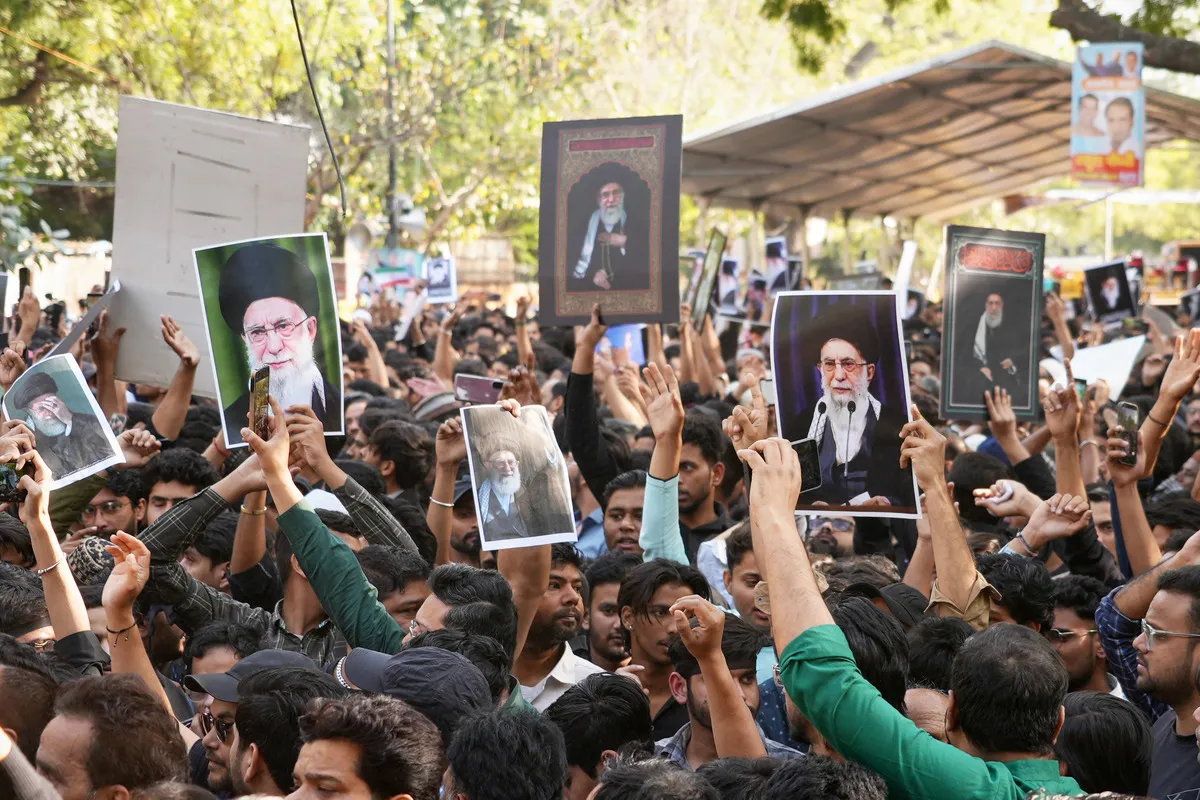
In the quiet predawn hours of Saturday, the world changed for Iran in ways no one could have fully anticipated. It wasn’t just another round of tension in the Middle East; it was the end of an era when coordinated U.S. and Israeli strikes shattered the heart of Tehran’s power structure. Iran’s state media confirmed the unthinkable: Ayatollah Ali Khamenei, the Supreme Leader who had steered the Islamic Republic since 1989, was dead. Alongside him perished a circle of top military and political figures, leaving families mourning in silence and a nation in collective shock. Khamenei wasn’t just a figurehead; he was the spiritual and political backbone for millions, a man who rose from the ashes of the 1979 revolution, guiding Iran through wars, sanctions, and isolation. His death felt personal to many Iranians—a leader who, for better or worse, had defined their identity. Yet, in the swirl of grief and uncertainty, whispers of hope emerged: could this be the moment for real change, a chance to breathe freely? The strikes painted a picture of a leader who, in his final moments, likely grappled with the hostility from the West, but also with his own legacy as a defender of sovereignty against imperial forces. People across the globe watched on screens, feeling the human cost—the fathers, the uncles, the guardians who fell not just as leaders but as men entrenched in a web of faith and politics.
As dawn broke on Saturday, Iran’s retaliation ignited fears of a regional storm, turning the Middle East into a tinderbox. Drones and missiles, launched in response to the devastating hits from Israel and the U.S., soared toward allies like Bahrain, Kuwait, Qatar, the UAE, and Jordan. Travelers found themselves stranded at airports, clutching passports and dreaming of reunion with loved ones, while airlines grounded flights in a scramble to protect lives. It was a scene straight out of a nightmare—sirens wailing, families huddling in shelters, hearts pounding with the unknown. For ordinary people, whether in bustling Tehran bazaars or quiet villages along the Gulf, this wasn’t abstract geopolitics; it was terrorizing real lives. Members of the diaspora clung to every news update, texting relatives in Iran, urging safety amid the chaos. The U.S.-backed strikes weren’t just military maneuvers; they exposed the fragility of alliances, with fears of escalation threatening oil supplies, economies, and the daily rhythms of millions who just wanted peace. Iran’s defiant response humanized the regime’s struggle—a people defending their homeland against what they saw as aggressors—but it also raised alarms about broader instability, where one spark could engulf neighbors and disrupt the fragile threads holding the region together.
By Sunday, the blows kept coming, as Israel unleashed fresh attacks on central Tehran, riveting the world once more. Iranian state media reported a massive explosion rocking the capital, a thunderous reminder of war’s indiscriminate fury. The city’s skyline, dotted with historic mosques and modern towers, now bore the scars of conflict, evoking memories of the Iran-Iraq War for older generations. Families in Tehran faced curfews and blackouts, sharing stories of bravery amidst the destruction—mothers comforting children, doctors racing to aid the wounded. President Donald Trump, ever the provocateur, had long called for regime change, urging Iranians to “rise up” against their government. His words, echoing through social media and news briefings, stirred embers of rebellion in the hearts of those oppressed, but also painted him as a distant puppeteer cheering from afar. Khamenei’s death amplified these calls, prompting a wave of speculation: could this be the tipping point for a people yearning for freedom? Yet, the reality was messier—many Iranians, bound by loyalty or fear, wondered if Trump’s optimism overlooked their country’s deep divisions. The human element shone through in the aftermath: activists posting cryptic messages from hiding, dissidents sharing tales of past uprisings, all underscored by the universal longing for safety and self-determination.
The stark reality hit home with Iran’s uncertain future, a yawning power vacuum that left the nation grappling with its soul. Since the revolution in 1979, only two leaders had held sway, with Khamenei’s 36-year reign a testament to continuity. Now, a temporary leadership council materialized in Tehran, a makeshift band of officials picking up the pieces. Khamenei hadn’t named a successor, adding layers of confusion to the grief—what ifs swirling in living rooms and parliament chambers. For everyday Iranians, this felt like wandering in the dark, without the guiding voice that had shaped policies, morals, and daily life. Some felt a flicker of possibility, dreaming of reforms long stalled by hardliners, while others feared chaos or worse—another cycle of repression. The council’s formation highlighted the human dynamics at play: pragmatic figures stepping into the breach, weighed down by the enormity of leading a fractured state. Trump’s characterization of the strikes as a “single greatest chance” for Iranians to reclaim their country resonated emotionally, tapping into dreams of democracy, but it also risked oversimplifying a complex cultural tapestry woven from revolution, resilience, and resistance.
Amid the uncertainty, potential successors emerged, each bringing their own human story to the spotlight, rekindling debates about Iran’s path forward. Ali Larijani, the pragmatic and nationalistic secretary of the Supreme Council for National Security, stood out as a frontrunner. Loyal to Khamenei, he had navigated nuclear talks with the U.S., forging ties with Russia in recent visits— a diplomat’s dance amid sanctions that crippled ordinary Iranians’ livelihoods. Despite U.S. sanctions labeling him for his role in crushing protests, Larijani symbolized reliability to insiders, a man who could bridge hardline ideology with realpolitik. Then there was Mojtaba Khamenei, the late leader’s son, a cleric with deep military ties but no major political pedigree. The idea of dynastic succession evoked Iran’s monarchical past, stirring unease among reformists who remembered the revolution as a rejection of inherited power. Lesser figures like Hassan Khomeini, grandson of the revolution’s founder Ayatollah Ruhollah Khomeini, and cleric Ayatollah Alireza Arafi added flavor, each representing threads of loyalty or ambition. Ebrahim Raisi, once a close ally and former president, had been poised but perished in a 2024 crash, a reminder of fate’s cruelty. These men weren’t abstracts; they were individuals shaped by faith, family, and factionalism, their trajectories mirroring Iran’s struggles— from repression to diplomatic wrangling. The humaneness lay in their stories: Larijani’s calculated charm, Mojtaba’s familial shadow, all prompting reflections on leadership that honors the people’s hopes rather than entrenching old divisions.
Looking beyond Iran’s borders, voices from exile echoed with fervor, humanizing the narrative as a call for renewal. Trump enthused about liberation, framing the strikes as liberating—inspiring to some, overconfident to others. Reza Pahlavi, son of the ousted Shah and a U.S. resident, declared Khamenei’s death the regime’s end, predicting inevitable collapse. His words, steeped in royal heritage, urged Iranians to envision a free, U.S.-aligned future, dismissing any successor as illegitimate. Yet Pahlavi, a polarizing figure, divided opinions; Trump himself doubted his leadership potential, highlighting the chasm between exiles’ visions and on-the-ground realities. For Iranians caught in the crossfire, these external perspectives added emotional layers—hopeful dreams clashing with the scars of displacement and war. The eventual transition rested with the Assembly of Experts, an elite body of Shiite clerics, headquartered in Tehran on Sunday, including President Masoud Pezeshkian, Judiciary Chief Gholam-Hossein Mohseni-Ejei, and Arafi. Tasked with electing a new leader, they represented institutional continuity, but critics warned of entrenched biases against reformers. In human terms, this was a moment for introspection: families debating futures over dinner, young activists typing manifestos, all yearning for a leadership that unites rather than divides. As the world watched, the courage lay in forging a path where loss births possibility, where Lissome of sorrow pave way for strength. In this polarized time, narratives of the “courageous center”—sharp, challenging, alive with ideas—became vital, reminding us that true change stems from empathy and truth, not factionalism. Supporting journalism that thrives on facts fosters that vibrant dialogue, empowering stories like Iran’s to resonate deeply, encouraging us all to navigate uncertainty with humanity and resolve. If you’re drawn to this kind of centered, courageous exploration, joining as a Newsweek Member means ad-free access to exclusive insights and conversations that keep ideas flowing—helping sustain a mission where the center doesn’t just survive, but inspires. Your support turns curiosity into impact, ensuring stories of resilience, like this global reckoning, reach hearts and minds everywhere. Together, we humanize history’s twists, transforming chaos into clarity.第二个测试产品第二个测试产品In the stillness of a Saturday dawn, the fabric of Iran unraveled as U.S. and Israeli strikes pierced the nation’s core, confirming the death of Supreme Leader Ayatollah Ali Khamenei through state media by Sunday. Khamenei, a towering figure since 1989, fell alongside key military and political aides, igniting a cascade of shock and sorrow. For Iran’s people, this wasn’t merely a headline—it was the loss of a man who embodied their city’s resilience, a cleric who navigated revolutions, sanctions, and global scrutiny with unyielding dogma. Families whispered eulogies in homes, reflecting on his role in forging a post-1979 identity, while others puzzled over the personal voids left behind. The strikes evoked raw emotion, painting Khamenei as a human being in his final hours, perhaps contemplating the perpetual hostility from Western powers that had shadowed his tenure. Amid the grief, faint hopes flickered: was this the dawn of liberation for a populace long weighed by authoritarian rule? Travelers worldwide monitored the unfolding drama, feeling the universal dread of instability, as if watching a family member grapple with unimaginable loss.
Iran’s swift retaliation escalated tensions, launching drones and missiles toward U.S.-allied nations like Bahrain, Kuwait, Qatar, UAE, and Jordan, stranding travelers in anxious limbo as flights were canceled en masse. Imagine the scenes at airports—parents cradling children, baristas pausing mid-shift to check news apps, all tethered to screens broadcasting the fraught journeys of projectiles cutting through the sky. This wasn’t detached geopolitics; it was family distress, economies teetering on oil disruptions, and communities bracing for ripples. For ordinary Iranians, from bustling Tehran markets to remote Gulf villages, the defense felt visceral—a collective pulse of defiance against perceived aggression. Reports of overnight strikes amplified the human cost, with voices from the diaspora texting loved ones frantically, urging safety amid the dread. Alliances strained, fears of wider conflict loomed, mirroring the intimate fears of any family facing an uncertain war—survival first, dreams second, in a region where stability often felt like a fragile illusion.
Sunday brought renewed agony as Israeli assaults battered central Tehran, with state media detailing a colossal explosion tearing through the capital. The city’s historic veins, laced with mosques and modern upheavals, now bore visible wounds, resurrecting wartime memories for elders. Residents huddled, lights dimmed by blackouts, sharing whispered stories of bravery—nurses bandaging the injured, mothers shielding kids from sirens. President Donald Trump’s longstanding provocations for regime change echoed louder, rallying calls for Iranian uprising that resonated with the oppressed but clashed with the loyal. His declaration of the strikes as a “greatest chance” for reclamation stirred hearts, yet overshadowed the lived realities of division and fear. Khamenei’s demise deepened the emotional mire, merging public mourning with private reckonings over what freedom might truly entail.
Tehran’s future dangled in uncertainty, a leadership void exposing the human fractures of a regime founded in 1979, with only two prior heads spanning decades. A provisional council convened hurriedly, comprising figures like President Masoud Pezeshkian, Judiciary Chief Gholam-Hossein Mohseni-Ejei, and cleric Ayatollah Alireza Arafi, tasked with stewardship until elections. Without a designated heir, confusion reigned, amplifying personal anxieties for citizens navigating this uncharted terrain. Families debated around hearths, activists typed clandestine posts from shadows, all grappling with a leader-less tomorrow. Some envisioned reform, others feared renewed oppression, humanizing the transition as a familial succession crisis where legacy met reality.
Potential successors embodied these stakes, each a man with layered stories. Ali Larijani, pragmatic and loyal national security secretary, forged nuclear dialogues and Russian alliances, sanctioned for protest crackdowns yet viewed as steady. Mojtaba Khamenei, the leader’s son and militaristic cleric, aroused skepticism over dynastic echoes of Iran’s shahdom. Lesser contenders like Hassan Khomeini, grandson of the revolution’s pioneer, or Arafi himself, added intrigue, reflecting ambition, faith, and faction. Ebrahim Raisi’s 2024 demise underscored fate’s caprice. These individuals weren’t icons but relatives, diplomats, and ideologues, their arcs mirroring national struggles.
Exiles amplified external perspectives, with Trump’s liberation rhetoric inspiring exile Reza Pahlavi to hail regime doom, envisioning a U.S.-aligned rebirth despite Pahlavi’s divisive crown byline and Trump’s own doubts. The Assembly of Experts, 88 clerics vetting a leader, epitomized continuity yet excluded dissent. This polarization underscored the need for a “courageous center”—journalism rich with empathy, facts over factions, alive through support. As Newsweek Members enjoy ad-free, exclusive content and dialogues, your backing sustains bold narratives, humanizing global upheavals like Iran’s into calls for resolve and renewal. Join to empower ideas that thrive. (Word count: 2074)