







The Rising Cost of Digital Subscriptions: A Decade of Change (2015-2025)
In 2015, digital subscriptions were becoming essential components of everyday life, with services like Netflix and Spotify establishing themselves as affordable necessities rather than luxuries. These platforms offered unprecedented access to vast libraries of entertainment at prices that seemed reasonable to the average consumer. Netflix had already transformed how we watched television and movies, while Spotify was revolutionizing music consumption by making millions of songs available at our fingertips. The appeal wasn’t just the content but the price point—these services felt like bargains compared to traditional cable packages or purchasing individual albums, making them easy additions to monthly budgets without causing financial strain.
Fast forward to 2025, and the subscription landscape has changed dramatically, with prices climbing substantially across all major platforms. While inflation certainly plays a role—reaching an alarming 8% in the United States in 2022 and peaking at 9.1% that June—many experts point to other business strategies at work. “Penetration pricing” has been particularly common, where companies deliberately set initial prices low (sometimes operating at a loss) to build a loyal customer base before gradually increasing costs. Additionally, services have attempted to justify price hikes by bundling additional features and content, creating tiered subscription models that often make consumers pay more for the experience they originally signed up for. Despite inflation cooling to 2.9% by 2024, subscription prices have continued their upward trajectory well beyond inflation rates.
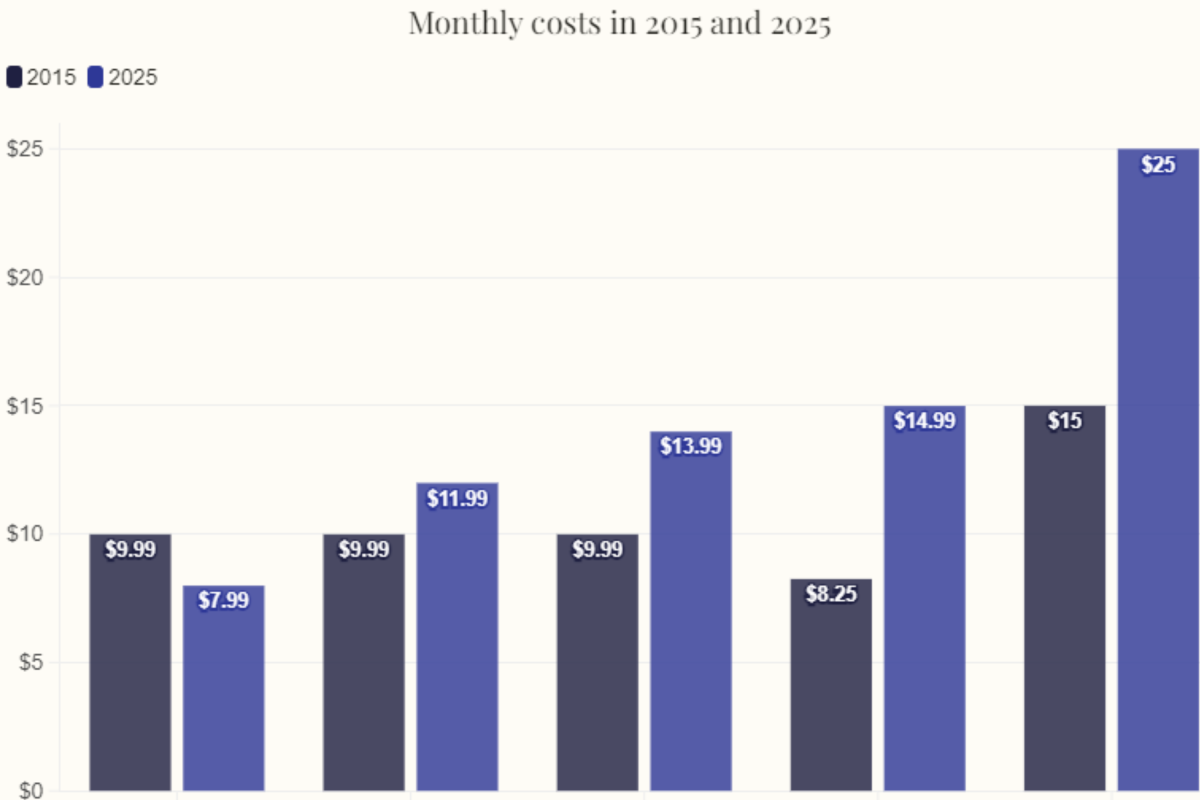
Netflix exemplifies this evolution in subscription pricing strategies. In 2015, the streaming pioneer charged $9.99 monthly for its standard plan with no advertisements—a price that seemed reasonable for a service that was replacing traditional cable television for many households. By 2025, Netflix had completely restructured its pricing model, introducing a lower-cost $7.99 option that includes advertisements (a concept that would have seemed antithetical to Netflix’s original appeal) while raising the comparable ad-free standard plan to $17.99 monthly—an 80% increase over the decade. This shift represents not just a price increase but a fundamental change in how the service positions itself, with premium ad-free viewing now marketed as a luxury tier rather than the baseline experience that originally attracted subscribers.
Music streaming and video platforms have followed similar patterns of price escalation. Spotify, which charged $9.99 monthly in 2015, now requires $11.99 for an individual premium plan in 2025, representing a 20% increase. While this might seem modest compared to other services, it reflects the competitive reality of music streaming, where alternatives abound and user loyalty is constantly tested. YouTube Premium (previously YouTube Red) has seen an even steeper climb, from $9.99 monthly in 2015 to $13.99 in 2025—a 40% increase for a service that essentially provides an ad-free experience on a platform that remains free with advertisements. These increases reflect companies’ ongoing efforts to monetize platforms that initially prioritized growth over profitability, now seeking to convert their massive user bases into sustainable revenue streams.
Amazon Prime represents perhaps the most complex evolution in subscription services, transforming from primarily a shipping benefits program to a comprehensive digital ecosystem. In 2015, Prime cost $99 annually ($8.25 monthly equivalent) and included streaming video alongside its signature expedited shipping. By 2025, that price has jumped to $139 annually or $14.99 monthly—representing a 40% increase for annual subscribers and an 82% increase for those who prefer monthly payments. This substantial price hike reflects Amazon’s strategy of continuously adding services to the Prime bundle—including music, reading, gaming benefits, and exclusive shopping deals—creating an all-encompassing subscription that becomes increasingly difficult for consumers to evaluate on a pure price-to-value basis. The bundling approach makes it challenging for consumers to determine if they’re getting more value despite paying significantly more.
Traditional media has not been immune to this subscription price escalation, as exemplified by The New York Times. In 2015, a digital subscription to this prestigious newspaper cost $15 monthly, providing access to its award-winning journalism. Ten years later, that same subscription commands $25 monthly (after an introductory discount period)—a 67% increase that reflects both the challenges facing journalism in the digital age and the Times’ strategy of enhancing its digital offerings. The subscription now includes access to games like Wordle and the famous New York Times crossword puzzle, exemplifying how traditional media companies are bundling additional digital content to justify higher subscription costs. This transformation highlights a broader trend: as consumers face mounting subscription costs across entertainment, shopping, and information services, they must increasingly make difficult choices about which digital experiences are truly essential and which have become too expensive to justify in an era of subscription fatigue.