



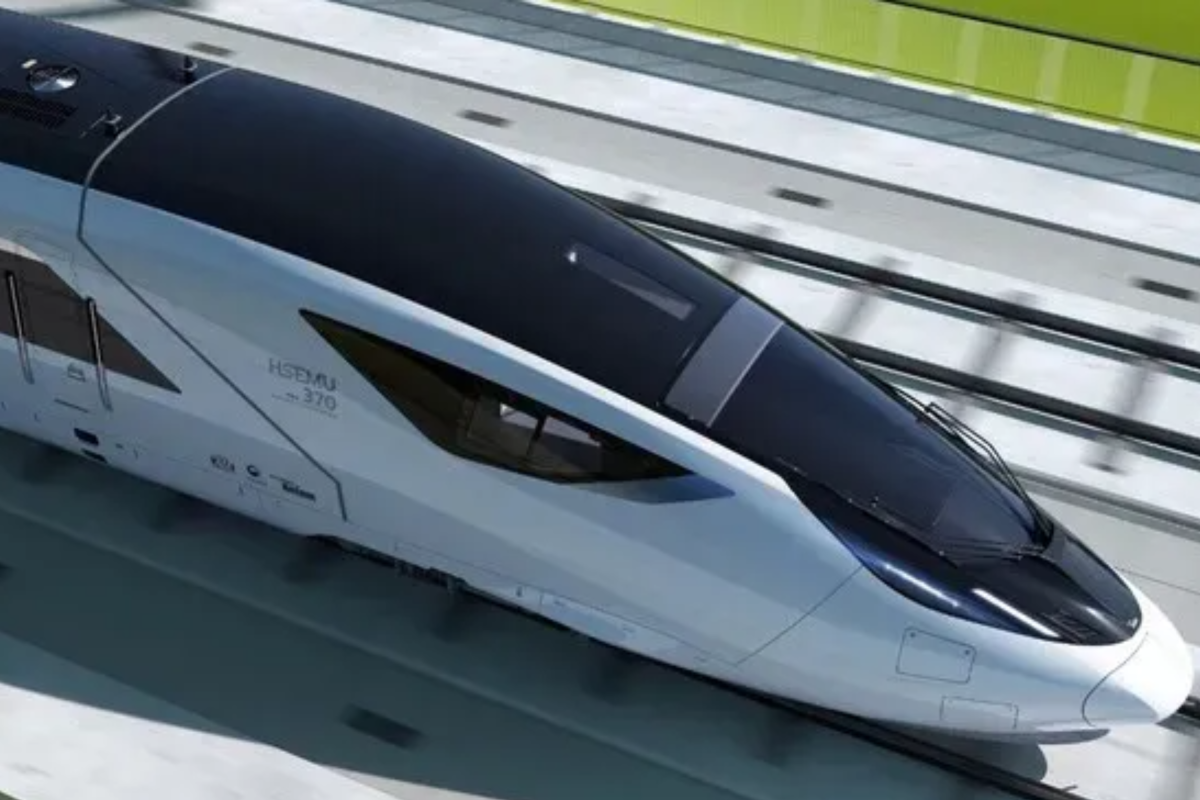
South Korea’s Next-Generation High-Speed Train Marks a Major Leap in Rail Technology
South Korea has unveiled its groundbreaking next-generation high-speed train, the EMU-370, designed to operate at a commercial speed of 370 kilometers per hour (230 mph). This technological marvel represents a significant achievement in the country’s transportation evolution, positioning South Korea to operate the world’s second-fastest high-speed train, behind only China’s CR450. The development comes just two decades after South Korea first introduced high-speed rail service, highlighting the rapid pace of the nation’s technological advancement. Beyond simply moving passengers from point A to point B more quickly, this train project carries broader implications for economic development, as it will connect all major Korean cities within a two-hour travel window, potentially transforming how citizens live, work, and interact across the nation.
The EMU-370 is the culmination of an ambitious four-year national research and development initiative that began in April 2022 and concluded in December 2025. The Korea Railroad Research Institute (KRRI) spearheaded this collaborative effort, bringing together seven public and private organizations, including industrial powerhouse Hyundai Rotem. The project represented a national investment of 22.5 billion KRW (approximately $15.54 million USD), demonstrating South Korea’s commitment to advancing its transportation infrastructure. For everyday travelers, the practical benefit is striking: the new train will slash the Seoul-Busan journey to approximately 110 minutes, a remarkable improvement that will fundamentally alter the relationship between the nation’s two largest cities. Such a reduction in travel time effectively shrinks the geographical constraints of the Korean peninsula, potentially allowing for more balanced economic development across regions that were previously considered too distant for convenient daily connections.
What makes the EMU-370 particularly impressive is its suite of technological innovations that build upon its predecessor, the KTX-Cheongryong (EMU-320). The new train’s enhanced capabilities begin with its propulsion system, featuring high-efficiency 560kW traction motors—24 per trainset—that deliver a 47.4 percent increase in output compared to the previous generation. The engineering team didn’t stop at raw power, however. They meticulously refined the train’s aerodynamics by redesigning its nose, bogies, and reducing rooftop equipment, resulting in a 12.3 percent reduction in air resistance. This attention to aerodynamic detail is crucial at such high speeds, where air resistance becomes a major limiting factor and energy consumption concern. These improvements represent not just incremental advances but fundamental rethinking of high-speed rail design principles that will likely influence global standards.
Passenger comfort received equal attention in the EMU-370’s design process. Engineers optimized the suspension systems with sophisticated air springs and dampers that reduce lateral vibration by 33 percent, creating a noticeably smoother ride even at extreme speeds. This improvement addresses one of the persistent challenges of high-speed rail: maintaining passenger comfort as velocity increases. The design team also tackled noise issues, upgrading aluminum body structures and implementing composite sound insulation that reduces interior noise levels by approximately 2 dB, keeping the cabin environment in the 68-73 dB range. Perhaps most significantly, the project established entirely new ultra-high-speed safety standards for operation up to 400 km/h, surpassing existing European benchmarks that cap at 350 km/h. This forward-thinking approach ensures the train isn’t merely meeting current safety requirements but establishing new parameters for future high-speed rail development worldwide.
The significance of this achievement has not been lost on South Korean officials. Vice Minister for Transport Kang Hee-up highlighted the collaborative nature of the success, noting that “Through the joint efforts of the government, public institutions, and private companies, we have independently secured the technology for high-speed operation at 370 km/h, becoming the second country in the world to do so just 20 years after introducing high-speed railways.” His statement reflects both pride in the accomplishment and recognition of how quickly South Korea has advanced in this technological domain. The vice minister also signaled that this achievement is merely a stepping stone, adding that “Starting next year, the government will spare no efforts to support the development of core technologies for third-generation high-speed trains capable of running at 400 km/h, enabling Korea to leap forward as a global leader in railway technology.” This forward-looking perspective suggests that South Korea views rail technology not just as domestic infrastructure but as a strategic industry with global export potential.
The EMU-370 project now moves from development to implementation, with the government planning to place initial orders in the first half of 2026, followed immediately by production commencement. The introduction will be measured and methodical, with test operations scheduled to begin on the Pyeongtaek-Osong section by 2030, and full commercial service expected after 2031. This timeline reflects the careful balance between technological ambition and practical implementation concerns typical of major infrastructure projects. When fully operational, the EMU-370 will not only revolutionize domestic travel in South Korea but also serve as a showcase of the country’s engineering capabilities and technological prowess. As global transportation systems increasingly prioritize high-speed rail as an environmentally responsible alternative to short-haul flights, South Korea’s advancements position it to be a significant player in what promises to be a growing international market. The EMU-370 represents not just a faster train, but a statement about South Korea’s vision for its technological future.