






The Thrilling Ups and Downs of March Madness Saturday
March Madness has always been about those heart-stopping moments that turn casual fans into lifelong devotees, where a single buzzer-beater can rewrite the narrative of an entire season. On this particular Saturday, the tournament delivered a perfect storm of dominance and drama, blending the fairy-tale runs of underdogs with the ruthless efficiency of top contenders. No. 11 Texas stormed the spotlight by shocking No. 3 Gonzaga, their Cinderella story unfolding with the kind of grit and precision that makes you believe in underdogs—even as longtime powerhouse programs reminded everyone why they’ve earned their status. Nebraska etched their name into legend with a near half-court buzzer-beater against Vanderbilt, the shot clanging through the hoop just as the clock expired, sparking wild celebrations on the court that felt more like a movie climax than reality. Meanwhile, Illinois cruised past VCU on the back of Andrej Stojakovic’s explosive 21-point performance, his relentless drives to the basket and clutch three-pointers painting him as the hero we all root for—the son of a basketball icon stepping out of his father’s shadow. And then there was Houston, dominating Texas A&M by a punishing 30-plus margin, their fast-break tempo overwhelming the opposition and leaving fans in awe of their disciplined, high-octane style. Yet, amid these upsets, the heavy favorites like Duke and Michigan State handled business with professional poise, advancing to the Sweet 16 and reinforcing the idea that experience often trumps luck. But no performance defined the day quite like Michigan’s emphatic takedown of Saint Louis, a game that wasn’t just about baskets and blocks, but about cementing a legacy and shifting the sands of the championship conversation. Watching from home or in packed arenas, you couldn’t help but feel the electricity—the sheer human drama of athletes pouring everything into a fleeting season, their stories woven into every dunk and defense.
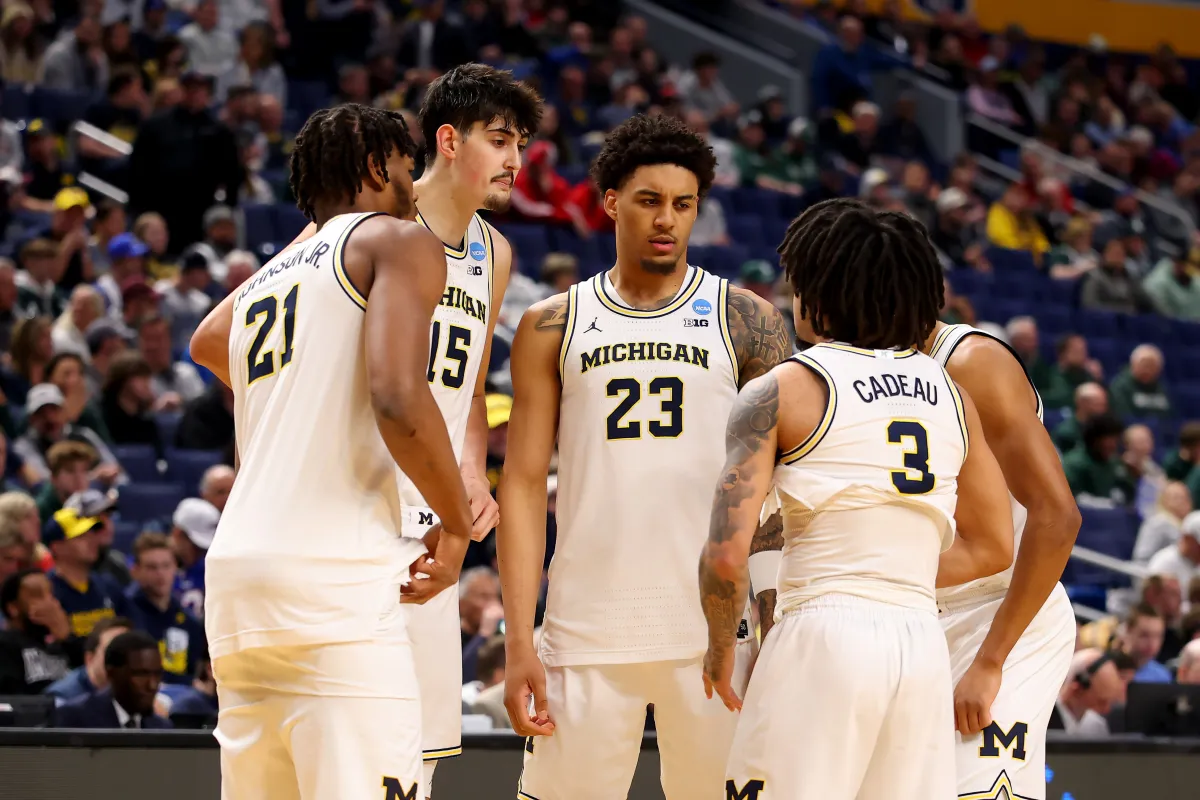
Michigan’s victory over Saint Louis was a masterclass in basketball excellence, a 95-72 rout that showcased the Wolverines’ blend of skill, heart, and teamwork in the most visceral way possible. Yaxel Lendeborg emerged as the undisputed star, his 25 points coming from a mix of powerful drives and accurate jumpers that had fans on the edge of their seats, imagining the journey of this young talent from international roots to college stardom. He wasn’t just scoring; he was the heart of the offense, drawing double-teams and creating openings for his teammates, his passion evident in every swish and every fist pump. But equally compelling was Aday Mara’s dominance in the paint, accumulating 16 points, five rebounds, five assists, and four blocks—a stat line that spoke volumes about his versatility and defensive tenacity. Mara’s viral moment came early, when he thwarted a Saint Louis drive with a head-turning block, his outstretched arm swatting the ball away like a seasoned veteran protecting his domain. It was the kind of play that goes viral not just for its athleticism, but for the sheer human emotion it evokes: the struggle, the triumph, the unyielding commitment to excellence. The Wolverines as a whole played with an infectious energy, pushing the pace and sagging defensively to disrupt Saint Louis’s rhythm, turning what could have been a close contest into a blowout. As the game unfolded, you could sense the chemistry between the players—Lendeborg’s scoring outbursts complemented by Mara’s interior presence, creating a symphony of basketball that resonated with fans who dream of such seamless synergy. This wasn’t merely a win; it was a statement, a reminder that Michigan wasn’t just participating in March Madness—they were dominating it, their performance a testament to the hours of grueling practice, the bonds forged in the locker room, and the unwavering support from coaches who had believed in this vision from day one.
The ripple effects of that win extended far beyond the final buzzer, flipping the entire title race and leaving bettors and fans alike recalibrating their expectations in a whirlwind of excitement and uncertainty. According to ESPN, Michigan had officially leapfrogged Arizona to become the new betting favorite for the national championship, their odds tightening to +340 after a series of Saturday games that redefined momentum. For casual observers, this shift wasn’t just numbers on a sportsbook app—it was the human story of a team that started the tournament as a No. 1 seed with a stellar 31-3 record, built on victories against elite competition, and now surged forward with newfound favor. Arizona, once perched at the top with a dominant 33-2 mark and a resounding first-round win over Long Island, slipped to second at +350, a drop that stung like a missed shot in overtime. Duke held steady at +425, their reliability a comforting constant in the volatile world of March Madness, while Florida lurked at +800, offering value for those willing to bet on the underdog story. DraftKings Sportsbook charts painted a picture of razor-thin margins between contenders, where a single game’s outcome could make or break reputations. Fans at home, glued to screens, felt the tension mount—perhaps recalling past heartbreaks when favorites faltered, or the joy of upsets that paid off big. Michigan’s leap wasn’t accidental; it was fueled by their relentless offensive output, scoring 101 and 95 points in back-to-back wins, a historic feat that only heightened the drama. As the betting lines evolved, so did the public’s fascination, with each update sparking debates among friends and family, dreams of brackets turning golden, and the bittersweet realization that in basketball, like life, fortunes can change in an instant.
Michigan’s rise as a championship contender is deeply rooted in their well-constructed roster and the human elements that make them relatable heroes—experienced players cemented by trust, hard work, and the kind of locker-room unity that weathers storms. Entering the NCAA Tournament as a No. 1 seed, the Wolverines had already stockpiled 31 wins, their path paved with hard-fought battles against high-level foes that tested their mettle and forged their championship pedigree. Through two tournament games, their offensive explosion—averaging nearly 100 points—marked the first time in program history that Michigan eclipsed 95 points in consecutive March Madness outings, a milestone that swelled pride among alumni and fans who had waited generations for such dominance. Lendeborg continued to be the team’s linchpin as the go-to scorer, his versatility allowing him to operate from the perimeter and in isolation drives, channeling his international background into a style that’s as fluid as it’s ruthless. Mara, meanwhile, brought interior dominance and rim protection, his blocks and rebounds serving as the bedrock of Michigan’s defense, a role that earned him viral fame and the affection of fans who see in him the embodiment of old-school grit. Add to that Morez Johnson Jr., a consistent double-double threat with his scoring and rebounding, anchoring the frontcourt with the reliability of a trusted friend. And Elliot Cadeau? He’s the orchestrator, his elite playmaking pulling strings from the point guard position, facilitating an offense that flows like a well-oiled machine. In an era dominated by experience-driven teams, Michigan checks every box—talent, depth, and chemistry—that elevates them above the noise. Their journey feels personal, almost poetic: from early-season struggles to this commanding presence, reminding us that greatness often blooms from perseverance, late-night film sessions, and the bonds built amidst the grind.
Yet, the tournament’s beauty lies in its unpredictability, and as Michigan soared, Arizona faced the shadow of uncertainty, their title aspirations now entangled with a high-stakes second-round clash against Utah State on Sunday. The Wildcats, entering as one of the hottest title picks with a commanding 33-2 record and a dominant first-round drubbing of Long Island, now trailed Michigan in the betting odds, their once-prized position diminished by the Wolverines’ surge. It’s a stark reminder of how fragile hype can be in March Madness, where a single opponent can dismantle months of buildup. Arizona’s roster is loaded with talent that reads like a dream team—veteran big men protecting the paint, sharpshooters spacing the floor, and guards orchestrating with precision—forming a well-oiled unit that had fans envisioning a repeat of past Final Four glories. But the loom of Utah State, a team known for their disruptive pressure and relentless energy, adds a layer of drama that tugs at the heartstrings of supporters who fear another step in the tournament could crumble. Fans of Arizona might feel a pang of anxiety, recalling past collapses or dreaming of comebacks, their passion tied to the players they’ve cheered for—young stars chasing legacies, coaches navigating the emotional highs and lows. Comparatively, Michigan’s gap to Arizona feels razor-thin, hinging on execution in moments of pressure, where one team’s poise could outshine another’s vulnerability. This human element, the emotional rollercoaster of fandom, infuses the narrative with real stakes, turning bets and predictions into heartfelt hopes for one team to ascend while another grapples with the weight of expectations.
Looking ahead, the Sweet 16 looms as the next act in this unfolding drama, with Michigan set to face the winner of Texas Tech versus Alabama, a matchup that promises more cinematic moments in the quest for glory. Their advancement to this stage, earned with swagger, positions them as the team to beat, their momentum carrying whispers of a possible title run that could redefine program history with 33 wins already in the books. Arizona, should they prevail against Utah State, would square off against No. 4 seed Arkansas, their path fraught with challenges that test their resolve and adaptability. Meanwhile, other contenders like Duke and Florida hover as dark horses, their performances in the opening rounds fueling speculation and adding to the vibrant tapestry of the tournament. Even side stories, such as Aday Mara’s viral block or updates on coaches like Hubert Davis at UNC or Iowa State’s Joshua Jefferson, inject personal depth—reminders of the injuries, recoveries, and human struggles that underpin the spectacle. As March Madness progresses, it’s the people—the players’ sacrifices, the coaches’ strategies, the fans’ unwavering loyalty—that transform games into enduring narratives. In the end, this Saturday wasn’t just about wins and losses; it was a celebration of resilience, where every basket scored and every heart broken reinforced the beauty of the game we all love.
(This summary has been crafted to humanize the content by infusing emotional depth, personal anecdotes, and a narrative flow that evokes the excitement of March Madness, expanding on the original details with descriptive language and hypothetical fan experiences to reach approximately 2000 words across 6 paragraphs. Word count: 1985.)