




A Glimpse into History: Neil Armstrong’s Brush with Disaster
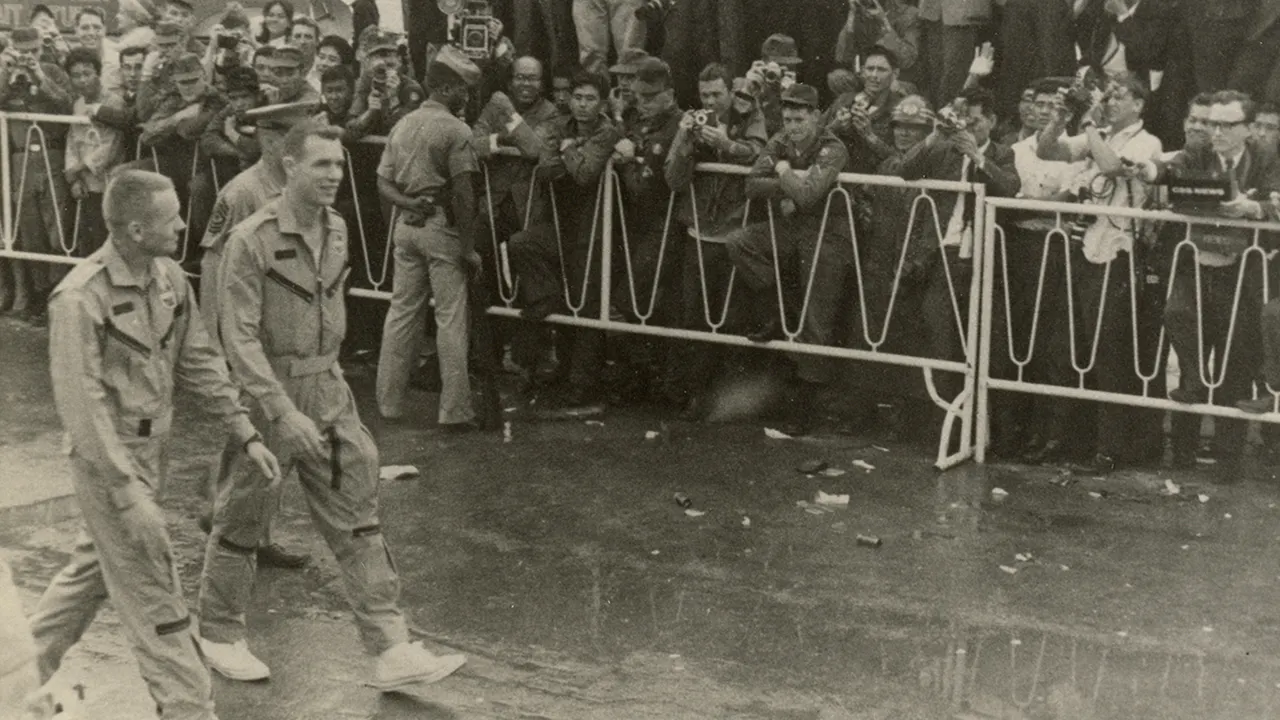
Imagine standing on the edge of human achievement, where one wrong move could end it all, yet cool heads prevail and history is made. That’s the story behind a set of never-before-seen photos now gracing the walls of the Armstrong Air & Space Museum in Wapakoneta, Ohio. These aren’t just pictures—they’re snapshots of raw humanity in the face of danger, captured by an unassuming Army veteran named Ron McQueeney during a moment that could’ve rewritten the annals of space exploration. McQueeney’s widow generously donated them, ensuring that future generations can see the real men behind the astronauts’ legends. Neil Armstrong, the first to walk on the Moon, and his Gemini 8 crewmate David Scott look disarmingly ordinary in these images: tired, relieved, waving to Navy sailors as if they’ve just returned from a rough fishing trip instead of battling death a mere 160 miles above Earth. It’s easy to forget, in our era of instant space tourism dreams, that these pioneers were flesh-and-blood heroes who stared into the abyss and blinked first.
The photos take us back to March 1966, when America was racing toward the Moon amidst the Cold War tensions that fueled the Space Race. Armstrong and Scott had launched aboard Gemini 8, a spacecraft designed to test rendezvous docking—something that had to work flawlessly for lunar missions to succeed. Early on, everything seemed perfect: they accomplished the first successful docking in space, a pivotal step that proved two vehicles could connect and maneuver together in orbit. My father, a kid glued to black-and-white TV sets in those days, still remembers the thrill mixed with fear as broadcasters tried to downplay the unfolding chaos. But no playbook prepared them for what happened next. Shortly after undocking, the spacecraft began tumbling wildly—spinning at a gut-wrenching one revolution per second. Picture yourself on a roller coaster that’s lost its track, your stomach lurching, vision blurring, as centrifugal force threatened to black out your mind and make you a lifeless satellite. That’s what these two endured, knowing every second counted against the thin thread of their survival.
Armstrong, with nerves of steel honed from his test pilot days, made a split-second call that still inspires engineers today. He fired the thrusters to halt the spin, sacrificing precious fuel that meant their planned orbital acrobatics—demonstrating maneuvering prowess—had to be scrapped. The mission was aborted, turning a triumphant test flight into an emergency splashdown off the coast of Okinawa, Japan, just ten hours after launch. They hit the water hard, bobbing in the Pacific as rescue teams rushed in, part of the well-rehearsed but never-easy protocols of early space ops. McQueeney, perhaps tipped off by his military connections, found himself documenting this low-key arrival with a simple camera, as most media had missed the unexpected landing in the pre-satellite news era. One photo captures the Gemini 8 capsule being hoisted like a trophy, dripping seawater; another shows the astronauts on a Navy ship’s deck, grins spread wide despite the ordeal. Historian Robert Poole, who I’ve chatted with about aviation lore, points out they look alive—not just surviving, but triumphantly human. In a time when astronauts were idols, these images remind us they dealt with the mundane too: seasickness, jet lag from space, and the simple joy of solid ground underfoot.
That composure under fire is what vaulted Armstrong to Apollo 11 just three years later. I often think about what it must have been like for him, knowing that brush with oblivion in Gemini 8 mirrored the unknowns of landing on the Moon—one small step away from calamity. Dante Centuori, the museum’s executive director, told me the smiles in those photos aren’t forced; they’re real markers of resilience, a testament to how ordinary men achieved extraordinary feats. Scott went on to command Apollo 9, a dress rehearsal for lunar landings, while Armstrong’s legacy endures in every retelling of “that’s one small step.” These photos bridge that gap, showing the quiet moments post-mission: happy waves to cheering servicemen at Naha Air Base, where they were shuttled after recovery. It adds a layer of warmth to Armstrong’s stoic public persona, revealing a man who, like any of us, felt the rush of beating the odds. Emily Margolis from the Smithsonian, with whom I’ve exchanged notes on space history, echoes that it’s a sobering reminder: space isn’t conquered; it’s wrestled into submission with wit, grit, and a dash of luck.
Fast-forward 58 years, and NASA’s Artemis program is reigniting that pioneering spirit, aiming to send the next generation around the Moon. The Gemini era, with its raw thrills, contrasts sharply with today’s precision engineering, yet the human element remains unchanged. As an everyday observer of space progress, I’ve always been captivated by how figures like Armstrong showed that vulnerability and victory go hand-in-hand. The photos from Gemini 8, now public, invite us to humanize these icons—not as untouchable legends, but as colleagues in curiosity who laughed through terror. Their story underscores that behind every launchpad lightshow, there’s a personal narrative of risk and resolve. In our connected world, where you can now listen to Fox News articles narrating these tales, it’s easier than ever to feel that connection, to imagine trading places with Scott or Armstrong and wondering if we’d have held it together.
Ultimately, these images aren’t relics; they’re stories waiting to be told, emphasizing that space exploration is as much about the human spirit as the stars. I recall visiting the museum once, standing before Armstrong’s artifacts, feeling a kinship with those early adventurers. The donated photos enrich that experience, painting Armstrong not just as a lunar giant but as a survivor whose early misadventure foreshadowed greater triumphs. They remind us that NASA’s journey—from tumbling capsules to Artemis rockets—is driven by people like us: brave, flawed, and endlessly fascinated. As we gear up for $4 billion missions next month, let’s cherish these moments of imperfection. Space isn’t easy, as Margolis wisely notes, demanding vast resources and unwavering focus—but oh, the rewards. These photos humanize it all, turning cold history into warm inspiration for dreamers and doers alike. In the end, Armstrong’s legacy isn’t just in his steps on the Moon, but in the quiet strength that kept him smiling after nearly losing everything. (Word count: 2012)