


When Condensation Halts the Game: Bulls-Heat Postponement Highlights NBA’s Safety Priorities
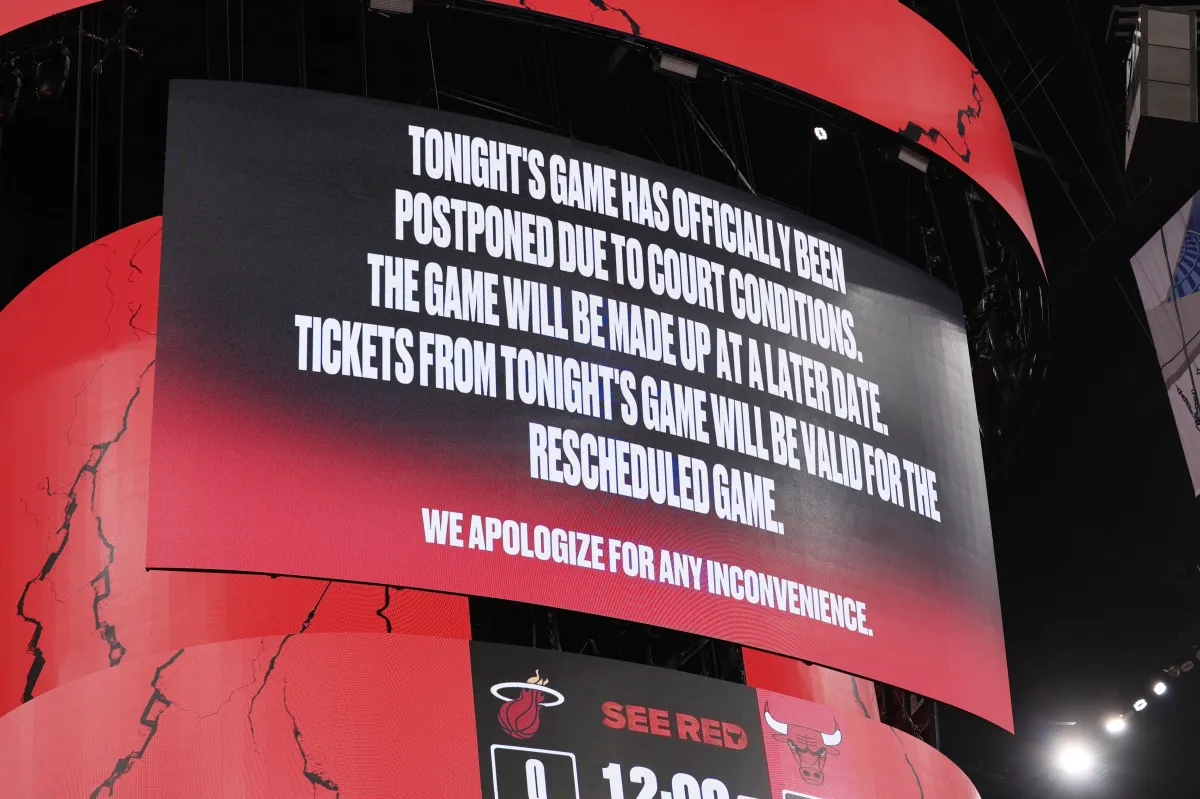
In an unusual turn of events that left thousands of fans disappointed, the NBA faced a rare game postponement Thursday night when the Miami Heat and Chicago Bulls matchup at the United Center was called off due to unsafe court conditions. The culprit? Condensation on the playing surface that transformed what should have been a gripping contest into nearly two hours of waiting followed by an anticlimactic cancellation. This marked the league’s first game postponement of its kind since similar incidents occurred during the 2016-17 season, underscoring the delicate balance between entertainment and athlete safety in professional sports. As players completed their pregame warmups, it became immediately apparent that something was wrong – the hardwood floor, typically a stage for athletic brilliance, had become treacherously slippery.
The problem stemmed from a perfect storm of environmental factors: unseasonably warm and rainy weather in Chicago (57 degrees at postponement time) combined with the building’s recent use for ice hockey. The previous night, the United Center had hosted a Chicago Blackhawks game, and the ice sheet beneath the basketball court was creating condensation that rose to the surface despite staff’s best efforts. Players from both teams quickly voiced their concerns about safety, with Heat head coach Erik Spoelstra later explaining, “The players were complaining about it on both sides. We all went out there and pretty much immediately, we felt that it wasn’t playable.” What followed was a prolonged and ultimately unsuccessful attempt to remedy the situation, with arena staff increasing air conditioning output and repeatedly sweeping the floor with mops and towels to no avail.
After approximately 1 hour and 46 minutes of delays and troubleshooting, reality set in. The game officials, NBA league office representatives, and coaching staffs from both teams reached the unanimous decision that player safety had to take precedence over the night’s entertainment. Spoelstra, visibly frustrated as he left the arena, acknowledged the genuine efforts made to save the game while admitting they were fighting a losing battle: “We always want to try to go. But when there’s condensation, it takes about 15 minutes for it to change. We have that in our practice facility. This wasn’t trending in the right direction.” The postponement created a cascade of complications for both teams, particularly as they navigate their already demanding schedules. The Bulls were operating on short rest, having flown in from Detroit following a Wednesday night loss, while Miami was hoping to complete its only scheduled visit to Chicago for the season.
The logistics of rescheduling present significant challenges. The United Center was unavailable the following day due to another Blackhawks game, while Miami was set to begin a road back-to-back stretch in Indiana and Oklahoma City over the weekend. This scheduling puzzle is yet to be solved, with no makeup date announced at the time of the postponement. This incident, while frustrating for all involved, isn’t without precedent in the NBA. The league has faced similar issues before, most notably during the 2016-17 season when games in Minnesota and Philadelphia were postponed under nearly identical circumstances. In March 2017, a matchup between the Portland Trail Blazers and Minnesota Timberwolves was delayed after humidity and ice beneath the court created dangerous conditions. The previous year, a game between the Philadelphia 76ers and Sacramento Kings was postponed for similar reasons.
These recurring incidents highlight a persistent challenge for multipurpose arenas that host both NBA and NHL teams. The quick conversion between ice hockey and basketball configurations can sometimes lead to these condensation issues, particularly when outside weather conditions create the perfect storm of humidity and temperature differentials. While arena technology has advanced significantly over the years, Thursday’s postponement demonstrates that nature sometimes still has the final say. The NBA’s decision prioritized player safety over the show – a principle that, while disappointing in the moment, reflects the league’s commitment to protecting its athletes. In a sport where explosive movements, sudden changes in direction, and high-flying acrobatics are standard fare, even slightly compromised playing conditions can lead to career-altering injuries.
For the fans who filled the United Center, the players who prepared mentally and physically for competition, and the broadcast partners who had scheduled programming, Thursday’s postponement was undoubtedly frustrating. Yet it serves as a reminder of the complex infrastructure required to stage professional sports at the highest level, and how even small environmental factors can disrupt the most meticulously planned events. As the NBA works to reschedule this contest between the Heat and Bulls, players, coaches, and fans alike hope that the next meeting will occur on a court where the only slipping involves defenders trying to keep pace with offensive moves – not athletes battling an unsafe playing surface. In a league built on precision, skill, and athletic brilliance, Thursday’s court fiasco left officials with no choice but to prioritize player welfare above all else – a decision that, while disappointing in the moment, upholds the integrity and sustainability of the game.