







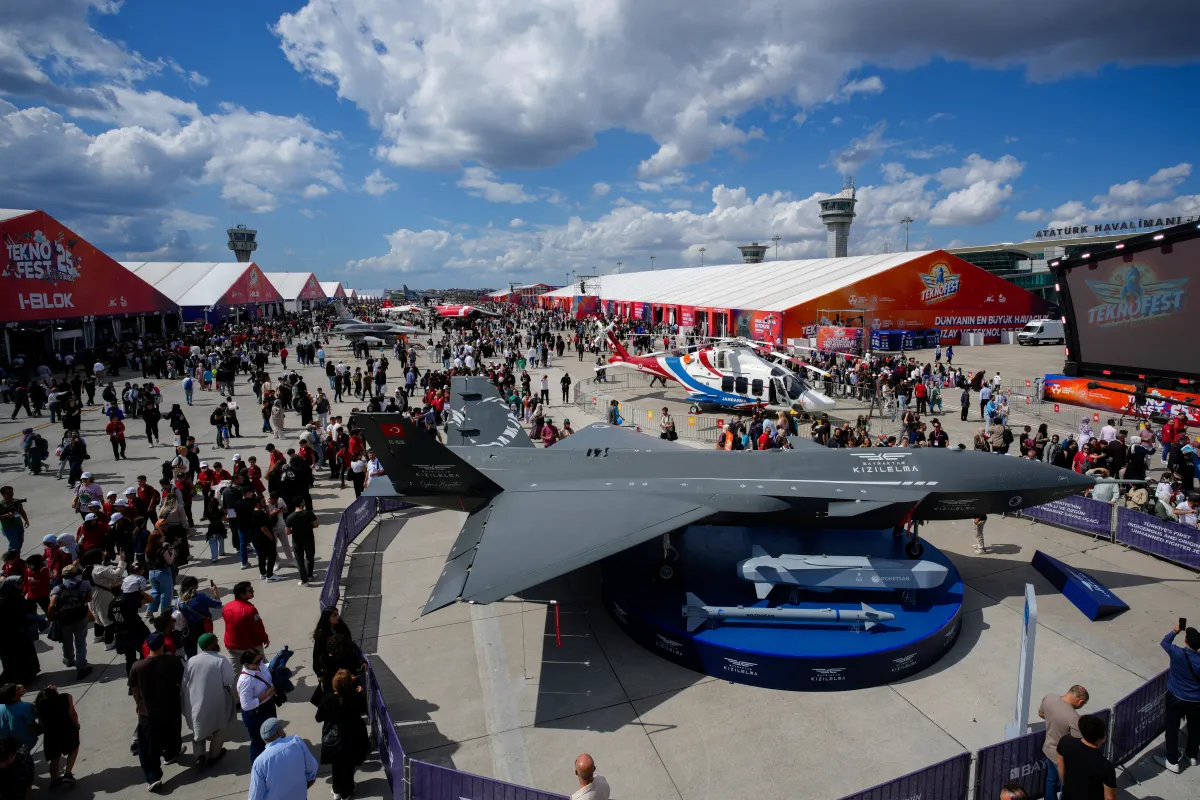
Turkey’s Bayraktar Kizilelma: Revolutionizing Aerial Combat with the World’s First Long-Range Drone Strike
In a historic breakthrough for military aviation technology, Turkey’s unmanned fighter jet, the Bayraktar Kizilelma, has achieved what no other drone has done before – successfully striking a jet from long range. During recent tests over the Black Sea, this next-generation combat drone fired a radar-guided air-to-air missile and hit an aerial target with perfect accuracy, marking a significant milestone in unmanned aerial warfare. This achievement represents more than just a successful weapons test; it signals a fundamental shift in how future air combat will be conducted, with unmanned systems increasingly taking on roles traditionally reserved for piloted fighter aircraft. Baykar, Turkey’s leading drone manufacturer, proudly announced this world-first accomplishment, highlighting the revolutionary potential of their indigenous defense technology program that has already seen success with the widely-deployed Bayraktar TB-2 drones used by Ukraine against Russian forces.
The significance of this achievement extends far beyond the technical accomplishment itself. For NATO member Turkey, this successful test demonstrates the country’s growing capabilities in advanced military technology and validates President Recep Tayyip Erdogan’s ambitious vision for an indigenous defense program. By developing sophisticated unmanned combat systems like the Kizilelma, Turkey is positioning itself as a rising power in military technology, reducing its dependence on foreign suppliers and potentially expanding its influence through defense exports. The Kizilelma’s successful test comes at a time when Turkey has been navigating complex relationships with traditional defense partners – having been removed from the F-35 program after purchasing Russian S-400 air defense systems, while simultaneously signing deals for Eurofighter Typhoons to modernize its air force. This homegrown capability gives Turkey greater strategic flexibility and autonomy in an increasingly unpredictable geopolitical landscape.
The technical capabilities of the Bayraktar Kizilelma represent a quantum leap in drone technology. Unlike previous generations of unmanned aerial vehicles primarily designed for surveillance or limited strike missions, the Kizilelma functions as a true unmanned fighter jet. During the groundbreaking test, it destroyed a jet-engine-powered aerial target using a domestically produced Gokdogan beyond-visual-range air-to-air missile while being fully guided by Turkish radar systems. This integration of advanced targeting, radar, and weapons systems in an unmanned platform creates new tactical possibilities for air forces worldwide. The Kizilelma combines sophisticated electro-optical targeting systems with infrared sensors, laser designation capabilities, and multi-mode radar to detect targets at extended ranges. With an operational endurance of up to three hours and a payload capacity of 1,500 kilograms – sufficient for carrying laser-guided munitions, missiles, and long-range cruise missiles – the system offers remarkable versatility for various combat scenarios.
What makes the Kizilelma particularly formidable is its stealth-oriented design and sensor fusion capabilities. The aircraft features a low radar cross-section that reduces its detectability, while its advanced sensors allow it to identify enemy aircraft at long ranges before being detected itself. Powered by a turbofan engine that provides the necessary thrust and maneuverability for air combat, the Kizilelma completed its first flight test in 2022 and has rapidly progressed to demonstrating complex combat capabilities. This accelerated development timeline reflects Turkey’s determination to advance its military-industrial complex across multiple domains. Beyond the Kizilelma drone fighter, Turkey is simultaneously developing the next-generation manned Kaan fighter jet and the ambitious Mugem aircraft carrier program – all part of a comprehensive strategy to establish domestic production capabilities for sophisticated military hardware that previously would have required foreign procurement.
The successful test has generated enthusiasm among Turkish defense officials and military leadership. Baykar Technologies emphasized in their announcement that the historic live-fire test demonstrated how air combat concepts will evolve in the future, suggesting that the transformative impact Bayraktar TB2 drones had on air-to-ground missions will now extend to air-to-air combat through the Kizilelma platform. This sentiment was echoed by General Ziya Cemal Kadioglu, Commander of the Turkish Air Force, who described witnessing a historic day that “opens the doors to a new era” – one whose significance will become even more apparent with the passage of time. These statements reflect the understanding that unmanned combat aircraft are not merely supplementing traditional air power but fundamentally reshaping it, creating new operational paradigms that combine human decision-making with autonomous systems capable of executing increasingly complex missions in contested airspace.
Looking ahead, the Bayraktar Kizilelma has already entered mass production, with the sixth prototype currently on the production line and deliveries to the Turkish Armed Forces scheduled to begin in 2026. This rapid transition from testing to production highlights Turkey’s commitment to fielding these advanced capabilities at scale. As these systems enter operational service, they will likely influence military doctrine and force structure not only in Turkey but potentially among allied nations as well. The proven ability of an unmanned combat aircraft to successfully engage aerial targets at long range represents a significant evolution in modern warfare – blurring traditional distinctions between manned and unmanned platforms while creating new tactical and strategic possibilities. For Turkey, this achievement reinforces its growing status as an innovator in military technology and provides tangible evidence that its indigenous defense strategy is bearing fruit, potentially reshaping regional power dynamics and the global defense industry landscape in the process.