






Contender’s Return: The Atlantic’s Largest Tagged Great White Shark Makes Florida Comeback
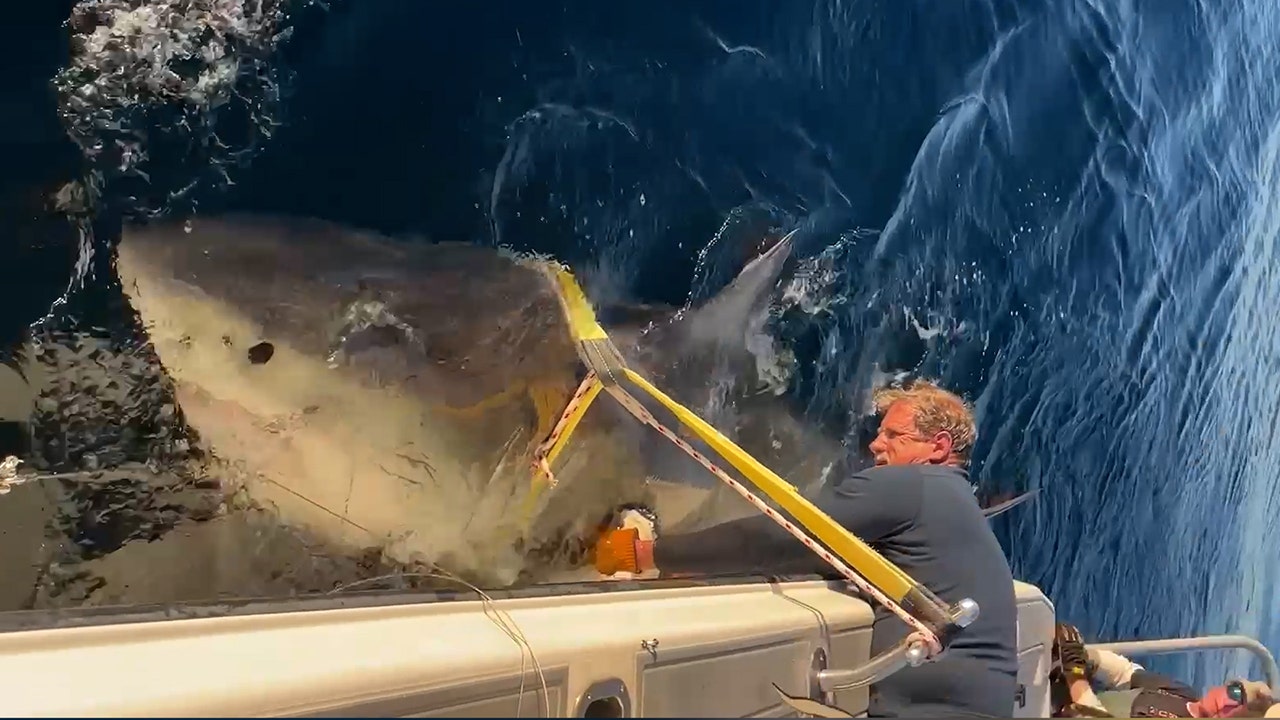
In a remarkable development for marine researchers, “Contender,” the Atlantic’s largest recorded male great white shark, has returned to Florida waters exactly one year after scientists first tagged him. This massive 14-foot, 1,700-pound predator, named after the Contender Boats company that supported the research, was initially tagged off the Florida-Georgia border on January 17, 2025. After completing one of the most extensive migrations ever documented for an Atlantic great white shark—traveling as far north as the Gulf of St. Lawrence in Canada before returning south—Contender’s movements are providing unprecedented insights into the mysterious lives of these ocean giants. The timing of his return to warmer coastal waters has particularly excited scientists, who believe it may coincide with the largely unknown mating season of great white sharks.
“Of the few clues we have, it seems like we need to be paying attention to the late winter and early spring area,” explained Chris Fischer, founder of OCEARCH, the marine research organization tracking Contender and other sharks. This statement highlights how little we still know about the reproductive habits of one of the ocean’s most iconic predators. OCEARCH has been meticulously following Contender’s journey using satellite technology that provides real-time data on his location and movement patterns. The SPOT tag attached to Contender is expected to function for approximately five years, offering researchers a lengthy window to study his behavior. Throughout his year-long journey, the shark has been recorded swimming near the coasts of New Jersey, Massachusetts (near Nantucket), North Carolina’s Outer Banks, and Jacksonville, Florida, demonstrating the remarkable range these animals cover in their annual migrations.
The scientific significance of Contender’s movements extends beyond simply mapping his travel route. Researchers are particularly interested in whether his return to Florida waters coincides with other tagged sharks, potentially revealing patterns related to mating behavior. “Most importantly, will there be other mature male white sharks like Bretton and mature female white sharks like Goodall and others that are in that similar region at the same time?” Fischer wondered. This question gets to the heart of one of the most persistent mysteries about great white sharks: when and where they reproduce. Despite decades of study, scientists have never documented great white sharks mating in the wild, making any potential clues from tracking data extremely valuable. The research team will be watching closely over the next 60 to 90 days to see if Contender’s movements suggest mating-related behavior.
OCEARCH’s approach to unraveling the secrets of great white shark reproduction goes beyond satellite tracking alone. The organization combines multiple research methods, including blood sampling and hormone analysis, to build a more complete picture of these animals’ reproductive cycles. The data collected from Contender and other tagged sharks like Breton and Goodall contributes to a growing understanding of great white shark behavior that could ultimately lead to better conservation measures. Great whites, though often portrayed as fearsome predators in popular culture, face numerous threats including habitat degradation, accidental catching in fishing gear (bycatch), and climate change impacts on ocean ecosystems. Understanding their reproductive patterns and critical habitats is essential for developing effective protection strategies.
Contender’s epic journey also serves as a powerful reminder of how mobile these animals are and how artificial national boundaries mean little in their oceanic world. In a single year, this shark traversed the waters of multiple states and countries, highlighting the need for international cooperation in marine conservation. The satellite tracking technology employed by OCEARCH allows researchers to follow these migrations in unprecedented detail, revealing how sharks navigate across vast distances and potentially respond to changing ocean conditions. This technology has revolutionized shark research, transforming our understanding of these animals from occasional sightings and sporadic data points to comprehensive movement maps that reveal seasonal patterns and potential breeding grounds.
As Fischer and his team at OCEARCH continue monitoring Contender’s movements in the coming months, the scientific community and ocean enthusiasts alike await new discoveries about great white shark behavior. “We all have our eyes on him over the next 60 to 90 days,” Fischer stated, emphasizing the potential importance of this period for understanding reproductive patterns. The story of Contender represents the cutting edge of marine science—where advanced tracking technology meets classic field biology to unveil the secrets of one of the ocean’s most mysterious inhabitants. What researchers learn from this magnificent animal could reshape our understanding of great white shark ecology and contribute to more effective conservation efforts for these vital ocean predators. Contender’s journey continues to write new chapters in our understanding of marine life, one ping of satellite data at a time, as he patrols the Atlantic coastline that has been his home for countless generations of his species.