





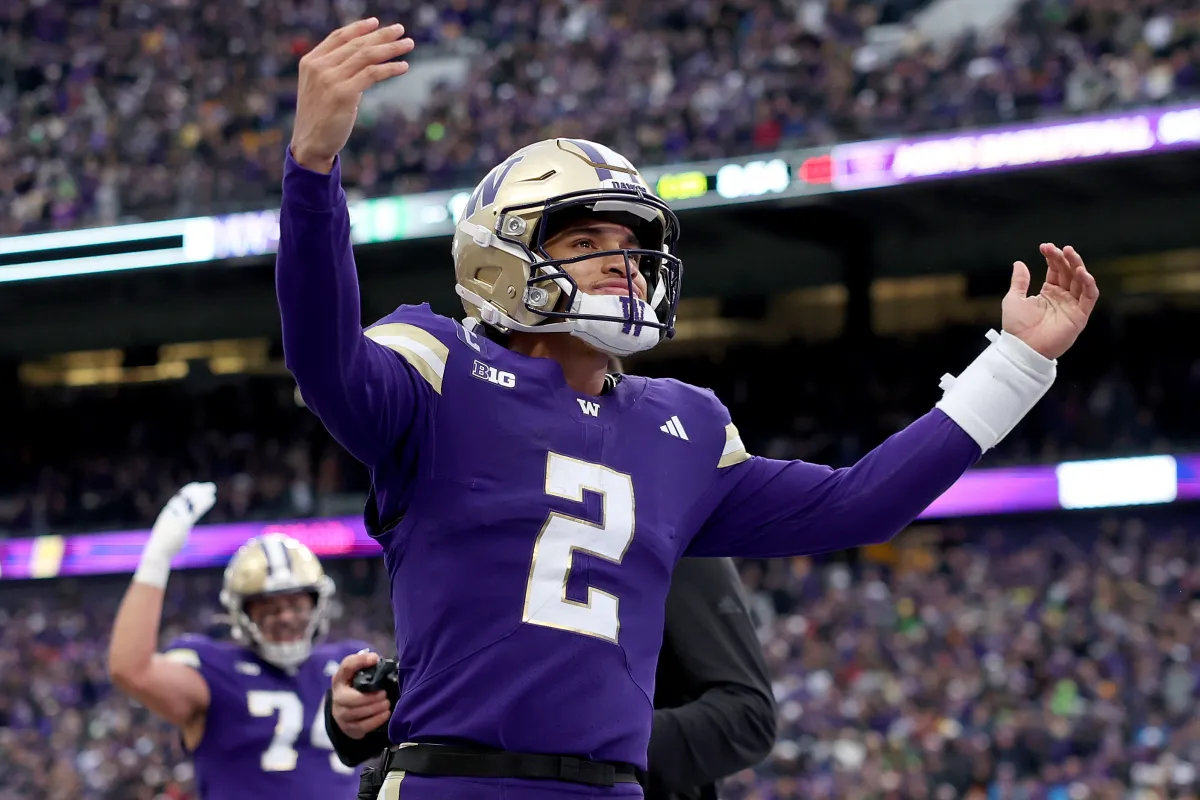
Quarterback Drama: Demond Williams Jr.’s Shocking Transfer Decision
In a stunning development that highlights the evolving landscape of college football, Washington quarterback Demond Williams Jr. has decided to enter the transfer portal despite recently signing a lucrative NIL (Name, Image, and Likeness) deal with the Huskies. This unexpected move sent shockwaves through the college football community, as Williams had seemingly committed his future to Washington through 2026. According to CBS Sports’ Matt Zenitz, “LSU is expected to be a team to watch as a possibility” for Williams’ next destination, setting the stage for what could be one of the more contentious transfer sagas in recent memory. The situation perfectly encapsulates the new reality of college athletics, where verbal commitments and even signed agreements don’t necessarily guarantee a player’s continued presence on a roster.
The LSU Tigers, now under the direction of Lane Kiffin, appear to be positioning themselves as frontrunners in the race to secure Williams’ services. Kiffin’s program has been actively searching for a quarterback to lead them into a new era, and Williams would represent a significant acquisition. There are clear parallels between Williams and Kiffin’s former quarterback Trinidad Chambliss, who developed into one of college football’s premier talents. LSU brings considerable financial resources to the table and has strong motivation to land a quarterback of Williams’ caliber, though the situation remains fluid with numerous competing factors at play. Williams’ playing style and potential fit in Kiffin’s offensive system make this a particularly intriguing possibility, should he ultimately decide to make the move to Baton Rouge.
The timeline of events makes this situation all the more remarkable. On January 2nd, respected college football reporter Pete Thamel announced via social media that “Washington quarterback Demond Williams has agreed to a new deal to return to the Huskies for 2026.” All indications suggested Williams was committed to continuing his development under head coach Jedd Fisch. However, in a dramatic reversal, Thamel reported Tuesday evening that the sophomore quarterback would indeed be entering the transfer portal. Adding another layer of complexity to the situation, Thamel noted that Williams’ portal entry would include a “do-not-contact tag,” suggesting a specific direction or limitation to his transfer process. This rapid about-face illustrates the sometimes chaotic nature of modern college athletics, where decisions that once seemed final can quickly be reconsidered.
The NIL era has fundamentally transformed college sports, creating an environment where the boundaries of contractual agreements are continuously tested and players exercise unprecedented freedom in determining their athletic futures. Williams’ situation exemplifies this new reality, as he appears to be backing away from a formally signed agreement in pursuit of what he believes best serves his interests and development as a player. This case is particularly notable because it involves a signed deal rather than merely a verbal commitment. According to Thamel’s reporting, the agreement Williams signed with Washington was “near the top of the market,” suggesting significant financial considerations are at play. The university’s response has been equally noteworthy, with Thamel reporting that “Washington sources say they are prepared to pursue all legal avenues to enforce Demond Williams’ signed contract,” setting the stage for a potential legal battle that could establish important precedents for similar situations in the future.
The implications of this situation extend far beyond Williams and Washington, potentially affecting how universities structure NIL deals going forward. The apparent tension between contractual obligations and player autonomy represents one of the central challenges of the current college athletics landscape. For Washington, losing Williams would be a significant blow to their quarterback depth chart and overall program trajectory, particularly after investing considerably in his development and financial compensation. For Williams, the decision likely reflects a complex calculation about his professional development, financial opportunities, competitive situations, and personal preferences. While outside observers might question the ethics of apparently reneging on a signed agreement, many within college sports recognize that players are increasingly approaching their careers with the same strategic mindset that coaches and administrators have long employed when making career decisions.
As this situation continues to unfold, it will be closely watched by stakeholders throughout college athletics. The potential legal battle between Washington and Williams could establish important precedents regarding the enforceability of NIL contracts and the limitations of player movement. For other quarterbacks in the transfer portal, Williams’ situation might influence their own decision-making processes and negotiations with prospective schools. Programs like LSU will need to carefully navigate the complex legal and ethical considerations while pursuing a talented player who may still have contractual obligations elsewhere. Regardless of the ultimate outcome, this case represents another significant chapter in college football’s ongoing transformation from its traditional model toward something more closely resembling professional sports in terms of player movement, compensation, and contractual relationships. The days of expecting unwavering loyalty from college athletes appear increasingly distant as players embrace their newfound agency in shaping their athletic careers.