




Thailand and Cambodia’s Military Standoff: Analyzing the Balance of Power in a Renewed Border Conflict
The recent flare-up of hostilities between Thailand and Cambodia along their disputed border has reignited concerns about regional stability in Southeast Asia. Less than two months after a ceasefire brokered by former U.S. President Donald Trump, both nations have accused each other of violations, leading to Thai airstrikes and forcing tens of thousands of civilians to flee their homes. The conflict has revealed a significant imbalance in military capabilities between the two neighboring countries. Thailand, with the 25th largest military globally according to Global Firepower’s 2025 assessment, enjoys substantial advantages over Cambodia, ranked 95th. This disparity extends across personnel numbers, equipment sophistication, and defense budgets, suggesting that any prolonged conflict would heavily favor Thailand. Despite these imbalances, the localized nature of the fighting indicates both sides may be attempting to limit the scope of hostilities while asserting territorial claims over disputed border regions.
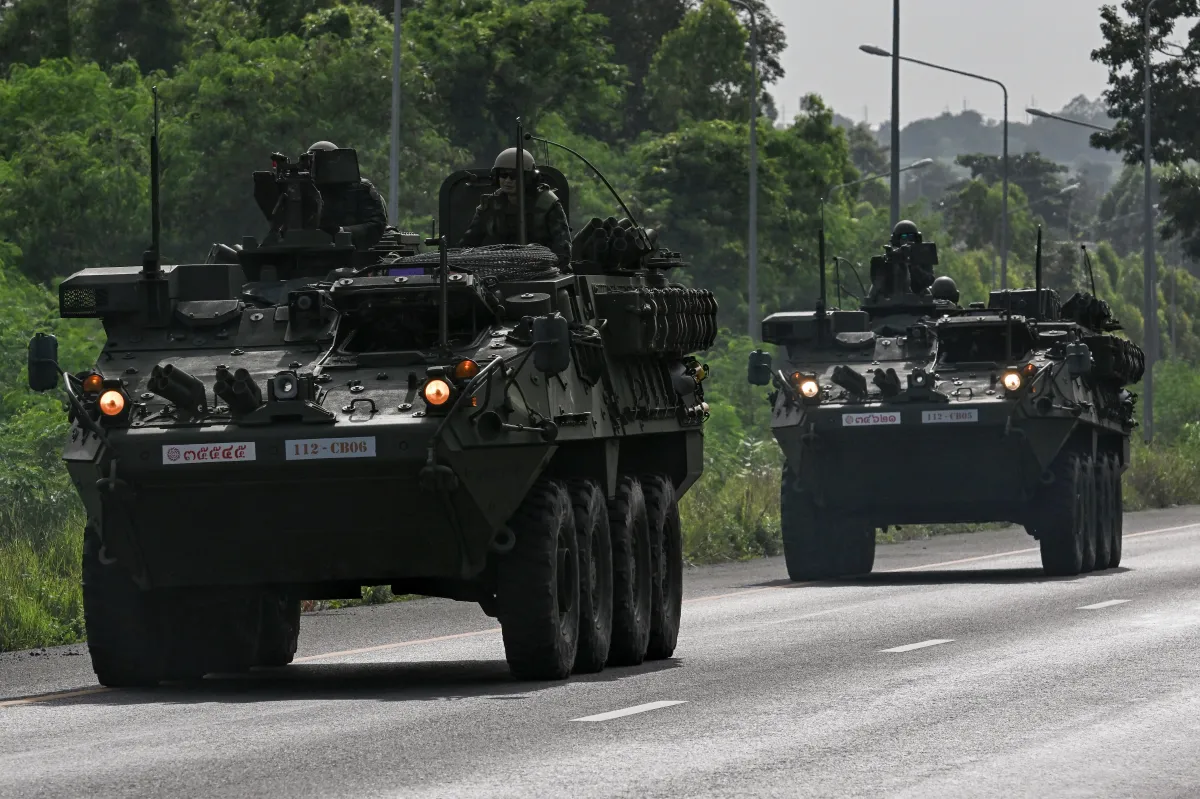
Thailand’s military dominance is evident across multiple metrics, beginning with its personnel strength of 585,850 (including 360,850 active-duty soldiers, 200,000 reserves, and 25,000 paramilitary forces)—more than twice Cambodia’s total of 231,000 military personnel. Even more striking is Thailand’s defense budget of approximately $5.89 billion, which dwarfs Cambodia’s $860 million allocation by more than seven times. This financial advantage translates directly into Thailand’s superior air power and modernized equipment. While Cambodia maintains a slight edge in the number of tanks (644 to Thailand’s 635), Thailand possesses substantially more armored fighting vehicles (16,935 compared to Cambodia’s 3,627) and enjoys overwhelming air superiority with 493 military aircraft to Cambodia’s mere 25. The Royal Thai Armed Forces operate modern fighter jets including F-16s and Saab Gripens, alongside transport aircraft and helicopters, while Cambodia lacks modern fighters or strike platforms, relying primarily on a small number of transport aircraft and helicopters.
Cambodia’s military strategy appears to reflect its resource limitations and historical relationships. The country has benefited from Chinese military assistance in recent years, which has helped upgrade some equipment, but much of its arsenal still consists of older Soviet-era weaponry and basic infantry systems. Cambodia’s advantage in rocket projectors (463 compared to Thailand’s 26) suggests a focus on artillery and ground-based firepower rather than advanced air or naval capabilities. Military Power Rankings, a defense analysis website, characterizes Cambodia’s military priorities as regime protection, rural stability, and defense cooperation with Beijing and other ASEAN countries. By contrast, Thailand’s military focus encompasses territorial defense, internal stability, and regional deterrence, though analysts note that despite its extensive manpower and resources, Thailand suffers from procurement delays and platform obsolescence in some areas.
The current conflict dynamics reflect these military disparities. Anugya Chitransh, Lead Security Analyst for Southeast Asia at security firm International SOS, told Newsweek that Thailand is likely to conduct more precision airstrikes against Cambodian military targets, leveraging its superior air power, while Cambodia will primarily rely on its ground forces and artillery capabilities. Thai newspaper The Nation highlighted Thailand’s “more extensive and technologically advanced military” compared to Cambodia’s focus on ground-based firepower. Both nations are attempting to restrict artillery shelling and fighting to disputed sites in specific provinces—Ubon Ratchathani, Sisaket, and Sa Kaeo in Thailand, and Preah Vihear, Oddar Meanchey, and Banteay Meanchey in Cambodia—though analysts warn that peripheral impact on nearby villages remains highly possible given their proximity to the international border.
The human toll of the renewed conflict is already mounting. Cambodia’s government reports seven civilians killed and 20 injured, while Thailand acknowledges at least three soldier fatalities. The resumption of hostilities has prompted tens of thousands of people on both sides of the border to flee their homes, raising humanitarian concerns. The White House issued a statement emphasizing that “President Trump is committed to the continued cessation of violence and expects the governments of Cambodia and Thailand to fully honor their commitments to end this conflict,” highlighting international interest in preventing further escalation. While there is currently no indication of an all-out war developing between the two nations, the situation remains volatile and has raised concerns about broader security implications for the region.
Despite the clear military advantage Thailand holds, several factors may constrain the conflict’s escalation. Both nations are members of ASEAN (Association of Southeast Asian Nations), which emphasizes regional cooperation and conflict resolution through dialogue. Additionally, Cambodia’s close relationship with China introduces a potential diplomatic complication for Thailand. The localized nature of the fighting suggests both sides may be pursuing limited objectives rather than broader military confrontation. Nevertheless, as artillery exchanges continue and airstrikes target border positions, the risks of miscalculation or unintended escalation remain significant. The situation underscores the persistent challenge of unresolved territorial disputes in Southeast Asia, where historical grievances and strategic interests can quickly transform border tensions into armed conflicts with serious humanitarian consequences.