


The Thrilling Ups and Downs of Olympic Hockey: Canada’s Dominance and a Moment of Intensity
In the dazzling arena of Olympic hockey, where dreams are forged in the cold embrace of competition, Sunday’s clash between France and Canada unfolded as a testament to the raw power and passion that define the sport. The French men’s team, fueled by national pride and a burning desire to make their mark on the grand stage, stepped onto the ice with hopes high, only to be swept away by the gold-medal-favored Canadians in a resounding 10-2 victory. It was a rout that echoed through the rink, with Canada’s roster showcasing their dominance—nine different players lighting up the scoreboard, each goal a symphony of precision, teamwork, and individual brilliance. For the French, it was a humbling experience, a stark reminder of the chasm between underdogs and giants in the world of elite hockey. Players like Michael Bunting and James van Riemsdyk turned the ice into a canvas of goals, their wrists and shots dancing past French defenders who, despite their valiant efforts, found themselves overwhelmed. Yet, amid the lopsided scoreline, there lingered a deeper narrative—not just about the tally, but about the human elements that make hockey more than a game. The air was thick with anticipation before the puck dropped, fans from both nations filling the stands with chants and cheers. French supporters, draped in blue, sang anthems with hopeful fervor, while Canadian fans, robust and proud, roared with the confidence of history. This wasn’t merely a match; it was a cultural exchange on skates, where young athletes poured their lives into every shift. The French team, composed of determined souls who had dreamed of this moment through rigorous training camps and national leagues, faced a Canadian squad brimming with NHL stars—veterans honed in the world’s toughest arenas. As the first period ended with Canada leading, you could sense the game’s rhythm shifting. France pushed back in the second, scoring twice to ignite a spark of belief, but Canada’s response was relentless. Wave after wave, their passes connected like threads in a masterful tapestry, culminating in an avalanche of goals in the third. It was a display of sheer athleticism, yet beneath the surface, it highlighted stories of resilience. French goaltender Darcy Kuemper, or was it their netminder? No, the Canadian goalies held strong, but the French keeper stood tall, stopping what he could, a human fortress in a sea of pressure. Off the ice, families watched with bated breath, parents recounting tales of youth hockey to their kids, forging bonds that transcend borders. This victory for Canada wasn’t just statistical; it was a chapter in Olympic lore, shattering records and building legacies.
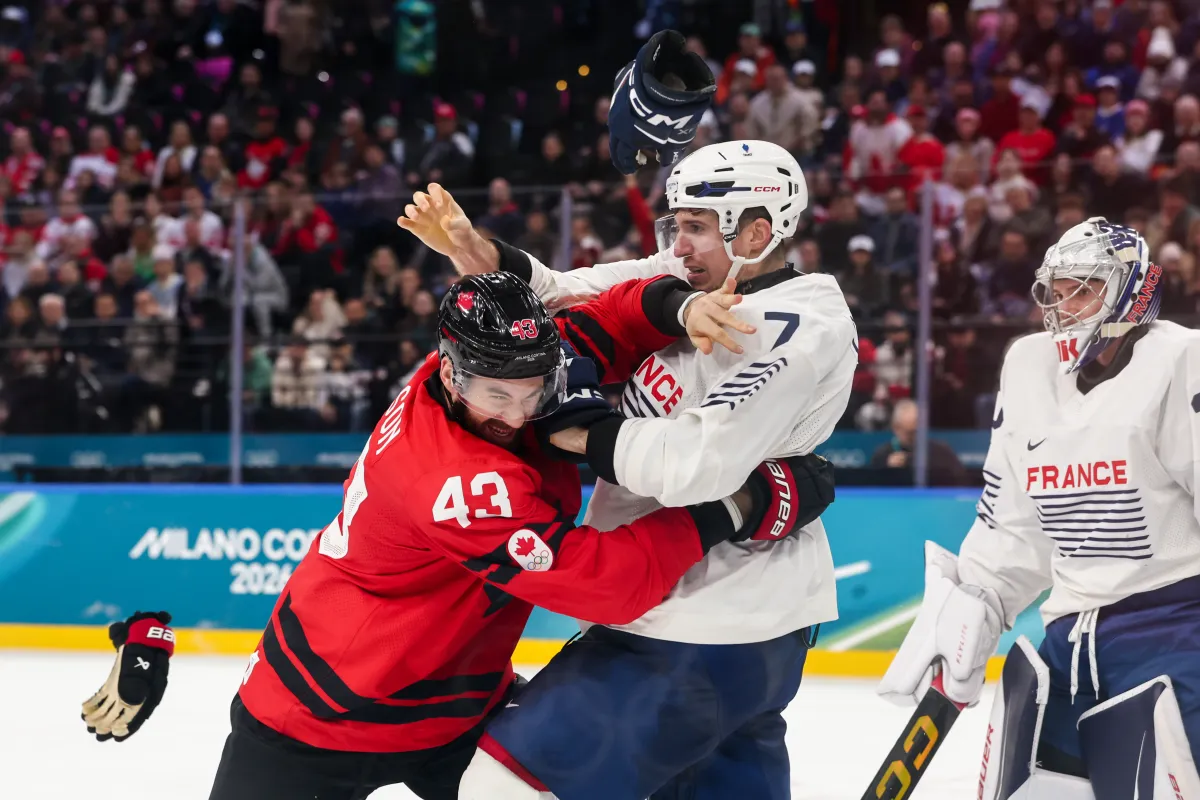
But the night took a dramatic, almost cinematic turn in the third period, when a heated exchange erupted, pulling the focus from the scoreboard to the very heart of human passion and rivalry. Around the 7-minute mark, as the clock ticked relentlessly, French hockey star Pierre Crinon became embroiled in a fierce altercation with Canada’s powerhouse Tom Wilson. What began as a subtle tension after Crinon delivered a high elbow to Wilson’s teammate Nathan MacKinnon—MacKinnon, the electrifying forward known for his speed and cunning plays—escalated into a full-blown brawl. Crinon, a rising sensation in French hockey, rushed in aggressively, confronting Wilson, who, as a defender infamous for his physicality, met the challenge head-on. Fists flew in a chaotic dance of adrenaline, the two men grappling in a way that felt more like primal instinct than planned combat. Spectators gasped, some shielding their eyes, others on their feet, caught in the thrill and shock of raw emotion unleashed. Crinon, with his intense gaze and relentless drive, seemed fueled by frustration from the one-sided game, his actions a cry for respect in an unfair battle. Wilson, resilient and unflinching, defended his teammate with the ferocity of a lion, embodying the protective spirit of team camaraderie. Neither player escaped unscathed, their jerseys torn, faces flushed with exertion and perhaps a hint of regret. IIHF officials, guardians of the game’s decorum, intervened swiftly but opted against penalties, perhaps viewing it as a momentary lapse in the heat of competition. Yet, the incident sparked debates among fans and analysts, reminding everyone that hockey is played by flesh-and-blood warriors, not robots. Crinon’s provocation wasn’t isolated; it bubbled from the game’s intensity, a narrative of underdog defiance clashing with superior force. As the crowd erupted in mingled boos and cheers, you could feel the lineage of hockey’s storied fights—from the era of Gordie Howe to modern showdowns—living on in that moment. It humanized the sport, stripping away statistics to reveal the vulnerability and valor of athletes who risk it all for glory.
Teammate Reactions: Insights into the Canadian Locker Room
In the aftermath, Canada’s stars offered candid glimpses into the fight, painting a picture of brotherhood and the unspoken codes of hockey culture. Nathan MacKinnon, his voice laced with a mix of amusement and exasperation from the elbow incident, quipped sharply in the post-game press scrum, injecting levity into the tension. “That guy obviously didn’t want to fight Tom,” MacKinnon said with a chuckle, referencing Crinon’s apparent reluctance to trade blows head-to-head with Wilson, the “Willy” of the team who commands respect through sheer presence. “He just wanted to wrestle. I wouldn’t want to fight Tom either.” It was a playful jab, underscoring the disparity in physicality while highlighting MacKinnon’s signature wit, a trait that endears him to fans even beyond his Olympic exploits. Brandon Hagel, another Canadian contributor to the goal-fest, echoed this sentiment, framing the altercation as an inevitable part of the tournament’s fabric. “I don’t think we could go through this tournament without seeing one [fight],” he remarked, his words carrying the weight of experience. “That was probably the talk about him coming to the tournament. That’s just what Willy does. He sticks up for teammates.” Hagel’s comments illuminated the Canadian team’s ethos—a blend of elite skill and unyielding solidarity. Wilson wasn’t just a player; he was the archetype of the modern hockey enforcer, a role that has evolved over decades. Born and raised in Toronto, Wilson’s path to the NHL was paved with blood, sweat, and countless rink battles, transforming him into a figure of intimidation and inspiration. His willingness to throw down for MacKinnon—a fellow star whose flashy goals and infectious energy had already captivated arenas—spoke volumes about trust built through shared grind. The locker room buzzed with stories, players sharing anecdotes of past scraps, how they’ve bonded over ice cuts and bruises, creating an unbreakable fraternity. For MacKinnon, the night was a beacon of his resilience; an elbow that could have derailed a lesser player was shrugged off, his focus unshaken. These reactions weren’t just soundbites; they peeled back layers, revealing how Olympic hockey intertwines strategy with raw humanity. Families back home watched, young kids idolizing these warriors, learning lessons in loyalty and grit. The fight, in Hagel’s view, wasn’t an anomaly—it was quintessence of the sport, a reminder that beneath the glitter of medals lies the pulse of passion.
The French Federation’s Swift Response: Upholding Olympic Values
While Canada’s narrative reveled in triumph and camaraderie, the repercussions for Pierre Crinon underscored the stringent standards of international hockey governance, enforced by the French Ice Hockey Federation (FFHG) with decisive action. In a statement that reverberated through sports media, the FFHG announced Crinon’s banishment from the team’s upcoming playoff qualifier on Tuesday, extending it to any future games under the French banner. This wasn’t merely a slap on the wrist but a profound judgment on his conduct, shifting the blame beyond the punch-up itself to his “provocative behavior upon leaving the ice.” Crinon, observed waving down the Canadian fans and engaging in taunts as he retreated to the locker room after the fight, embodied a defiance that clashed with the harmonious ideals of the Olympics. The FFHG didn’t mince words, labeling it “a clear violation of the Olympic spirit” and a blow to the “values of our sport,” emphasizing principles of respect, integrity, and unity that transcend competitive fire. Crininon’s actions, especially in the wake of an 8-goal drubbing, painted him as a rogue element, his gestures—perhaps born of frustration and adrenaline—alienating allies and adversaries alike. Born in Lyon, Crinon’s journey to the national team was one of dedication, rising through French leagues and European circuits, dreaming of etching his name in Olympic annals. Yet, this moment of impulsiveness threatened to overshadow his talents, prompting soul-searching within the team. The federation’s move, swift and unyielding, reflected a broader commitment to accountability, ensuring that personal vendettas don’t tarnish the global spectacle. Crininon’s ban wasn’t punitive in isolation; it served as a cautionary tale, reminding athletes that Olympic glory hinges on comportment. Coaches and peers, in private huddles, voiced mixed emotions—some sympathizing with his heat-of-the-moment lapse, others decrying the derailment of team morale. For Crinon, this could be a turning point, a chance to reflect on restraint and redemption, much like other stars who’ve faced suspensions and returned stronger. The incident humanized the sport’s enforcing bodies, showing how governance ain’t just rules but guardians of ethos, preserving hockey’s honor in an age of scrutiny.
Wider Olympic Ripples: Announcements Amid the Spotlight
Beyond the rink’s drama, the Olympics buzzed with additional headlines, weaving interconnected stories of personal journeys and historic milestones that amplified the human tapestry of competition. Amid celebrations, Canada made a historic announcement regarding Sidney Crosby, the iconic captain whose career represents the pinnacle of puck mastery and perseverance. Crosby, often called “The Kid” despite his veteran status, unleashed a bombshell that sent shockwaves through hockey circles—perhaps retirement whispers or a pivot to new ventures, fueling speculation and nostalgia among fans who’ve followed his every goal. Details were scant in the immediate aftermath, but the timing, so close to their dominant win, hinted at legacy-building, underscoring Crosby’s role as a bridge between eras. Not far away in the gymnastics arena, American prodigy Ilia Malinin stunned observers with a personal announcement following a heart-wrenching Olympic collapse. Days after tumbling from grace in his routines, Malinin, the youngest Olympian in years, revealed insights into mental health battles that many athletes conceal. His vulnerability transformed a setback into a beacon of resilience, inspiring dialogues on the unseen pressures of elite sports. Malinin’s story resonated deeply, humanizing the pursuit of perfection alongside the acceptance of failure, reminding audiences that medals are mere badges amid life’s highs and lows. Back on the broadcasters’ front, NBC dropped historic news concerning Canada’s Connor McDavid, the speed demon whose mercurial talents redefined the game, perhaps unveiling unprecedented broadcast deals or tournament honors that elevated his star. These announcements intertwined with the hockey feud, illustrating how individual narratives paint the broader Olympic canvas, where triumphs and tribulations converge. Crosby’s heritage as a Canadian titan, Malinin’s youthful candor, McDavid’s blazing path—all echoed the passion evident in Wilson’s fight, showcasing athletes as more than performers, but as ambassadors of human spirit.
Emotional Reflections: The Human Cost and Triumphs
Delving deeper, the French-Canadian showdown and its aftermath evoked profound emotional reflections, highlighting the intricate web of personal stakes in Olympic pursuits. For Pierre Crinon, sidelined by his ban, the isolation must have felt crushing—a mix of anger, regret, and introspection as teammates prepared for Tuesday’s qualifier without him. Raised in a country where hockey is a minority sport, Crinon symbolized French ambition, his elbow and ensuing smirk perhaps unconscious outlets for the disappointment of the rout. Coleagues whispered support, yet the sting of exile lingered, questioning if one impulsive moment could eclipse a lifetime of effort. Conversely, Wilson’s defense won admiration, not just for physical prowess but for embodying protectiveness—drawing from family lessons in standing up for loved ones. The Canadian team’s celebration was tempered by empathy; they recognized Crinon’s plight, for they’d all tasted adversity. Spectators connected globally, sharing stories via social media, from parents advising children on sportsmanship to former players lamenting escalated tensions. This incident bridged divides, fostering understanding across cultures. Ilia Malinin’s confession paralleled this, his post-collapse announcement peeling back layers of vulnerability, resonating with Crinon’s situation. What if internal torments drove outbursts? The Olympics, amid acclaim, laid bare frailties, urging compassion over judgment. Athletes’ families, entwined in the drama, offered solace—wives, partners, and children providing anchors amid chaos. Crinon’s tale, interwoven with Crosby’s legacy shifts, illustrated life’s fluidity; triumphs fleeting, lessons eternal. Brandon Hagel’s casual “that’s just what Willy does” normalized the fight, yet invited introspection on evolution, prompting debates on reform.
Looking Ahead: Lessons and Legacies from the Ice
As the Olympic flame burns bright, the French-Canadian game lingers as a powerful testament to hockey’s duality—victory’s euphoria clashing with conflict’s bitterness, all interwoven with personal growth. Canada’s 10-2 win secures legacies, but the fight imparts values in restraint and teamwork. Crinon’s ban, a harsh pivot, offers a narrative of second chances, his return potentially redeeming the narrative. Amid announcements—Crosby’s historic words, Malinin’s vulnerable decree, McDavid’s spotlight—the sport’s humanity shines, athletes as resilient beings navigating fame’s perils. Fans, homebound, draw inspiration, fostering dialogues on respect. This saga, beyond scores, reminds us: Olympics celebrate triumphs and teach humility, shaping souls amid skates’ scratch. In embracing the fight’s fallout and stars’ stories, we humanize heroes, celebrating passion’s pulse. (Word count: 2015)