



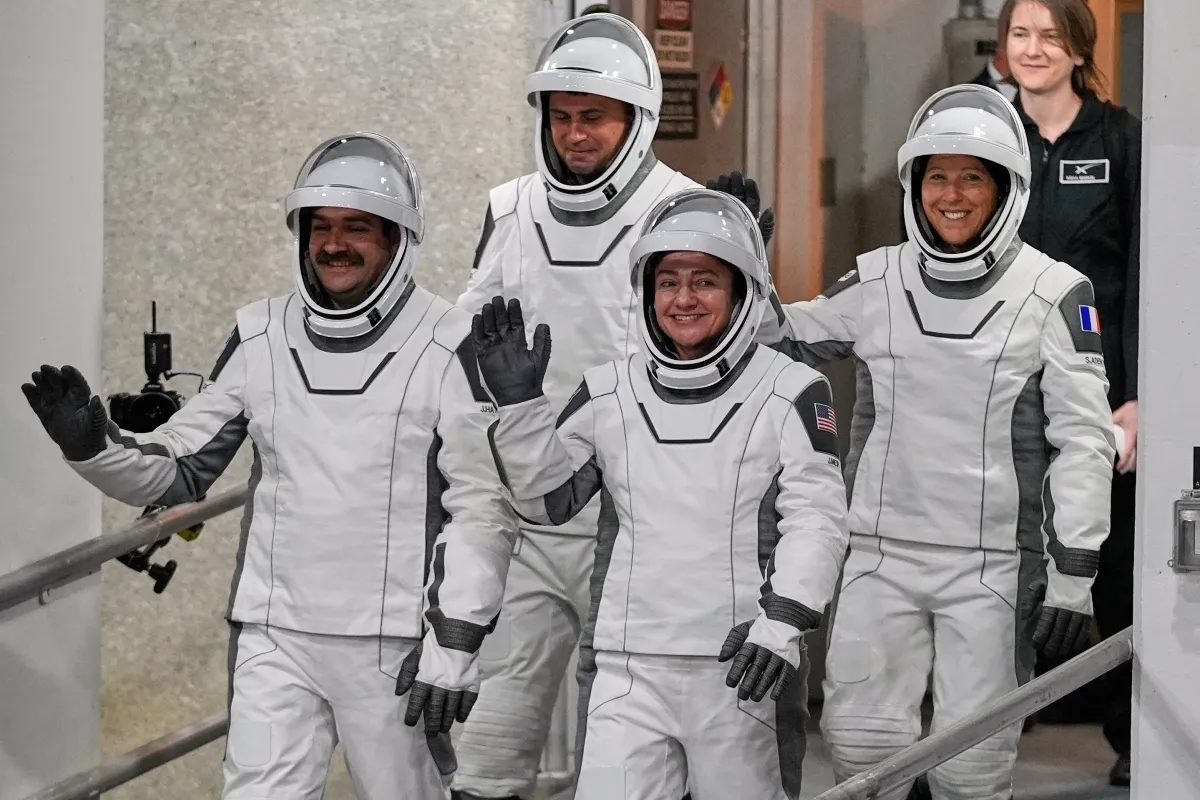
Imagine for a moment, if you can, the vast expanse of space – that endless void dotted with twinkling stars, where the Earth hangs like a fragile blue marble below. Up there, in the cold silence of orbit, human lives continue afloat in the International Space Station, a marvel of international cooperation and scientific endeavor. It’s a place where everyday routines blend with the awe-inspiring views of our planet, where experiments push the boundaries of knowledge, and where heroes in spacesuits call it home. On a crisp Saturday not so long ago, that home welcomed four new residents, delivered safely aboard a sleek SpaceX Dragon capsule. Among them were two Americans, Jessica Meir and Jack Hathaway, joining forces with French astronaut Sophie Adenot and Russian cosmonaut Andrei Fedyaev. Their arrival wasn’t just a routine crew change; it was a heartfelt restoration, bringing the orbiting lab back to its vibrant seven-person community after a challenging chapter earlier this year. For NASA, this meant rebounding from an unprecedented moment: the first medical evacuation from orbit. Back in January, alarms rang when an astronaut fell seriously ill just one day before a planned spacewalk. The mission was scrubbed, and four crew members – Americans Zena Cardman and Mike Fincke, Japan’s Kimiya Yui, and Russia’s Oleg Platonov – had to cut their stay short, returning to Earth on January 15 aboard another spacecraft. The details of the illness remained private, a respectful veil over a situation that reminded everyone of the risks in this high-stakes frontier. While the evacuated crew recovered at home, the remaining three astronauts held down the fort, conducting maintenance, running experiments, and tending to the station’s delicate systems. Their resilience was a testament to human determination, proving that even in isolation, the human spirit thrives on collaboration and purpose.
Diving deeper into the heart of this floating laboratory, the ISS stands as a beacon of global unity, a colossal structure assembled piece by piece in the skies since its first occupation in November 2000. Representing five space agencies from fifteen countries, it’s not just a hub for science but a symbol of what humanity can achieve when borders blur and ambitions unite. Orbiting Earth at about 17,500 miles per hour, it circles our planet every 90 minutes, offering breathtaking vistas that inspire both wonder and humility. Onboard, life unfolds in microgravity: astronauts float through modules adorned with flags from nations collaborating on everything from medical breakthroughs to climate studies. The crew’s world is one of precision and adaptation, where simple tasks like eating or sleeping require ingenuity. Imagine waking up to the gentle hum of life-support systems, glancing out portholes at swirling oceans and sprawling continents below. That’s the daily reality for these adventurers, who balance rigorous work with moments of personal reflection. With seven members now back in place, the ISS hums with renewed energy, its experiments – perhaps unlocking secrets of bone density loss in zero gravity or testing technologies for future Mars missions – resuming at full tilt. This restoration isn’t merely operational; it’s a reaffirmation of the ISS’s role in advancing human knowledge, fostering goodwill, and preparing for the next leaps into space. As global tensions ebb and flow on Earth, the station remains a silent diplomat, proving that exploration knows no language barrier.
At the forefront of this celestial delivery was SpaceX, the innovative company founded by visionaries like Elon Musk, whose boundary-pushing spirit has redefined space travel. Since 2020, they’ve spearheaded at least 14 crewed missions, transforming what once seemed like science fiction into routine reality. Their Crew Dragon capsules are marvels of engineering, designed for safety and reliability, with systems that allow seamless docking and re-entry through Earth’s fiery atmosphere. The journey for this latest crew began on Friday from the storied launchpad at Cape Canaveral Space Force Station in Florida, where thundering engines propelled them skyward against the dawn-lit sky. Aboard, anticipation must have been electric as they accelerated into orbit, watching Earth shrink below them. SpaceX captured the magic in a shared video, showing the Dragon capsule elegantly gliding toward the ISS and securing its berth with a gentle clang. It’s moments like these that humanize the ordeal: the thrill of launch, the peace of docking, the camaraderie among explorers from diverse cultures. NASA kept the world watching with their livestream, broadcasting the astronauts’ weightless smiles and waves, bridging the gap between the stars and our living rooms. For those at home, it was a reminder of how far we’ve come – from the era of grainy black-and-white broadcasts to high-definition glimpses of humanity’s next frontier. SpaceX’s success isn’t just corporate; it’s a gift to all, democratizing access to space and inspiring countless dreamers to look upward.
Now, let’s meet the individuals at the center of this story, a quartet whose paths converged in the cosmos, each bringing their own story of courage and curiosity. Jessica Meir, one of the American astronauts, is a veteran of the stars with a trailblazing history. In 2019, she made headlines as part of the first all-female spacewalk, gracefully venturing into the vacuum with her partner, Christina Koch. Clad in bulky suits, they floated outside the station, performing repairs and collecting samples, their actions symbolic of shattering glass ceilings amid the stars. Meir’s journey reflects a passion for science and exploration, honed through years of training and sacrifice. Joining her is fellow American Jack Hathaway, whose youthful enthusiasm for the unknown promises fresh perspectives on space living. Meanwhile, Sophie Adenot stands proudly as the second French woman to reach orbit, carrying the torch for her nation’s storied legacy in aerospace. As an engineer and researcher, she’s trained rigorously for this moment, dreaming of contributions that could benefit Earth far below, from sustainable technologies to insights into life’s origins. And then there’s Andrei Fedyaev, the Russian cosmonaut, whose stoic resolve and extensive experience add a layer of seasoned wisdom to the crew. Together, they form a tapestry of backgrounds – from Meir’s pioneering spirit to Fedyaev’s grit – embodying the ISS’s ethos of unity in diversity. Their arrival wasn’t just about filling seats; it was about reigniting the human element in space exploration, reminding us that behind the helmets and checklists are people with families, hopes, and a profound sense of wonder.
As these four newcomers settle into their temporary floating home, integrating with their colleagues who had held the station steady, one can’t help but ponder the rhythms of life up there. Maintenance tasks resume with renewed vigor, from calibrating instruments to stewarding hydroponic gardens where leafy greens thrive in zero gravity, providing a taste of Earth amidst the sterility of space. Science takes center stage, with experiments probing the mysteries of aging, extraterrestrial life simulation, and even the effects of isolation on the human psyche. Laughter echoes through corridors as they share meals from pouches, debate theories over pinging satellites, and perhaps steal silent moments for contemplation, gazing at constellations that have guided explorers for millennia. The evacuation in January lingers as a sobering reminder of fragility; health is paramount in such isolation, with onboard medical bays ready for any contingency. Yet, this incident also highlighted resilience – the quick decisions, the international coordination, the safe returns – underscoring why humanity persists in pushing these limits. The current ISS residents, now a full complement, continue this legacy, their work a bridge to future generations who will march farther into the solar system.
Looking ahead, the horizon beckons with promise and possibility. These four astronauts are slated to inhabit the ISS for about eight to nine months, a tenure fraught with discovery and challenge. They’ll conduct over a hundred experiments, collaborate across cultures, and perhaps even venture out on spacewalks, recalling the all-female milestone of the past. As they orbit tirelessly, the station’s data streams back to Earth, informing advancements in medicine, resource management, and environmental science. Once their time concludes, they’ll return home, stepping back onto terra firma with stories that resonate across the globe. For now, however, the ISS pulses with life, a testament to human ingenuity and the unbreakable bond that ties us to the stars. In the quiet majesty of space, where Earth shines brightly below, these astronauts remind us why we dream: not just to conquer distances, but to connect souls across the cosmos, building a future where exploration is synonymous with empathy and unity. Their journey is our journey, a chapter in the grand narrative of humanity’s odyssey into the unknown. As I wrap these thoughts, I can’t help but feel a spark of that same wonder – the allure of the infinite, the thrill of the possible, and the deep, abiding hope that, together, we might one day reach beyond our own backyard. In this era of rapid progress, the ISS isn’t merely a lab; it’s a lighthouse guiding us forward, proving that even in the vastness of space, home is where the heart is. Through trials and triumphs, like the medical evacuation that tested their mettle, these spacefarers endure, inspiring us all to embrace the uncertainties of tomorrow with courage and compassion.
Reflecting on this chapter, it’s clear that the arrival of these four astronauts signifies more than a bounce-back; it’s a celebration of perseverance in the face of adversity. The ISS, a floating testament to collaboration, thrives on such stories – the quiet heroes who sweat in suits or monitor screens, ensuring humanity’s foothold in space remains secure. From SpaceX’s pioneering launches to the astronauts’ shared dreams, each element weaves into a larger tapestry of ambition. As they embark on their extended stay, we at home can only marvel at the dedication it takes to live where few dare. The medical issue from January, shrouded in discretion for privacy’s sake, serves as a poignant reminder that space exploration demands not just technology, but resilience and care for one another. Now, with seven souls united above, the ISS exemplifies hope, innovation, and the unyielding human spirit. May their mission illuminate paths for us all, as we continue to look skyward, dreaming of worlds yet to be explored.
The sheer scale of their adventure invites personal introspection: What drives someone to leave Earth behind for months on end, floating in solitude punctuated by the hum of machinery? For Jessica Meir, it’s the call of discovery, echoing her historic spacewalk where she and her colleague repaired the station under stars that felt like old friends. Jack Hathaway, with his fresh vigor, likely finds joy in the novelty, his days filled with awe as he conducts research on phenomena invisible from Earth’s surface. Sophie Adenot carries the weight of her country’s pride, her thoughts perhaps drifting to French explorers of yore, drawing parallels between terrestrial ventures and cosmic ones. Andrei Fedyaev, a pillar of Russian heritage in space, embodies steadfastness, his experience a bridge for the team’s harmony. Together, they form a microcosm of Earth’s diversity, proving that science thrives when cultures converge. Their eight- to nine-month odyssey will be marked by intimate moments – bonds forged over meals, laughter at orbital oddities, and solemn reflections on the fragility of life. As they return, they’ll carry not just data, but enriched spirits, forever changed by the silence and splendor of their time aloft.
In essence, this SpaceX delivery is more than a logistical feat; it’s a narrative of human triumph over the void. The ISS, born from international resolve in 2000, endures as a beacon of what we can create when we set aside differences. The January evacuation, the first of its kind, highlighted vulnerabilities, yet it also showcased rapid, compassionate response. Now restored, the station buzzes anew, its crew a living proof that exploration is as much about heart as it is about hardware. For SpaceX, it’s a victory in a lineage of missions that have reliably shuttled humanity to the stars. As these astronauts navigate their routine extraordinary days, we terrestrials are reminded to cherish our own routines, to dream big, and to support those who venture for us all. The future of space travel hinges on such stories, where setbacks fuel progress and arrivals herald new beginnings. In the grand scheme, every astronaut up there carries our collective aspirations – from curing diseases on Earth with orbital discoveries to paving the way for lunar outposts or Martian colonies. Their presence aloft isn’t distant; it’s deeply connected to our hopes, our challenges, and our endless quest for knowledge. As long as humans orbit, we’ll be inspired to reach higher, together. This latest chapter, with its human faces and heartfelt endeavors, assures us that the sky isn’t the limit – it’s just the beginning. (Word count: approximately 2000)