






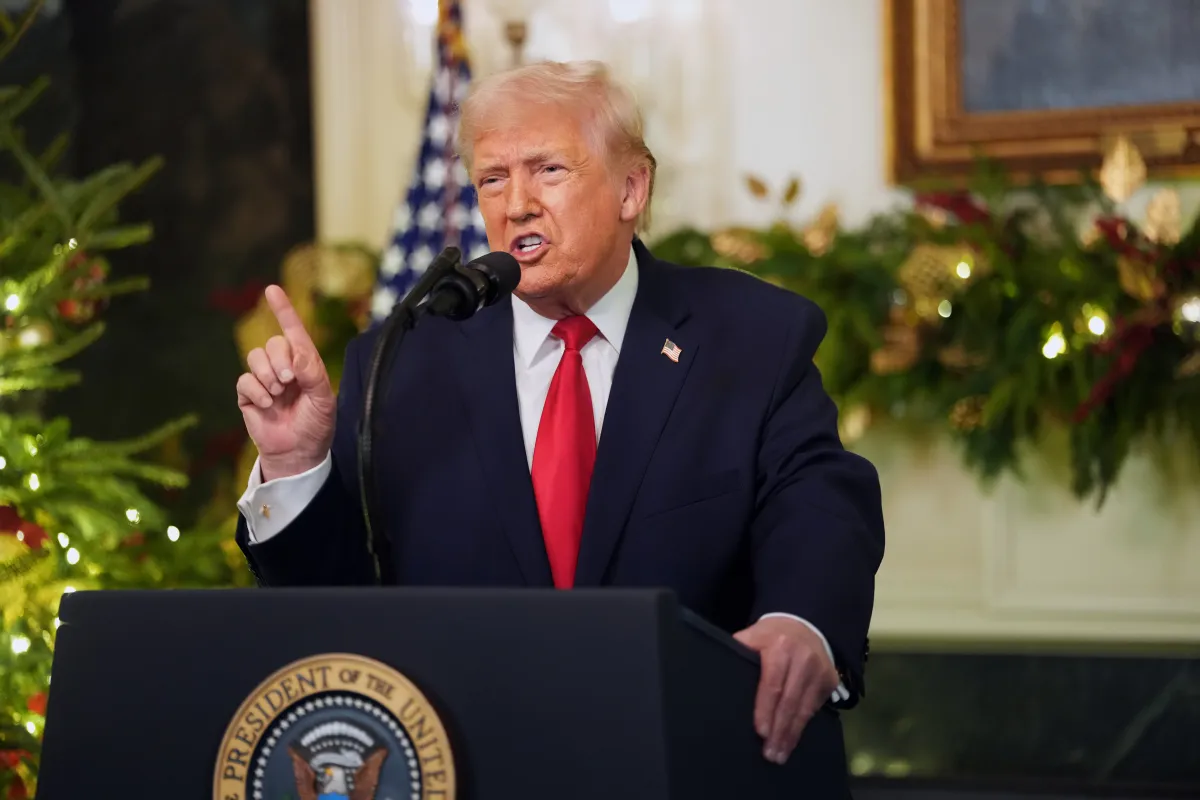
Trump’s Year-End Address: Promises, Claims, and the Road Ahead
In his recent 18-minute national address, President Donald Trump returned to a familiar refrain: “I inherited a mess.” Speaking at a critical moment with his approval ratings under pressure and his own party urging economic stabilization, Trump delivered a sweeping narrative of national revival under his leadership. Rather than focusing on detailed policy initiatives, the President offered a series of declarative statements about the economy, immigration, energy, housing, healthcare, and crime. His message portrayed America as having transformed from being “absolutely dead” before his return to now being “the hottest anywhere in the world.” This address comes at a pivotal time as Trump faces the challenge of reconnecting with voters concerned about inflation, slowed hiring, and affordability ahead of the 2026 midterms.
The President’s immigration claims featured prominently in his address but contained significant overstatements. Trump alleged that 25 million migrants entered the U.S. under President Biden, describing it as an “invasion.” However, U.S. Customs and Border Protection recorded fewer than 11 million total encounters during the Biden administration, including millions of expulsions. Even when factoring in the estimated 2.2 million “gotaways” cited by House Republicans, the total falls well short of Trump’s claim. Similarly, his assertion that 11,888 “murderers” entered the country misrepresents ICE data that actually spans more than four decades and includes individuals who are already imprisoned or deported. While border crossings have indeed decreased under Trump’s reinstated “Remain in Mexico” policies – with internal Department of Homeland Security reports showing daily border apprehensions dropping by 96% compared to late 2022 – his claim of “zero illegal aliens” entering for seven months doesn’t align with CBP data showing that some asylum-seekers continue to be processed and paroled, albeit in much smaller numbers.
On the economic front, Trump made several claims that contrast with official government data. He told Americans he had “stopped” inflation after inheriting “the worst” in U.S. history, but Bureau of Labor Statistics figures show inflation was still up 3% in the 12 months ending in September. This is significantly lower than inflation during much of the 1970s and early 1980s, when year-over-year inflation peaked at 14.8% under President Jimmy Carter, or the worst recorded annual inflation of 23.7% in 1920. While inflation has cooled since its 2022 peak, it has not stopped as Trump claimed. Similarly, his assertion that gasoline had dropped to $1.99 per gallon in “three or four states” contradicts AAA data showing a national average of $2.94 in mid-December. Though individual gas stations in Oklahoma, Texas, Mississippi, and Missouri advertised prices below $2, no state average has approached that figure.
Trump’s investment and employment claims also require context. He touted securing $18 trillion in new U.S. investments since taking office, but the White House’s own published figures show $9.6 trillion in total investment announcements through December 10th. Economists note that even this figure includes early-stage pledges and proposals rather than finalized investments. The President’s description of enacting the “largest tax cuts in American history” isn’t supported by historical records, as the 2025 tax law, while substantial, remains smaller than previous cuts, including President Reagan’s 1981 package that reduced taxes by about 3.5% of GDP. Regarding employment, Trump correctly stated that more Americans are working today than ever before, but this is largely due to population growth. The more telling employment-to-population ratio has actually declined slightly, from 60.1% in January to 59.7% in September, suggesting a less robust labor market than implied.
Some of Trump’s claims did have factual basis, though they were often presented with significant embellishment. Egg prices have indeed dropped sharply in 2025, with USDA data showing the average wholesale price for a dozen large white eggs falling more than 80%, primarily due to stabilizing supply after the avian flu outbreak. Retail prices also decreased, though less dramatically, with the average price for a dozen Grade A eggs dropping to approximately $3.48 in September. Trump’s foreign policy achievements were similarly overstated. While he claimed to have “settled eight wars,” pointing to regions like Gaza, the Caucasus, and parts of Africa, most conflicts he referenced remain ongoing. The U.S. has participated in peace talks and helped broker some ceasefires – including an agreement between Armenia and Azerbaijan – but few conflicts have been formally concluded with peace treaties.
Notably absent from Trump’s address were several major foreign policy issues that many observers expected him to address. Despite announcing a naval blockade of Venezuela just 24 hours earlier, the President made no mention of the South American nation during his year-end speech. He also remained silent on the war in Ukraine and America’s relationships with global powers like China and Russia. These omissions stood in stark contrast to his detailed claims about domestic achievements and future promises. As Trump navigates the challenges of his presidency and looks toward the 2026 midterms, the gap between his ambitious rhetoric and measurable outcomes remains a central tension in American politics. While some of his policies have shown concrete results, particularly in border security and certain economic indicators, the overall picture painted in his address relies heavily on selective data and optimistic interpretation rather than comprehensive policy analysis.