




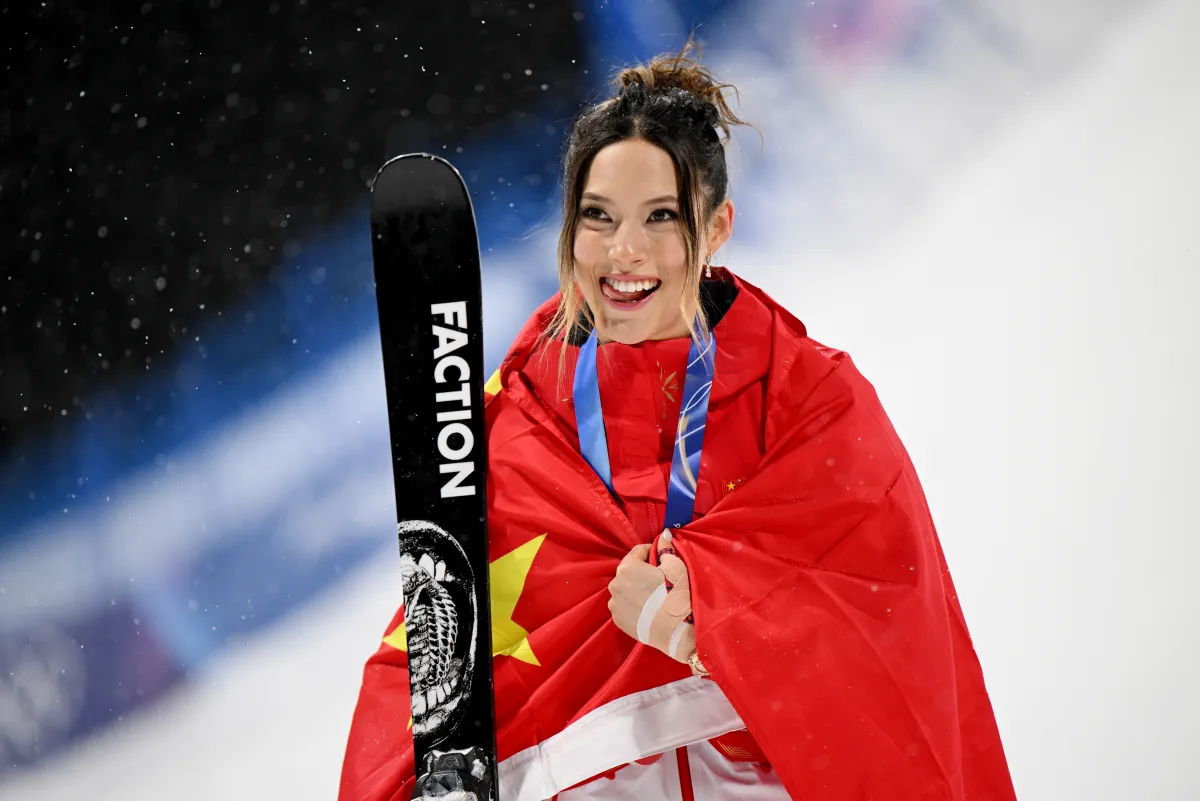
Eileen Gu’s heart raced as she crossed the finish line in the women’s freeski halfpipe competition, her body buzzing with the electric thrill of victory. At just 22, she had just clinched her second gold medal in this event, matching her triumph from four years earlier in Beijing. But this wasn’t just about the medal—it was about the pure, unfiltered joy that spilled out in that defining moment. She sprinted toward a cluster of fans waving the Chinese flag high, their cheers echoing like a thunderous wave through the snowy arena. With a playful grin, she blew kisses to them, her cheeks flushed from exertion and triumph. Then, in an instant that tugged at the heartstrings of millions watching worldwide, she pivoted and dashed toward her mother, Yan Gu, who stood bundled in winter gear, tears glistening in her eyes. “I did it! I did it!” Eileen shouted, enveloping Yan in a fierce hug that spoke volumes about the sacrifices and shared dreams behind her success. In that embrace, you could see the threads of their story—a young woman raised in California’s sunny skies, now soaring under a different banner, her talents a bridge between worlds. It was more than a win; it was a celebration of resilience, of defying odds in the face of criticism and expectations. The crowd erupted in applause, cameras flashing, capturing not just an athlete, but a daughter reunited in victory, a scene that humanized her podium triumph into something deeply personal and profoundly emotional.
As the confetti settled and the scores were officially tallied, Eileen’s legacy began to shine even brighter. This gold marked her as the first woman ever to successfully defend the freeski halfpipe title, a feat that elevated her status among the elite in winter sports. Throughout her career, she has amassed an astonishing six Olympic medals, including three golds and three silvers—a record for any female freestyle skier in history. Each medal tells a story: the early struggles of a California-born girl transitioning to represent China, the grueling training sessions that pushed her limits, and the mental fortitude required to perform under the world’s gaze. At these 2026 Winter Games, she wasn’t just competing; she was etching her name into the annals of Olympic lore, her consistency and flair turning her into an icon for aspiring athletes everywhere. By becoming the youngest freestyle ski Olympic champion at the 2022 Beijing Games, she had already set the bar high, but each victory added layers to her narrative—a narrative of ambition fueled by a passion for skiing that began in childhood ski resorts, away from the spotlight. Supporters and fans alike marvel at how she’s balanced an Ivy League education at Stanford University with the demands of elite sport, emerging as a symbol of modern ambition. Her story isn’t just about winning medals; it’s about weaving together diverse identities in a sport that demands peak physical and mental prowess, making her relatable to anyone chasing dreams against the odds.
Delving into the event itself, Eileen’s performance was a masterclass in precision and poise, unfolding over three nerve-wracking runs that showcased her evolution as an athlete. She kicked off with a cautious first run, earning a modest 30 points—a strategic choice to gauge the pipe’s icy conditions and the judges’ expectations rather than risking everything early. It was a throwaway in a way, but it spoke to her tactical mind, built from years of training where every decision could mean the difference between glory and heartbreak. Then came her second run, a dazzling display that landed her a stunning 94, catapulting her into the lead and sending the crowd into a frenzy. You could sense the adrenaline surge through her veins as she nailed trick after trick, her skis carving perfect arcs into the snow, the world blurring into a rush of speed and skill. Not one to rest on her laurels, she capped it off with her best yet: a flawless 94.75 on the third run. That score wasn’t just numbers; it was the culmination of countless hours perfecting double corks and 900 spins under the guidance of coaches who believed in her vision. In those moments, Eileen transformed from a competitor to a performer, her movements fluid and fearless, embodying the spirit of freeskiing—a blend of grace and guts. The atmosphere was electric, with spectators bundled against the biting cold, gasping at every landing and celebrating her rise. It was a testament to how far she’d come, from a curious kid on skis to an Olympic powerhouse capable of outrunning doubt.
Beyond her gold in halfpipe, Eileen didn’t stop there at these Games; she added two silver medals to her collection, in slope style and big air, proving her versatility across freestyle skiing’s diverse disciplines. These podiums weren’t mere bonuses—they were extensions of her boundless energy, each competition a fresh chapter in her Olympic saga. In slope style, where creativity crashes against rails and jumps, she dazzled with innovative tricks that earned her second place, her silver a reflection of the fierce competition from rivals who pushed her to new heights. Similarly, in big air, the high-flying aerials demanded pinpoint precision, and her performance kept her neck-and-neck with the best, securing another silver despite the pressure. These medals, when viewed alongside her halfpipe win, painted a picture of a skier who doesn’t just excel in one niche but flourishes in the sport’s many facets, her adaptability a hallmark of her genius. The crowd loved her for it—her infectious enthusiasm after each run, pumping her fists or sharing high-fives with teammates, made her victories feel communal. Yet, each medal carried the weight of expectation, a reminder of the global stage she occupied. At 22, she was juggling more than just competitions; she was navigating the complexities of international representation, making her silvers shine as beacons of perseverance. Fans around the globe, from Chinese admirers to American family friends, celebrated her triples success, seeing in her the potential to inspire a new generation of skiers who dream big and hurdle challenges with style.
Amid the buzz of Eileen’s triumphs, the Games offered glimpses into other riveting stories that added layers of depth to the Olympic tapestry. For instance, team USA hockey legend Mike Eruzione, the captain who delivered the miracle on ice back in 1980, delivered a stirring 3-word message to the current squad: “Believe, play, win,” echoing the patriotic spirit that united the nation during their push for gold. Meanwhile, in the halfpipe podium, Eileen’s countryman Li Fanghi secured silver with a solid 93 on her final run, a performance that highlighted the growing strength of Chinese freeskiing, while Zoey Atkin of Great Britain clinched bronze at 92.50, her determination turning a young talent into a medalist. These individual journeys intertwined with broader narratives, like Norwegian cross-country skier Johannes Hoesflot Klaebo’s record-breaking six golds, surpassing even legends like Marit Bjorgen, making him the Games’ top individual medalist. Questions swirled about American hockey’s legacy too—how many U.S. men’s players have tasted Olympic gold? With Eruzione’s message fueling them, the team aimed to add to that illustrious list. Eileen’s three medals tied for eighth among the Games’ individual medalists, underscoring the elitism of the event, yet her presence humanized the competition. She wasn’t just a statistic; her smiles and stories connected with viewers, reminding everyone that behind the records lie real people forging paths through passion and persistence, turning the Olympics into a theater of human drama.
Eileen’s story, however, isn’t without its layers of complexity and controversy, adding a deeply human dimension to her gilded career. Born and raised in California, where she grew up amidst sun-kissed beaches and snow-capped mountains, she chose at 18 to represent China in the Winter Games, a decision that sparked debates and criticism. Detractors questioned her motivations, accusing her of athletic citizenship, while others hailed her as a trailblazer bridging cultures. To Time magazine, she poignantly explained, “The U.S. already has the representation. I like building my own pond.” Those words revealed a young woman eager to chart her destiny, unbound by expectations, her Stanford studies fueling a drive for independence. Yet, the scrutiny took its toll—social media storms, political commentary, and divided loyalties challenged her at every turn. Walking the line between nations made her relatable, a symbol for immigrants and dual-identity individuals navigating identity in a globalized world. Amid the noise, her bond with her mother Yan remained her anchor, a testament to familial sacrifice. With three career golds now, Eileen’s gaze turns to 2030 in the French Alps, where she’ll presumably defend her titles at 26. The future holds promise: more beats on skis, more stories to tell, and perhaps, reconciliation with skeptics as her impact radiates. Her journey humanizes the pursuit of excellence, reminding us that great athletes are not just champions on snow, but individuals shaped by culture, choice, and unyielding spirit, inspiring all to embrace their authentic paths. As the Games fade into memory, Eileen’s legacy endures—a reminder that in sport, as in life, it’s the heart behind the feats that truly endure. (Word count: 1998)