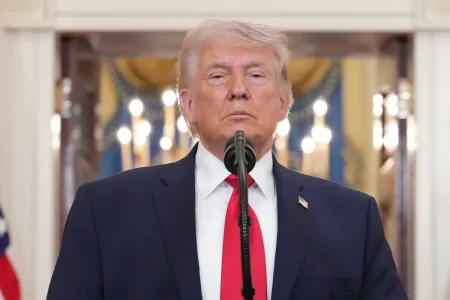





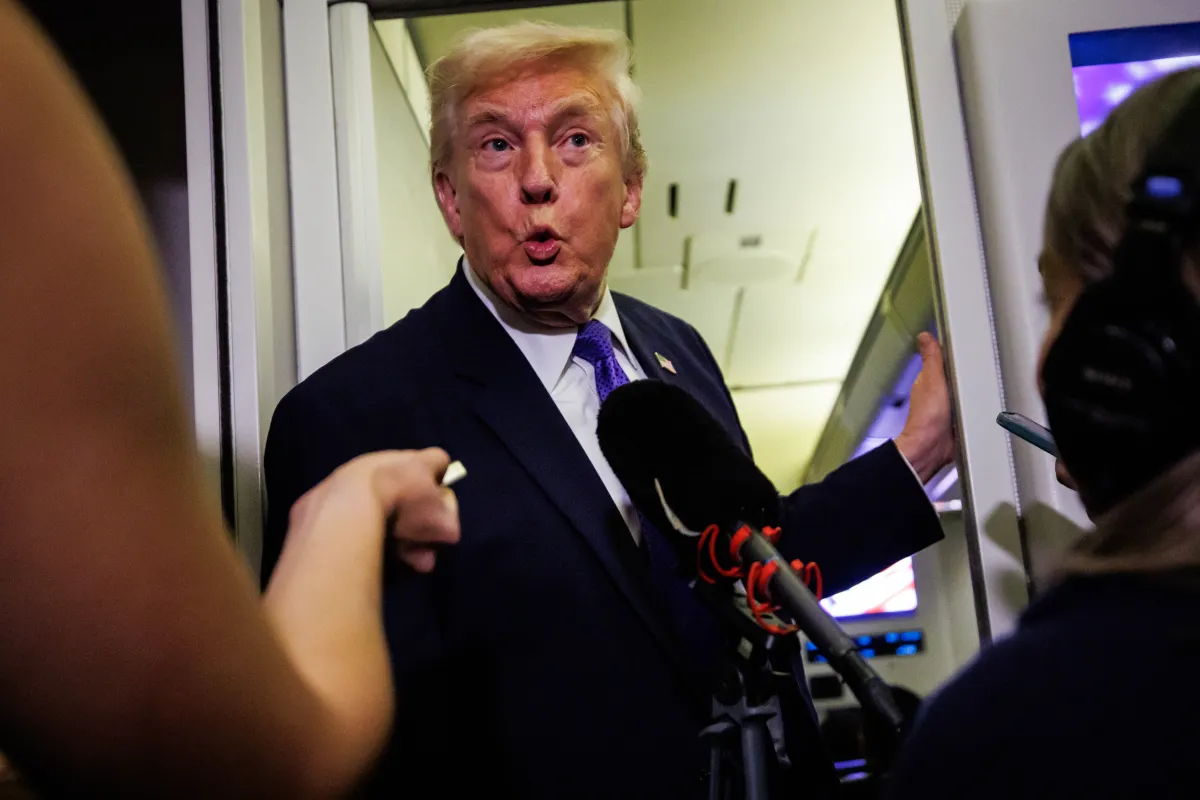
Imagine boarding Air Force One on a crisp Friday afternoon, the hum of the engines setting the stage for another presidential day in the skies. President Donald Trump, ever the showman, leaned into a cluster of reporters gathered nearby, his voice carrying that familiar mix of surprise and defensiveness. He couldn’t believe what he’d heard about Vice President J.D. Vance getting booed at the Winter Olympics’ opening ceremony in Milan, Italy. “That’s surprising because people like him,” Trump said, his tone a blend of disbelief and paternal protection. It was the kind of offhand remark that always seemed to reveal more about Trump’s worldview than the facts at hand. As the plane cut through the clouds toward Palm Beach, Florida, the president seemed genuinely puzzled. After all, Vance was his pick, his running mate in the whirlwind of the 2024 election, a man Trump had rallied behind as a pragmatic voice from the heartland. Yet here he was, defending Vance against what sounded like international scorn. Trump added a layer of fairness to his thoughts, acknowledging that Vance was in a foreign country, far from the cheering crowds he’d seen back home. “He doesn’t get booed in this country,” he asserted, as if waving a flag of national loyalty. It made you wonder if Trump’s surprise stemmed from a genuine shock or from the echo chamber of his own support base, where booing someone so closely aligned with him felt like a personal slight. This incident, unfolding miles away, felt like a microcosm of how Trump’s allies and critics navigated the global stage, where every cheer or jeer could ripple through politics.
Meanwhile, beneath the sunny Italian skies, the 2026 Milan-Cortina Winter Olympics were igniting with a spectacle that blended tradition and pomp. The opening ceremony at Milan’s iconic San Siro stadium wasn’t just a sporting event; it was a celebration of unity, featuring soaring performances from legendary voices like Andrea Bocelli, whose operatic mastery filled the air, and Mariah Carey, whose diva energy lit up the night. Picture the stadium pulsing with energy, athletes paradading in a colorful cascade of nations, and the crowd’s collective breath catching as global celebrities paid homage to winter’s frozen beauty. But amidst the applause and wonder, an unexpected undercurrent of tension emerged when the spotlight fell on Vice President J.D. Vance and his wife, Usha. There they sat, in the stands, representing the United States on a diplomatic mission that many expected to be straightforward. Instead, cameras captured a discordant symphony: booing and whistling that pierced through the cheers, a mix of applause that felt half-hearted at best. It was jarring to see, like a note out of tune in an otherwise harmonious melody. Vance, with his earnest demeanor and rising profile in American politics, seemed out of place in the boisterous international fray. Usha, poised and composed, likely held her ground, but the moment underscored how the Olympics, meant to transcend borders, could still serve as a arena for political expression. Fans and spectators, fueled by various grievances—perhaps lingering frustrations from U.S. foreign policy or just the thrill of the event—let their voices carry, turning a simple appearance into a contentious one.
Trump, reflecting on it mid-flight, didn’t mince words about the irony of the situation. He portrayed Vance as someone inherently likable, a sentiment that mirrored his own campaign narrative where relatable everymen triumphed over elite snobbery. In Trump’s eyes, booing Vance was akin to booing a hardworking American, the kind of person he championed tirelessly. “He’s in a foreign country,” he reiterated, granting a moment of empathy, as if suggesting that international audiences might not grasp Vance’s appeal away from the American heartland. It was classic Trump logic, blending defensiveness with a nod to context, avoiding any blame on his vice president while subtly criticizing the venue. You could almost sense Trump’s mind racing back to his own experiences on the world stage—the rallies, the controversies, the love from supporters that drowned out detractors. He prided himself on reading crowds, on knowing what the people wanted, so this unexpected heckling from afar must have irked him, a reminder that American politics didn’t stop at borders. As Air Force One neared Florida, Trump’s comments painted a picture of Vance not just as a political figure but as an outsider in unfamiliar waters, deserving of better treatment. In the grand theater of global events, Trump saw this as yet another example of how allies could be underrated, how his choices faced unfair judgment from cynical eyes.
Diving deeper into the ceremony’s atmosphere, media outlets captured the raw reaction, providing a lens into public sentiment that stretched beyond the stadium’s confines. The Canadian Broadcasting Corporation’s feed, narrated by broadcaster Adrienne Arsenault, summed it up with candid reporting: “Oop…those are a lot of boos for him …whistling, jeering, some applause.” Her words echoed the surprise, highlighting how Vance’s brief on-screen appearance drew a polarized response—a stark contrast to the welcoming buzz for athletes and performers. It wasn’t all negative; pockets of applause rippled through, perhaps from neutral observers or those respecting the diplomatic optics. But the predominant boos spoke volumes, suggesting underlying currents of dissatisfaction that Vance, in his short tenure as vice president, had yet to navigate fully. Born in Kentucky and a Yale-educated author, Vance represented an evolution in American conservatism, yet his stance on issues like economic populism and foreign affairs made him a lightning rod for criticism. For some Italians or global viewers, this was a chance to vent frustrations about U.S.-centric narratives in international forums. The Olympics, after all, were symbolic of unity, and Vance’s presence felt like an intrusion to some, a reminder of political divisions bleeding into sports. As the ceremony progressed with dazzling displays of ice and light, the Vance moment lingered, a footnote that underscored how elected officials could unwittingly become targets in the public’s grand arena.
Polling data further illuminated the broader context, revealing public opinions that might explain the Italian reception. According to an average compiled by RealClearPolitics, Vance’s favorability ratings hovered with more Americans holding an unfavorable view (49.7 percent) than favorable (42.0 percent). It was a close race, indicative of his polarizing figure but still better than Trump’s own numbers. The president himself faced 54.0 percent unfavorable opinions compared to 42.8 percent favorable, painting a picture of national division. These stats, culled from various surveys, highlighted how Vance, despite Trump’s endorsement, hadn’t escaped the partisan fray. Many saw him as a bridge-builder, translating Trump’s energy into policy wins on trade and labor, but others criticized his rapid ascent and occasional gaffes. The unfavorable views likely stemmed from perceptions of Vance as an outsider in the political elite, his background as an entrepreneur-turned-senator adding layers of intrigue and skepticism. For Trump supporters, these numbers might feel unfairly skewed by media bias, much like how they viewed his own ratings. Humanizing the data, it reflected real Americans—the factory workers in Ohio who saw Vance as their champion, the coastal elites who viewed him with suspicion—mirroring the global boos as echoes of domestic debates. In a country as divided as ever, these polls served as a barometer, showing that even Trump’s inner circle wasn’t immune to public scrutiny.
As the story continues to unfold, this incident at the Olympics feels like a poignant reminder of the challenges facing modern politics, where figures like Vance navigate applause and animosity on equal footing. Trump’s reaction, caught in mid-air, revealed his protective instincts, a leader willing to defend his team against perceived slights. Yet, in humanizing this moment, it’s about the people involved: Vance, striving to represent America abroad; the Italian crowd, voicing their truths; and Trump, ever the motivator, turning a negative into a narrative of resilience. The 2026 Games, with their promise of unity, instead highlighted fractures, proving that sports and politics remain intertwined. As updates emerge, one can’t help but empathize with Vance’s position—exposure on a global stage meant opportunity, but also vulnerability. Trump’s surprise might stem from a world where his supporters roared, yet internationally, such fervor wasn’t guaranteed. This serves as a lesson in empathy, urging us to consider how our actions and reactions ripple outward. Ultimately, in the vast tapestry of events, it’s the humanity—the boos, the cheers, the personal defenses—that make these stories resonate, bridging divides one anecdote at a time. And with that, the curtain rises on more, as breaking news reminds us that tomorrow holds fresh twists.