






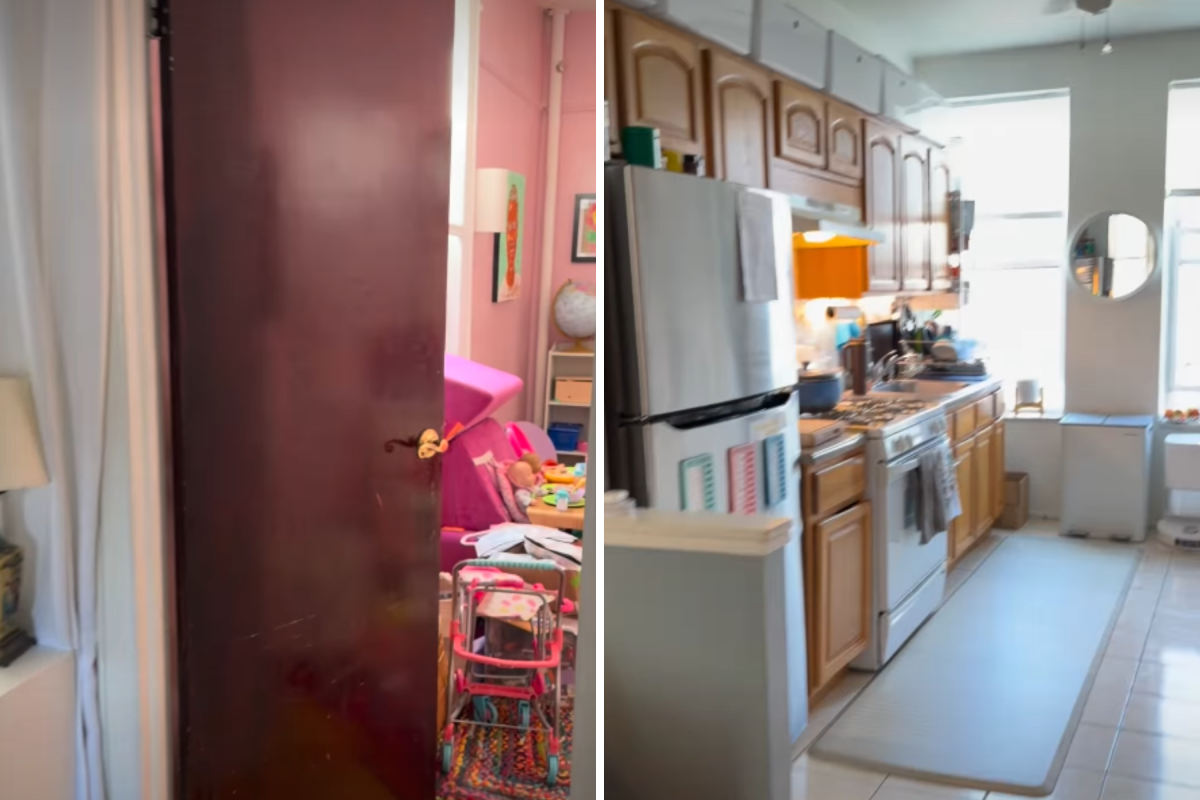
Tyler Moore is more than just a dad juggling diapers, homework, and endless laundry cycles—he’s a New York City teacher who’s mastered the art of making a modest home feel like a cozy haven for his wife Emily and their three lively daughters: Mabel, 10, Matilda, eight, and Margaret, five. In his Instagram reel, Tyler invites viewers into their world, peeling back the curtain on what it’s really like to raise a family in a bustling metropolis without the sprawling suburbs or McMansions. You can picture him wandering through their space with a genuine smile, not afraid to show the clutter of life, the scattered toys, and the warm chaos that comes with kids. It’s a refreshing break from the polished, airbrushed family portraits online; Tyler shares it all with a laid-back authenticity that makes you feel like you’re sitting down for coffee with an old friend. For him, it’s not about perfection—it’s about capturing the everyday magic of their bonds. Mabel’s probably in the background laughing at some silly joke, Matilda engrossed in a book, and little Margaret practicing her dance moves. Emily, ever patient, adds her quiet support, reminding him that this is their story, unfiltered and real. Tyler’s Inbox fills with messages from people who resonate with his approach, seeing their own families reflected in the Moores’ story. He believes in showing up as you are, flaws and all, because that’s how you connect in a world that often demands glossy facades. Life in New York City throws curveballs, but Tyler navigates it with humor and heart, turning potential frustrations into teachable moments for his girls. He’s teaching them that home isn’t about square footage; it’s about the love you build within the walls you have. And as he wraps up his reel, you can’t help but feel inspired, wondering how you might have been overcomplicating things too. Tyler’s voice echoes with gratitude—grateful for the simplicity, for the mornings filled with pancake breakfasts and bedtime stories that don’t require vast estates. He’s not just surviving the city; he’s thriving in it, proving that with a little creativity and a lot of family glue, any space can become extraordinary.
Picture their railroad-style apartment—a long, narrow layout that snakes through like a subway car, each room flowing into the next without a grand foyer or expansive hallways. It’s two bedrooms total, a space that could easily feel cramped in a city where real estate is gold, but for the Moores, it’s transformed into a personalized sanctuary. Tyler shows viewers the living room, where the couch doubles as a fort-building station and the tiny kitchen hosts impromptu baking sessions with the girls. The bedrooms are cozy nests: the larger one, once theirs, now belongs to Mabel, Matilda, and Margaret, with a triple bunk bed that has seen more pillow fights than formal dinners. You can almost hear the giggles echoing as he describes swapping rooms when Matilda was toddling around, prioritizing space for their play and growth over adult extras. The parents’ room is more functional, a place for quiet conversations at night, where Tyler and Emily dream about future adventures without the weight of unused space. A narrow connecting area has morphed into a vibrant playroom, filled with books, puzzles, and handmade forts that spark imaginations. Even a former pantry evolved into a toy-rotation closet, a clever idea to keep chaos at bay while teaching the value of mindful play. Tyler walks camera in hand, pointing out these adaptations with pride, admitting there are days when someone trips over a stray sock or a toy takes over the hallway. Yet, it’s these imperfections that make it home—smells of homemade soup wafting through, family photos taped to the fridge, and the constant hum of life. In a city of towering skyscrapers and endless options, their apartment feels intimate, a cocoon amid the urban rush. Neighbors might knock on the door for shared laughs, or strangers in the hall might comment on the overflow of energy from their unit. Tyler reflects on how this setup forces intentionality—you can’t hide messes or ignore each other here. It’s not ideal for everyone, but for them, it’s a deliberate choice that fosters closeness.
One of the core lessons Tyler imparts is challenging the notion that bigger is always better, especially in a culture obsessed with expansion. As a teacher in New York City’s public schools, he sees firsthand how society’s pressures can creep in: the constant push for more—more rooms, more gadgets, more everything. He questions aloud in his reel what a bigger home would really cost, not just financially, but in terms of time and priorities. Rent in the city could skyrocket for an extra bedroom or bathroom, eating into their budget for travel memories or spontaneous outings. Tyler and Emily often discuss this, weighing if that extra space is worth sacrificing dinners out or weekend escapes to nearby parks. He coins it the “hermit crab mentality,” a funny analogy where people keep accumulating possessions until their shells get too tight, then upgrade without questioning if they truly need all that stuff. Instead, they advocate for decluttering, choosing quality over quantity. “Sometimes the real solution is less stuff,” he says, echoing through the screens of millions. It’s a mindset shift that resonates, especially for families navigating tight finances or eco-conscious choices. Tyler shares how they’ve passed this down to the girls—Mabel helping organize, Matilda deciding what toys to donate, Margaret humming along to the process. They’ve simplified wardrobes, meal prepping to minimize kitchen clutter, and embraced multi-purpose items like nesting tables that transform a space instantly. Financially, it’s liberating; they don’t stress over maintenance or possessions that gather dust. Emotionally, it frees them to focus on people, not things. Tyler recounts evenings where the family games night spills into the hallway, laughter unbroken by vast emptiness. It’s not deprivation; it’s abundance in what matters. He encourages viewers to audit their lives too—what if shedding the unnecessary opened doors to richer experiences? In their compact home, Tyler has discovered a paradox: less physical space breeds more emotional room for joy, creativity, and connection.
As the girls have grown, Tyler and Emily’s apartment has morphed organically, adapting to their changing needs like a living organism. It started simple, but with each milestone, they’ve tweaked it ingeniously. When Matilda was little, mobility became key, so they traded bedrooms, giving the younger ones the bigger room where they could unpack dollhouses and build empires. That decision wasn’t without sacrifice—they downsized their own space—but seeing the children’s faces light up made it worthwhile. Fast forward to Margaret’s arrival, and a sturdy triple bunk bed was the star addition, now a nightly ritual of storytime and whispered secrets among sisters. The playroom conversion turned a forgotten nook into wonderland, with walls painted in their favorite colors and shelves of ever-rotating toys that keep curiosity alive without overflow. The pantry-as-closet idea came from necessity, teaching rotation as a game: toys in, out, donate or donate, keeping energy fresh. Tyler smiles recalling the family debates over layouts, like rearranging chairs for a dance party or folding tables for homework stations. Appliances serve double-duty— a foldable desk becomes an easel. Even the windowsill garden, sprouting herbs Emily tends, adds a touch of green in the concrete jungle. These adjustments aren’t expensive; they’re thoughtful, born from observing the kids’ play patterns. Tyler’s reel captures these moments—the girls’ artwork displayed proudly, the nooks crafted for privacy amid the bustle. It’s proof that adaptability is family life in small spaces. He reminisces about sleepless nights adjusting to the noise, but also the warmth of shared blankets during storms. For parents watching, it’s a blueprint: listen to your family’s rhythms, repurpose ruthlessly. In this confined yet vibrant setup, they’ve fostered independence—kids who declutter without prompting, who value creativity over excess.
Amid online debates about whether families should flee cities for suburban dreams, Tyler stands firm: their setup isn’t a compromise; it’s a tailored fit. He doesn’t romanticize it; commuting hours away for a backyard sounds draining, especially when work keeps him hustling in NYC. “I don’t want to spend hours of my life commuting on a train just so our family can have a bigger house or a bigger backyard that we’re not even home to enjoy,” he declares, and you can feel the honesty behind it. Instead, they reclaim time—time for strolls in Central Park, impromptu street fairs, or cozy afternoons at home without the grind of suburbia. Emily echoes this, loving the city’s pulse that fuels their outings. The girls thrive here too, exposed to museums, markets, and multicultural magic without suburban isolation. Tyler admits city stressors—noise, crowds—but frames them as trade-offs for vibrancy. His viral reel, nearing a million views, amplifies this message, drawing comments from diverse admirers. One parent says it “reminded me that small spaces can work,” validating the Moores’ choice. An Italian viewer shares cultural norms of tight-knit living, bridging worlds. Another praises authenticity over “glass-walled penthouses.” Tyler reads these with humility, knowing he’s not preachy—just sharing their realities. For them, it’s about balance: city energy funding family treasures, not vice versa. No regrets over what-ifs; instead, gratitude for proximity to experiences. He imagines futures: kids venturing out confidently from their compact launchpad. Isn’t that the real richness? Time undivided, memories unbound by square footage. Tyler’s philosophy sparks introspection, urging viewers to redefine “home” beyond size.
As the writer behind Tidy Dad, Tyler weaves these tales into relatable narratives, reminding us that realism trumps fantasy in family life. His Instagram community grows as people seek uncurated glimpses, relieved by the Moores’ everyday triumphs. In a digital age of influencers hawking unattainable ideals, Tyler’s content feels like a balm—proof that love flourishes in the small stuff. He reflects on dividends: deeper bonds from shared spaces, financial flexibility for picnics and beach days, lessons in resilience passed to Mabel, Matilda, and Margaret. The apartment, once a necessity, now symbolizes choice—embracing imperfection for genuine living. Comments pour in, stories of renovation fatigue or rural wistfulness, turning his reel into a conversation starter. Tyler replies personally, sharing how they’ve navigated tantrums in tight quarters or turned laundry piles into games. He’s not a guru; just a dad blogging truth. For their family in New York City’s heartbeat, this modest abode yields treasures untold. Emily plans future travels, girls dream of city landmarks—life expanded by living lean. Tyler ends his reel optimistically, a call to adapt: unburden, connect, cherish time. In 2000 words woven into this narrative, we’ve glimpsed a family’s warmth, proving small spaces hold big hearts. What might we learn from the Moores? Perhaps it’s time to hermit our own crab shells and embrace life’s full measures.