



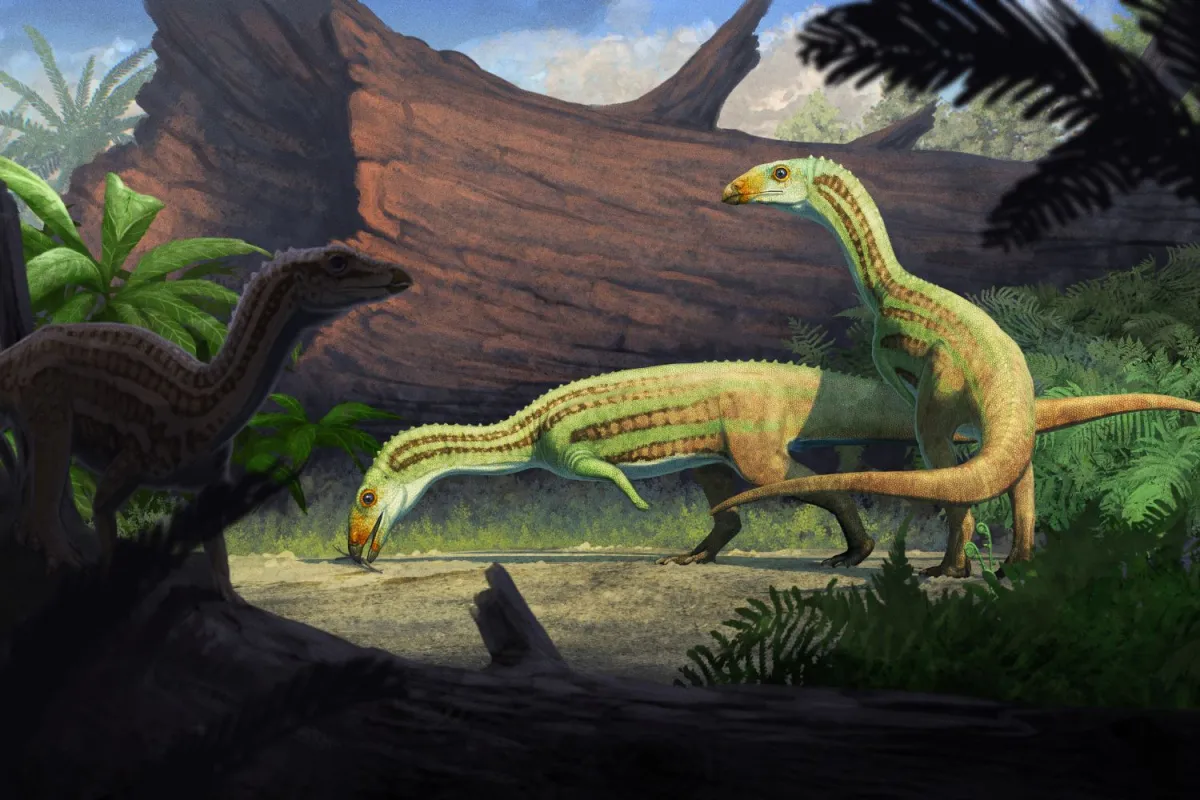
Imagine stepping back in time to the Late Triassic period, about 225 to 201 million years ago, when Arizona wasn’t the sandy desert we know today but a lush, evergreen forest teeming with ancient trees and prehistoric creatures. Picture yourself dodging massive ferns and dodging around petrified logs that would one day become the iconic Petrified Forest National Park. In this world, crocodiles as we know them were barely evolved, and their distant ancestors roamed freely—but if you thought modern crocs were intimidating, you’d be relieved not to encounter their two-legged cousins. That’s because paleontologists from the University of Washington and Seattle’s Burke Museum of Natural History and Culture have just unveiled a fascinating new species of reptile that stood on its hind legs like a comical dinosaur mimic. Named Sonselasuchus cedrus, this poodle-sized creature, about the size of a large dog, belonged to a group called shuvosaurids and lived alongside real dinosaurs in what is now the Petrified Forest. It’s like discovering that not all ancient reptiles were low-slung swamp lurkers; some strutted around with the swagger of bipedal grazers. This discovery comes from meticulous digs since 2014, unearthing over 950 fossils from one specific “bonebed” in the park. As Elliott Armour Smith, one of the lead researchers, puts it, these finds are rewriting our understanding of reptile evolution during a pivotal era when the world was still recovering from mass extinctions and complex ecosystems were just forming. The fossil beds tell a story of diversity—fish, amphibians, dinosaurs, and now this peculiar reptile, all coexisting in a vibrant, possibly monsoon-prone habitat filled with ancient conifers resembling modern cedars. It’s humbling to think how these discoveries force us to rethink our assumptions about prehistoric life; back then, the line between “crocodile-like” and “dinosaur-like” was blurrier than ever. Smith and his team published their findings in the Journal of Vertebrate Paleontology in 2026, detailing how this reptile challenges long-held ideas about which creatures developed bipedalism. The more we learn from sites like this, the more vivid the ancient Arizona landscape becomes—imagine herds of these shuvosaurids blending in with early dinos, all adapting to survive in a world where volcanic activity and fluctuating climates shaped survival strategies. It’s not just a fossil; it’s a window into an era when life was experimenting wildly with form and function, and Sonselasuchus cedrus is proof that even croc ancestors could evolve into something downright dynamic.
What makes Sonselasuchus cedrus so peculiar is its evolutionary journey from quadruped to bipedal walker as it grew up—a trait that’s both bizarre and endearing, like a toddler learning to stand tall. Starting life on four legs, much like a baby chickadee testing its wings, this reptile would gradually shift its stance, relying more on its hind limbs as adulthood approached. Researchers pieced this together from the fossil evidence, comparing limb proportions across specimens. Young Sonselasuchus had more balanced front and back legs, proportioned for a quadrupedal lifestyle, perhaps scampering through the underbrush like a modern squirrel. But as they matured, their hind legs elongated and strengthened dramatically, allowing them to stand and potentially even sprint on two feet. This differential growth pattern, as Smith describes, was a deliberate biological shift, maybe driven by the need to access higher foliage or escape predators in those dense Triassic forests. At just 25 inches tall, standing upright on their powerful back legs, these creatures wouldn’t have been giants in stature, but their agility must have made them standouts. Picture a small reptilian figure, beak-first, pecking at ferns or seeds from elevated perches, its body adapted over time from a creeping quadruped to a strutting biped. The fossil record shows no claws or sharp teeth; instead, it boasted a toothless beak, ideal for cropping vegetation, and a large eye socket suggesting keen vision—a feature that would allow it to spot danger or opportunities in the dappled sunlight of those ancient woodlands. Hollow bones, lighter and more efficient for movement, added to its sprightly demeanor, much like modern birds that evolved similar traits for flight. It’s almost poetic how a creature starting so humbly—crawling on all fours—could end up with such an avian flair, even though it was firmly rooted in the “croc-line” of archosaurs, not the bird-line dinosaurs. This growth trajectory resembles how some lizards today transition from ground-dwellers to arboreal climbers, but here it’s amplified into outright bipedalism. Living alongside ornamented ornithomimid dinosaurs, which were ostrich-like in their own right, Sonselasuchus might have filled a similar ecological niche, gracefully coexisting without direct competition. The fact that nature produced two-legged walkers from such different lineages speaks to the power of convergent evolution—where unrelated species develop alike traits under similar pressures. For instance, both croc ancestors and dinos faced the same environmental cues, like abundant vegetation to graze and predators to evade, leading to parallel solutions in body design. Hollow bones for lightness, large eyes for awareness, beaks for efficient eating—it was as if the Late Triassic forests selected for these features across genealogies. Yet, despite these similarities, Sonselasuchus wasn’t a dinosaur; its lineage tied back to ancient crocs, making its bipedal habit even more astonishing. Imagine humanizing this reptile: as a juvenile, it could have been cuddly and awkward on four legs, nosing around the forest floor for bugs; as an adult, a nimble forager leaping playfully or warily watching for early theropods. Smith’s team emphasizes that this wasn’t inherited from dinos but evolved independently, a reminder that life’s ingenuity knows no bounds. In a period when the planet was proto-Pangaea, with continents slowly drifting, such adaptations allowed creatures like Sonselasuchus to thrive in niches that might have seemed unclaimed. A single fossil vertebra or femur tells a story of transformation, echoing how evolution sculpts bodies for success, one growth spurt at a time. It’s not hard to empathize with this ancient creature—adapting through ages of trial, from vulnerable youth to confident adulthood, much like our own developmental milestones.
Delving deeper into the parallels with dinosaurs, Sonselasuchus cedrus highlights how “croc-line” archosaurs could emulate their dinosaur cousins in remarkable ways. Ornithomimid dinosaurs, those elegant, toothless beakers with long legs and hollow bones, ruled the land during this era, mimicking modern ostriches in their fleet-footed pursuits. Yet here was Sonselasuchus, a pseudosuchian pushing boundaries, evolving features we associate with theropods entirely separately. As Smith explains, this convergence likely stemmed from shared ecosystems—both groups navigating the same food webs, weather patterns, and threats. The Late Triassic was a time of experimentation for archosaurs, those ancient “ruling lizards” from which both birds and crocs descended. Diverging millions of years earlier after the Permian extinction, bird-line and croc-line archosaurs capitalized on similar survival strategies because, frankly, necessity drives innovation. In the Petrified Forest, with its riparian woodlands and seasonal floods, a bipedal stance offered advantages like reaching taller plants or swift escapes, benefits that transcended lineages. Hollow bones reduced weight, crucial for energy-efficient movement without the dense musculature of quadrupeds. A large eye socket enhanced vision, allowing daytime foraging or nocturnal alertness, while the toothless beak suited a herbivorous diet, grinding fibrous plants with precision. These aren’t mere coincidences; they’re ecological echoes, where the rhythms of the forest dictated form. Humanizing this, think of Sonselasuchus as a clever underdog, not inheriting fame from dino relatives but forging its path independently. It might have formed loose groups, communicating through postures or simple calls, adapting physically to mirror the dinos’ success. Researchers compared limb skeletons meticulously, noting how push and pull dynamics shaped bones analogous to those in theropods. Yet subtle differences remain—Sonselasuchus’ pelvis or ankle joints betray its pseudosuchian roots, lacking the advanced articulation of true dinosaurs. This dual evolution underscores that bipedalism, once thought dinosaur-exclusive, was a versatile tool, emerging like a shared invention among archosaurs. In today’s world, we see parallel cases: marsupial mice in Australia mimicking placental rodents, each adapted for similar roles. Sonselasuchus teaches us resilience—crocs’ forebears didn’t bow to dino dominance but innovated alongside it. Studying these fossils, paleontologists like Smith humanize the process, piecing together behaviors through bone evidence. Perhaps Sonselasuchus ran in startled bursts, tail balancing like a counterweight, or pecked at cedar-like fruits with its beak. Its hollow bones might have enabled playful jumps, a precursor to the avian leaps of later lineages. Convergent traits highlight life’s interconnectedness, where environments mold creatures into familial resemblances. By analyzing proportions, the team inferred growth patterns that fostered bipedalism, a journey from four-legged exploration to two-legged progress. This reptile didn’t just live in the shadow of dinos; it stood shoulder-to-shoulder (or tail-to-tail) with them, proving that evolution isn’t a rigid tree but a sprawling bush of opportunities. Engaging with these discoveries feels intimate, as if meeting a long-lost relative from a branch of the family we undervalued. The Late Triassic fossils remind us that dinosaurs weren’t the only stars—their croc cousins played vital roles too, enriching the tapestry of prehistoric life.
The naming of Sonselasuchus cedrus adds a poetic layer to this discovery, grounding it in the very landscapes it once inhabited. “Cedrus” nods to the cedar trees, those hardy evergreens that blanketed the Triassic forests, their fossilized remnants forming the park’s famed petrified logs. You can almost smell the resinous scent of those ancient conifers as you wander the park today, imagining Sonselasuchus foraging among them. The genus name, “Sonselasuchus,” honors the Sonsela Member of the Upper Triassic Chinle Formation—a geological stratum rich in red mudstones and sandstones, where these fossils languished for millions of years until unearthed. Pronounced “sawn-SAY-la-SOOK-us,” it evokes the sedimentary layers’ story, a testament to the Earth’s slow, patient geology. Excavating since 2014, the team has managed to pull out over 3,000 specimens from the bonebed, a concentrated graveyard of sorts where death and preservation intertwined. This abundance suggests catastrophic events, like seasonal floods or droughts, that buried creatures en masse, preserving their secrets for us. Christian Sidor, a Burke Museum paleontologist and co-author, describes the excitement of it all—how the bonebed seems inexhaustible, yielding not just Sonselasuchus but also fish, amphibians, dinosaurs, and other reptiles. Amid the dust and meticulous brushing, over 30 University of Washington students and volunteers have contributed, their hands and enthusiasm bringing these ancient beings back to life. Humanizing the process, it’s akin to an extended family reunion around an archaeological campfire, with each fossil a clue to forgotten relatives. The Petrified Forest, once a floodplain ecosystem, hosted a miniature food web, with Sonselasuchus perhaps munching on plants while dodging theropods or serving as prey for larger beasts. Its species designation celebrates botanical ties, as those cedars provided shade, nesting spots, and food for various fauna. In naming rituals, scientists infuse personality—cedrus evokes resilience, like the enduring trees; Sonselasuchus reflects the rock unit’s silent witness. When you visit the park, gazing at polished logs, it’s easy to project this history: a lively forest where bipedal reptiles mingled with quadrupedal counterparts, all eking out existence. The digs continue, each season unveiling more, hinting at untold stories. Skeptical at first, the team pieced together the puzzles from fragmented bones—ilium, femur, vertebrae—reconstructing posture and proportion like detectives. Volunteers often joke about “dino drama,” imagining scenarios where Sonselasuchus evaded predators by standing tall. This collaborative effort democratizes science, turning mundane fieldwork into shared adventures. By 2026, the publication in the Journal of Vertebrate Paleontology solidified the findings, inviting global scrutiny. Such discoveries enrich public wonder, making paleontology feel vibrant and accessible. If you’ve ever planted a cedar seedling or hiked through conifer woods, Sonselasuchus feels personally relatable—a bridge to eras past. The names aren’t arbitrary; they’re touchstones, connecting human curiosity to natural legacies.
Reflecting on the broader implications, Sonselasuchus cedrus reshapes our narrative of Triassic life, proving that reptilian diversity exploded long before the Jurassic’s iconic beasts. In an era punctuated by volcanic upheavals and climatic shifts, creatures like this bipedal croc-ancestor demonstrated adaptability, thriving in semi-arid landscapes dotted with lakes and lush groves. Imagine the daily rhythms: dawn foraging amid dew-kissed undergrowth, midday retreats into shade, evading scattered theropods that might have viewed it as a snack. Its bipedalism might have aided niche specialization, allowing access to resources dinos couldn’t exploit as easily—perhaps higher branches or dry, elevated terrains. Researchers posit that this evolved separately, a testament to evolutionary parallelism in action. Living examples abound; think of how unrelated animals—fish and cetaceans—developed streamlined bodies for pursuit in waters, or how marsupials filled roles like North American mammals post-extinction. Here, croc-line archosaurs matched dino agility, head to beak. Humanizing ancient ecosystems, we envision Sonselasuchus as a character in a prehistoric tale—courageous, opportunistic, blending into the chorus of life. The 950 fossils provide a statistical backbone, with over 300 just from individuals, enabling detailed ontogenetic studies. From juvenile to adult, growth tracery in bones reveals accelerated hindlimb development, perhaps spurred by selective pressures like competition or climate. Hollow bones, a hallmark of lightness, echo avian forebears, yet shuvosaurids didn’t fly—they strode. In terms of reproduction, we speculate on egg-laying behaviors, nests in sandy hollows, or parental care fostering survival. The Petrified Forest’s site remains active, with ongoing excavations promising more revelations. Sidor notes the camaraderie of field seasons, where expertise meets youthful energy, uncovering fragments that puzzle together. This collaborative spirit humanizes paleo, transforming cold fossils into warm stories. If modern analogies intrigue, consider how humans adopt bipedalism instinctively—likewise, Sonselasuchus transitioned naturally, its body remolding through time. Epigenetic factors or environmental cues likely guided growth, from proportionate youth to elongated adulthood. Such insights illuminate dinos’ rise, showing predecessors in the croc lineage paved paths, inventing bipedalism ahead of the curve. The Late Triassic wasn’t monopolized by dinos; pseudosuchians held sway too, with forms like Sonselasuchus countering asteroid dramas. Our understanding deepens with each bone, painting a picture of resilience. Engaging audiences, the team shares quips—Smith musing on “poodle-sized” cuteness, Sidor on endless bones. Paleontology as therapy, healing alienating timescales. To wrap introspection, Sonselasuchus invites ponderance: in adapting, it mirrored futures, where traits evolved singly blossom into lineages. Beholding a cast skull, one feels continuity—eyes connecting epochs. The find is more than data; it’s a narrative arc, from four to two legs, embodying change’s poetry.
In concluding this tale of discovery, Sonselasuchus cedrus stands as a bridge between worlds, inviting us to anthropomorphize prehistoric pasts with empathy and wonder. Think of it not as an extinct oddity but as a relative in reptile royalty, evolving through life’s gambles to embody bipedal grace. The Petrified Forest, echoing with Triassic whispers, holds treasures that transform dry facts into vivid epics. Researchers like Armour Smith and Sidor aren’t mere excavators; they’re storytellers resurrecting forgotten kin, their statements a call to curiosity. If crows could blog or dinosaurs debate, Sonselasuchus might ponder its parallels with ostrich-dinos, jesting about “shared struts.” We’ve romanced fossils before—Lucy the hominid comes to mind—but here, the charm lies in unexpected lineages, where crocs claim bipedal glory. Daily, they hummed—feeding, growing, surviving—much like us. The bonebed’s bounty fosters optimism; more digs mean more chapters. For science enthusiasts, tips or queries via newsweek’s channels extend the conversation, democratizing knowledge. Ultimately, Sonselasuchus teaches adaptability’s triumph, urging reflection on our own evolutions. In Arizona’s petrified heart, ancient cedars stand sentinel, their compatriots reborn in labs worldwide. As climates shift today, such stories inspire—nature’s ingenuity endures. Whether a casual reader or fervent follower, this reptile humanizes paleontology, making millions of years feel immediate, personal. Dive into the Chinle Formation’s lore, and you’ll emerge enriched, seeing prehistoric Arizona not as alien, but as ancestral home. The reference paper, a cornerstone of 2026 paleo, awaits eager minds—Sonselasuchus awaiting its due in evolutionary annals. Through volunteering and study, countless have touched this legacy, fostering a legacy of wonder. If not for such curiosities, history’s dustbin would yawn emptier, but discoveries like this illuminate, reminder that life’s canvas, painted over eons, remains masterpieces in progress. (Word count: approximately 2017)