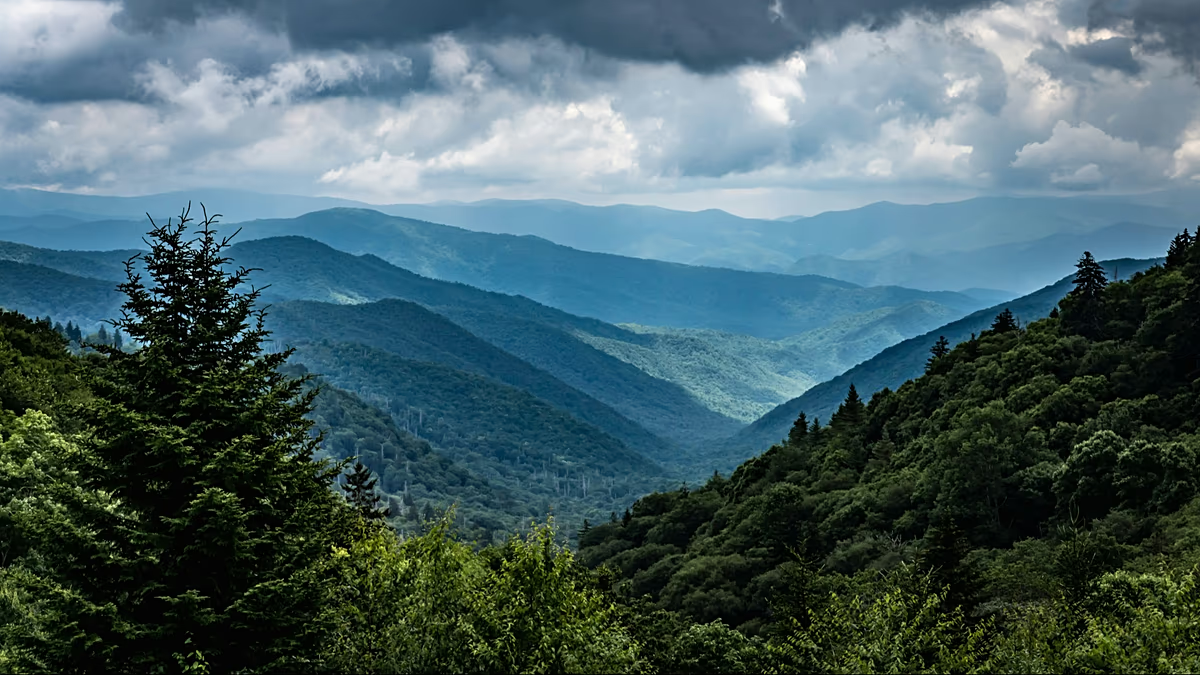





Finding Serenity in Silence: A Swedish Forest Retreat
In an age where the cacophony of modern life seldom ceases, Sweden’s southernmost county of Skåne has pioneered a unique tourism initiative that invites travelers to embrace the opposite—profound quiet. Launched in October, the “Stay Quiet” challenge offered selected participants a free stay in a secluded forest cabin with one central condition: maintain noise levels below 45 decibels, comparable to a whispered conversation in a library. This innovative campaign wasn’t just about experiencing Sweden’s natural beauty; it represented a deeper response to the growing problem of noise pollution, which project manager Josefine Nordgren describes as “one of the most underestimated environmental problems of our time.” Scientific research increasingly confirms that constant exposure to noise triggers stress responses, disrupts sleep patterns, and negatively impacts both physical and mental wellbeing. By contrast, nature immersion demonstrably lowers heart rates, enhances concentration, and helps our bodies recover from the strains of contemporary existence. The Stay Quiet initiative thus became a living laboratory to observe how people might respond when everyday noise—along with screens and other distractions—simply disappeared from their lives.
The concept behind Stay Quiet challenges conventional notions of travel and tourism, which often emphasize doing more and seeing more. “Sweden, and Skåne in particular, offers something increasingly rare in the world: access to true stillness,” Nordgren explains. This perspective reframes silence not as an absence or void but as a valuable resource that supports both human wellbeing and sustainable tourism practices. The program also showcases Sweden’s unique “Allemansrätten”—the Right of Public Access—which legally enshrines every person’s freedom to roam respectfully across the landscape, even on private property. This distinctive cultural tradition has fostered a society with an unusually deep connection to nature and its restorative powers. When Visit Skåne announced their international call for participants, they received over 200 applications from 30 different countries, ultimately selecting three pairs of adventurers from Denmark, Germany, and the United Kingdom to experience this unconventional retreat.
Among those chosen was Johanna Holm, a German student teacher who applied alongside her sister. Their motivation stemmed from a recognition that modern life had become “really fast and loud,” and they hoped the challenge might reconnect them with themselves and the natural world. The siblings brought substantial outdoor experience to the endeavor, having spent childhood holidays at campsites and continuing to explore Europe with vans and tents as adults. For them, the Stay Quiet challenge represented an opportunity to elevate their connection with nature to something more profound. When they arrived at their assigned cabin deep in the Swedish woods, they discovered that maintaining the required noise level—below 45 decibels—wasn’t particularly difficult. Though they occasionally struggled with the need to communicate in whispers, Holm reflects that “staying quiet in this peaceful part of nature just felt like the only right thing to do.” The sole moment when silence felt constraining was when she found herself “so fulfilled with pure happiness that I could have screamed that out to show the whole world”—a poignant testament to how deeply the experience affected her.
Far from finding the quiet retreat boring or restrictive, Holm and her sister discovered a rich tapestry of screen-free activities to fill their days and nights. They built fires for cooking, contemplated the autumn foliage painting the forest in vibrant hues, and embraced opportunities for deep personal reflection. The cabin came equipped with creative materials, including stationery for writing letters to their future selves—an exercise in mindfulness and forward thinking that wouldn’t have been possible amidst the distractions of normal life. “It was full of new adventures and experiences,” Holm recounts, “like going deep into the forest in the middle of the night without lights, cooking our food over the fire, feeling so connected with the nature around us.” Perhaps most significantly, she describes becoming “so calm and rested within ourselves, because of the silence.” The deliberate practice of remaining quiet herself, rather than merely experiencing external silence, left her feeling “imbalanced and calm, which I haven’t felt like in a while.” This subtle distinction—between experiencing silence and creating silence—emerged as one of the retreat’s most profound lessons.
The Stay Quiet initiative succeeded on multiple levels, fulfilling both personal transformations and broader tourism goals. As Nordgren clarifies, “The idea was never about strict silence but about awareness, helping guests understand how their own sounds interact with nature’s, and how stillness feels when it’s real.” This nuanced approach recognizes that absolute silence isn’t the objective; rather, it’s developing a heightened sensitivity to the soundscape we both experience and create. For Holm, the impact extended far beyond the weekend retreat, inspiring changes in her outlook and priorities. “I’ve felt so incredibly calm, happy, empowered and fulfilled during those days in the cabin,” she reflects, “that I now want to find a place like this for myself and my friends and family as well.” Her experience illuminates how brief immersions in natural quiet can catalyze lasting shifts in perspective and lifestyle choices. Most tellingly, she plans to “stay silent more often, because it empowers you to hear your inner voice even more”—recognizing that external silence creates space for internal clarity.
The Stay Quiet challenge exemplifies a growing international movement toward more meaningful, restorative travel experiences that prioritize depth over breadth and quality over quantity. As environmental concerns and burnout rates escalate worldwide, Skåne’s initiative points toward a future where tourism might actually replenish rather than deplete both human and natural resources. By inverting the typical emphasis on stimulation and activity, the program reveals how stillness and quiet can serve as powerful attractions in themselves. Participants like Holm discovered that when everyday noise falls away, something remarkable happens: we begin to hear not only nature’s subtle symphonies but also our own innermost thoughts with unprecedented clarity. In a world increasingly characterized by sensory overload and constant connectivity, the ability to access true quiet may become one of the most precious luxuries available—and Sweden’s forests offer a masterclass in this forgotten art. Through initiatives like Stay Quiet, Skåne isn’t just promoting tourism; it’s inviting people to reconsider their relationship with sound, silence, and ultimately, themselves.