


Alpine Village Offers Free Skiing As It Faces Climate and Economic Realities
In a paradoxical move that reflects the growing challenges faced by smaller European ski destinations, a French Alpine village has made the unusual decision to offer completely free skiing this season. Saint-Colomban-des-Villards, a charming community nestled at 1,100 meters in the Savoie region, isn’t doing this as a marketing stunt but as a financial necessity. While ski enthusiasts across Europe contend with ever-rising lift pass prices that put winter sports beyond many families’ reach, this small resort’s story reveals the complex realities facing mountain communities in an era of climate change and shifting tourism patterns. The village’s decision illuminates both the economic fragility of traditional winter sports and the creative adaptation some communities must embrace to survive.
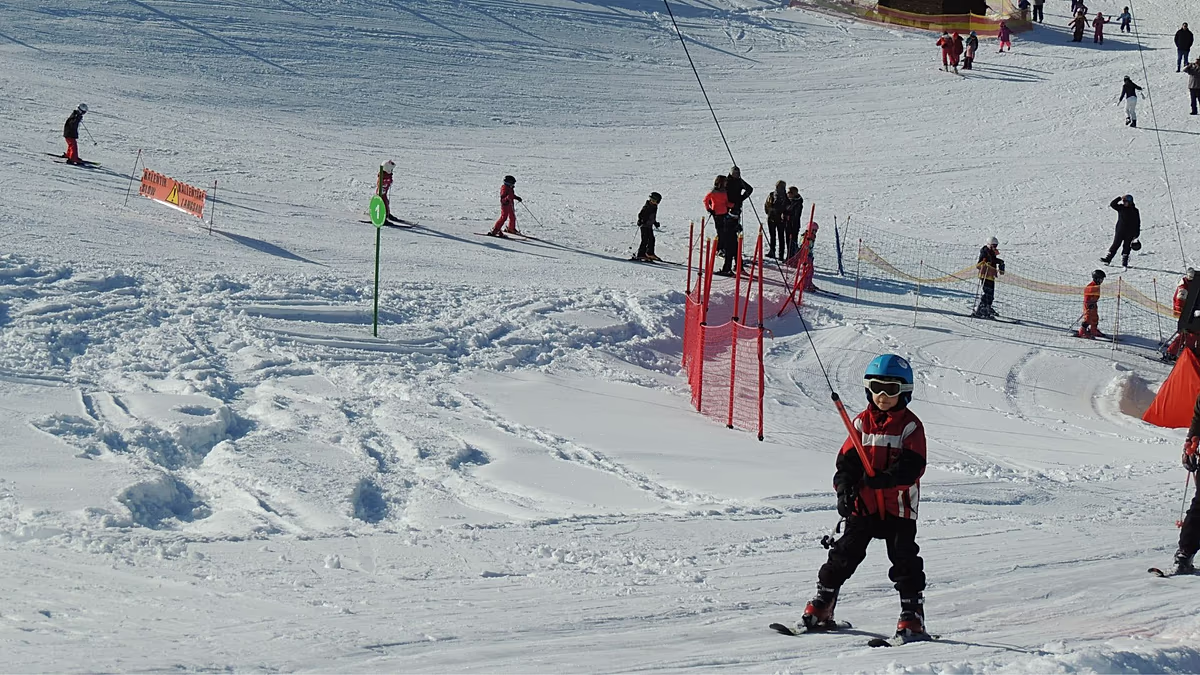
The financial mathematics behind Saint-Colomban-des-Villards’ free skiing policy seems counterintuitive until you examine the details. After running at a deficit for nearly 25 years, the situation became critical recently when annual losses ballooned to €1 million—an unsustainable figure for a municipality whose entire annual budget is just €2.7 million. “Almost 40 percent of the town’s budget was being used to cover a loss-making activity,” explains Mayor Pierre-Yves Bonnivard. When officials calculated the costs of running ticket offices and maintaining a pass system (approximately €41,000) against projected beginner pass revenue (only about €18,000), the conclusion was startling: it would actually cost more to charge for skiing than to offer it for free. By dramatically scaling back operations to just two drag lifts and a children’s belt, while eliminating ticketing infrastructure, the village expects to reduce its seasonal deficit to between €150,000 and €200,000—still a loss, but one-fifth of previous levels and financially manageable for the community.
Behind these economic calculations lies a more profound reality that many Alpine communities are reluctantly confronting: the existential threat posed by climate change to low and medium-altitude ski resorts. Saint-Colomban-des-Villards had previously been connected to Les Sybelles, France’s fourth-largest ski area, but this connection is no longer operational—another blow to the village’s winter tourism offering. “At 1,100 meters, alpine skiing is ultimately doomed to disappear,” acknowledges Mayor Bonnivard, noting that “climate change is progressing faster than anticipated, especially in the Alps.” This candid admission represents a significant psychological shift in a region where skiing has been not just an economic activity but a cultural cornerstone for generations. The village’s south-facing slopes increasingly struggle to retain snow coverage throughout the winter season, making traditional alpine skiing less viable with each passing year, regardless of economic models. For communities that have defined themselves through winter sports for decades, this recognition is both practically necessary and emotionally challenging.
What emerges from Saint-Colomban-des-Villards’ story is a community in transition, using this free skiing experiment as a bridge between its past identity and whatever comes next. The municipality has consciously chosen to maintain some skiing rather than abruptly abandoning it entirely, recognizing the psychological and economic shock such a sudden change would create for residents and local businesses. “Going from a connected ski area to nothing at all would have been too brutal,” explains the mayor. The free beginner slopes now serve multiple purposes: they preserve some skiing heritage, provide a gradual transition for local tourism-dependent businesses, and offer a low-risk environment where beginners and families can experience winter sports without the financial commitment that typically accompanies ski vacations. This transitional approach acknowledges that while the long-term future may not include traditional alpine skiing, communities need time to adapt both economically and culturally to new realities.
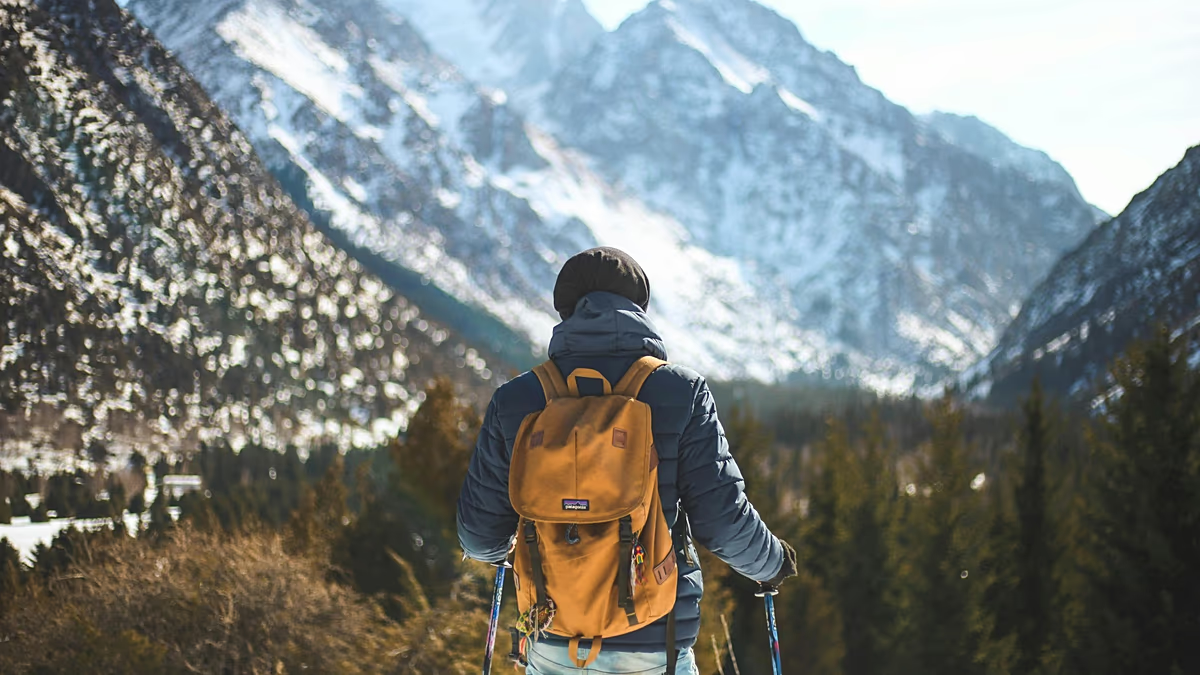
The village is simultaneously working to expand and diversify its tourism offerings beyond the traditional ski season model. Snowshoeing and winter walking routes are already established, particularly on the sunnier slopes where reliable snow coverage for skiing has become problematic. The municipality’s leadership sees an opportunity to redirect resources previously consumed by loss-making ski infrastructure: “Until now, we have invested almost all our energy, time and money into a ski activity that was losing money,” explains Bonnivard. “This decision frees up resources to imagine something else.” The village’s natural assets—its authentic character, unspoiled Alpine valley setting, and natural beauty—provide a foundation for developing year-round tourism focused on hiking, nature experiences, and cultural heritage. Summer tourism already brings visitors to the area, offering a potential model for expanding beyond winter sports dependency. However, transforming into a genuine four-season destination requires not just rebranding but infrastructure investment, business adaptation, and community buy-in—none of which happens overnight.
Saint-Colomban-des-Villards plans to evaluate this winter’s free skiing experiment in April, determining whether the approach can continue or needs modification. Whatever the outcome, this small Alpine community’s story represents in microcosm the challenges and transitions facing many traditional mountain destinations across Europe. Climate change is forcing difficult decisions that intertwine economic survival, cultural identity, and environmental adaptation. For visitors this season, the village offers a rare opportunity: experiencing winter sports without the significant financial barrier typical of Alpine resorts. For the broader tourism industry, it provides a case study in how communities can begin navigating the difficult path between traditional winter sports models and more sustainable, diversified futures. As Mayor Bonnivard puts it, this represents “a painful but necessary shift for communities long dependent on skiing”—a transition that many other Alpine villages may soon face as climate patterns continue to change and economic pressures mount. Saint-Colomban-des-Villards’ experiment may prove to be less an anomaly and more a preview of adaptations to come across Europe’s beloved mountain landscapes.