


Mount Etna Guides Strike: Balancing Tourism with Safety
In a historic turn of events, tour guides who shepherd adventurous hikers up Sicily’s Mount Etna have initiated their first strike in decades, protesting what they consider overly restrictive measures implemented by local authorities in Catania. The dispute centers on recent regulations that limit excursions to Europe’s most active volcano following a series of eruptions that began on Christmas Eve. Dozens of official guides demonstrated at Mount Etna’s lava flow gate, arguing that the new restrictions effectively undermine their professional role and expertise. “These measures effectively nullify the role of guides, stripping them of their skills, function, and professional responsibility,” stated the guides’ regional board in their official communication. The guides, who plan to continue their strike in the coming days, are seeking a middle ground that preserves both visitor safety and their livelihood, which depends on providing tourists with memorable volcanic experiences.
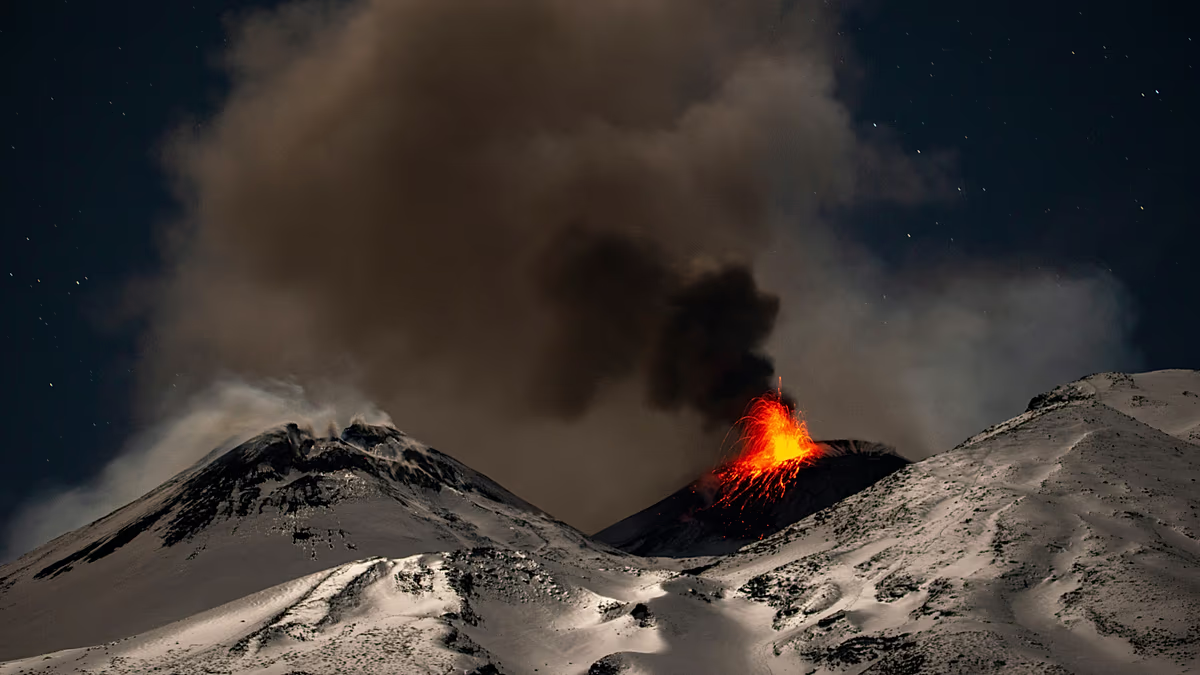
The new restrictions have significantly altered how tourists can experience Mount Etna’s spectacular natural displays. Under these regulations, excursions are permitted only until dusk, eliminating the popular nighttime views when lava flows are most dramatic against the darkened sky. Visitors must now maintain a distance of at least 200 meters from active lava flows, and authorities are strictly enforcing the existing ten-person-per-group limit, even deploying drones for surveillance. These measures have been met with frustration from both guides and disappointed tourists like 32-year-old Claudia Mancini, who traveled from Palermo only to have her excursion canceled. “Unfortunately, we got the bad news of the cancelling of all activity,” Mancini explained, expressing sympathy for the guides facing this difficult situation that “is not making anyone happy.” The enforcement has been rigorous, with local media reporting that 21 people were cited by forestry police for non-compliance with the new rules.
The controversy is further intensified by scientific assessments suggesting that current volcanic activity poses minimal danger. The lava flow that began on Christmas Eve reached 1,360 meters above sea level before cooling after traveling approximately two miles, and volcanologists have confirmed it presents no threat to residential areas or guided hikers. Boris Behncke, a volcanologist based at Catania’s National Institute of Geophysics and Volcanology, has been particularly vocal in his criticism of the restrictions. “Among all the eruptions of Etna in recent years, there hasn’t been one as harmless, pleasant, or as little dangerous,” Behncke wrote on Facebook, questioning the rationale behind the ordinances. Dario Teri, a member of Sicily’s association of alpine and volcano guides who participated in the protests, echoed this sentiment, emphasizing, “This is a lava flow that is descending very slowly on an area that is now also flat or semi-flat,” suggesting that the current activity doesn’t warrant such stringent limitations on access.
Mount Etna, standing 3,350 meters tall and 21.7 miles wide, represents more than just a natural wonder; it’s a vital economic resource for Sicily’s tourism industry. As Europe’s largest and most active volcano, it attracts a diverse range of visitors, from experienced hikers seeking to scale its slopes to casual tourists content with observing its majesty from afar. The volcano’s frequent eruptions provide spectacular displays that draw visitors from around the world, creating a unique tourism niche that balances natural wonder with controlled risk. For many travelers, witnessing the primal force of a volcanic eruption under safe conditions is a once-in-a-lifetime experience. The guided excursions are particularly important because, beyond certain altitudes (specifically past the 2,900-meter mark), regulations mandate that visitors be accompanied by qualified guides—professionals whose livelihoods now hang in the balance due to the new restrictions.
The current situation highlights the complex balance between safety concerns and tourism interests that many natural wonder destinations must navigate. While the June 2023 eruption, which forced tourists to flee from a massive plume of high-temperature gases, ash, and rock, demonstrates the real dangers that Mount Etna can present, the volcano’s monitoring systems typically provide advance warnings that allow for safe management of tourist activities. The guides argue that their professional expertise enables them to assess risks in real-time and make informed decisions about safe viewing distances—a capability they feel is undervalued by the current blanket restrictions. Their protest represents more than just a labor dispute; it reflects fundamental questions about risk assessment, the role of expert judgment in safety protocols, and how natural hazards should be managed in tourist settings.
As this standoff continues, the broader implications extend beyond Mount Etna to similar natural attractions worldwide. The situation exemplifies the tensions that arise when authorities must weigh public safety against economic interests and access to natural wonders. For Sicily, a region that depends significantly on tourism revenue, finding the right balance is particularly crucial. The guides’ strike and the ongoing negotiations with local authorities may ultimately lead to a new framework for managing volcanic tourism—one that incorporates more flexible, expertise-driven approaches to safety rather than rigid distance and time restrictions. Until such a compromise is reached, however, tourists hoping to experience the mesmerizing sight of Mount Etna’s lava flows may find their plans disrupted, caught in the crossfire between safety protocols and the practical knowledge of those who know the mountain best. As the National Institute of Geophysics and Volcanology confirms that the eruption is ongoing but cooling, all stakeholders await a resolution that respects both the majestic power of nature and the human desire to witness it safely.