



The Sky-High Revolution: How Starlink is Transforming In-Flight WiFi
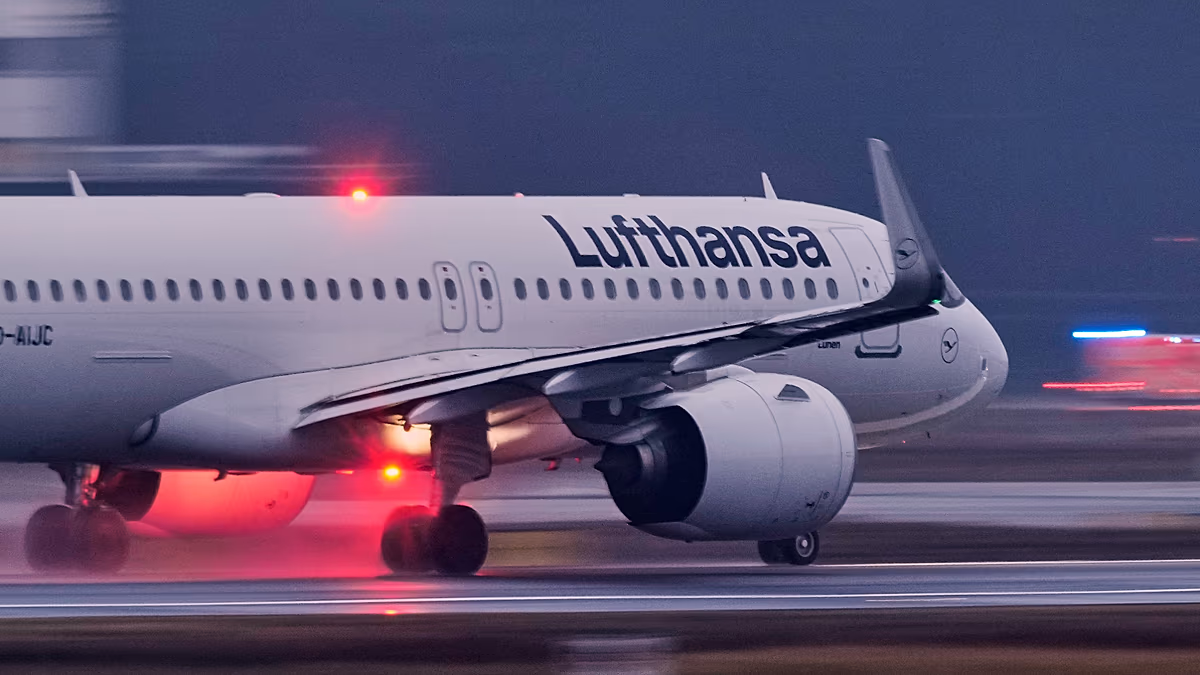
In the ever-evolving world of aviation, technological advancements continue to reshape our flying experience. While green fuels and the anticipated return of supersonic travel represent significant industry shifts, perhaps the most tangible change for passengers is the remarkable improvement in in-flight WiFi connectivity. The era of reluctantly switching to airplane mode and settling for a paperback has given way to seamless connectivity at 35,000 feet. Today’s travelers can stream high-definition videos, participate in video calls, and remain connected to the digital world throughout their journey. At the forefront of this connectivity revolution stands Starlink, Elon Musk’s satellite internet provider that’s rapidly changing how we experience long-haul flights. With Lufthansa Group recently announcing plans to implement this technology across its fleet, the transformation of air travel connectivity is accelerating. The once disconnected sanctuary of airplane cabins is evolving into an extension of our digitally connected lives, blurring the boundaries between ground and air experiences.
Starlink, a subsidiary of SpaceX, has revolutionized global internet access through its vast constellation of over 6,750 low Earth orbit satellites. The system functions by transmitting data from a user’s device to these orbiting satellites, which then relay the signal to receiving dishes mounted on aircraft. What distinguishes Starlink from traditional satellite internet providers is the altitude at which its satellites operate. While conventional satellites orbit approximately 36,000 km above Earth’s equator, Starlink’s satellites maintain a much lower orbit. This proximity to Earth significantly reduces latency—the time data takes to travel between points—to around 25 milliseconds, compared to the 600 milliseconds typical of traditional satellite connections. The result is a near-terrestrial internet experience that feels remarkably similar to ground-based broadband. The comprehensive coverage provided by Starlink’s satellite mesh makes it particularly well-suited for aviation applications, enabling connectivity in regions where traditional solutions fall short, including remote flight paths over oceans or polar routes.
The integration of Starlink into commercial aviation began in earnest in early 2024, with Hawaiian Airlines pioneering its implementation across its entire fleet by October of that year. Qatar Airways quickly followed, equipping approximately 120 aircraft with the technology within months. Europe saw its first Starlink-enabled flights through Latvia’s airBaltic in February 2025, with Air France and SAS introducing the service later that year. The momentum continues to build, with Lufthansa Group planning fleet-wide implementation beginning in the second half of 2026, while Virgin Atlantic is set to become the first UK carrier to offer Starlink connectivity starting in the third quarter of this year. This rapid adoption reflects airlines’ recognition that superior connectivity represents a significant competitive advantage in today’s market. For passengers, perhaps the most welcome aspect of this technological integration is that most airlines offer Starlink access at no additional cost, though some carriers require membership in their loyalty programs to enable access. This complimentary approach to high-quality connectivity marks a notable shift from earlier business models that charged substantial premiums for often underwhelming internet connections.
Despite the growing enthusiasm for Starlink among many carriers, not every airline is rushing to implement this technology. Most notably, Ryanair, Europe’s largest airline by passenger numbers, has explicitly ruled out introducing Starlink. CEO Michael O’Leary cited the relatively short duration of their average flights and the substantial costs associated with installation and maintenance as key factors in this decision. This highlights an important consideration in the Starlink adoption equation: the service may deliver the most value on longer flights where passengers have greater need for connectivity and airlines can more easily justify the investment costs. Budget carriers have generally remained hesitant about embracing Starlink, though this landscape is beginning to shift. Eurowings, as part of the Lufthansa Group, will soon incorporate the service, and Barcelona-based Level has announced plans to implement Starlink by the end of the year. These developments suggest that even in the price-sensitive budget segment, enhanced connectivity is increasingly viewed as an important competitive differentiator rather than merely a luxury amenity.
The broader implications of this connectivity revolution extend well beyond simple passenger entertainment. Enhanced in-flight internet enables business travelers to maintain productivity throughout their journeys, effectively transforming previously “dead” travel time into productive work hours. For airlines, the technology creates new opportunities for operational efficiency through real-time data transmission, potentially improving everything from maintenance scheduling to flight path optimization. The psychological impact for travelers is equally significant, as the anxiety that sometimes accompanies technological disconnection during travel diminishes. Families can remain in contact during long journeys, professionals can respond to urgent matters without delay, and the overall stress of being unreachable is substantially reduced. As this technology becomes standardized across more carriers, passenger expectations are being permanently reshaped, with robust connectivity increasingly perceived not as a luxury but as a fundamental aspect of the air travel experience.
Looking ahead, the integration of Starlink into commercial aviation represents just the beginning of a more comprehensive digital transformation in the skies. As satellite coverage continues to expand and technology evolves, we can anticipate even faster connections with negligible latency. The distinction between ground-based and in-flight connectivity experiences will likely continue to diminish until they become virtually indistinguishable. This connectivity revolution may also accelerate other technological innovations in the cabin experience, from augmented reality entertainment to more sophisticated personalization of services. For business travelers, the ability to conduct video conferences, access cloud-based applications, and collaborate remotely throughout flights will fundamentally change how work travel is structured and valued. While traditionalists and digital minimalists might lament the loss of air travel as a forced digital detox opportunity—a trend playfully referred to as “raw-dogging flights”—the overwhelming industry direction points toward ubiquitous connectivity becoming the new standard. As we journey further into this connected future, the airplane cabin is transforming from an isolated bubble into a seamlessly integrated extension of our digitally connected lives, redefining what it means to travel in the modern age.