




Japan on High Alert Following Earthquake, Issues Rare “Megaquake” Warning
Japan finds itself on heightened alert after experiencing a significant magnitude 7.5 earthquake that struck its northern regions late Monday. The seismic event prompted tsunami warnings and led to an unusual government advisory about the potential for a “megaquake” in the coming week. This situation has created a complex scenario for Hokkaido as it enters its prime winter tourism season, with ski resorts already welcoming early visitors ahead of the holiday rush. The timing of this natural disaster warning creates a delicate balance between safety concerns and the economic importance of tourism to the region.
The earthquake hit off the eastern coast of Aomori, Japan’s northernmost prefecture on the main island of Honshu, at approximately 11:15 pm local time. According to the Japan Meteorological Agency (JMA), the quake registered an upper 6 on Japan’s seismic intensity scale, causing slow but powerful waves to rattle parts of Aomori with shockwaves felt further north in Hokkaido. Fortunately, there have been no reports of fatalities or serious infrastructure damage, and nearby nuclear power plants showed no abnormalities according to Japan’s national broadcaster NHK. While initial tsunami warnings were issued for Iwate, Hokkaido, and Aomori, these were subsequently downgraded and fully lifted by early Tuesday morning. Transportation disruptions have been minimal, with Tohoku Shinkansen services briefly suspended before resuming normal operations on Tuesday.
What has drawn particular attention is the JMA’s unprecedented “megaquake” warning – the first since this alert category was introduced in 2022. The advisory warns of the potential for an earthquake of magnitude 8 or higher along the Japan Trench and the Chishima Trench off Hokkaido, remaining in effect until December 16. Authorities caution that a stronger tremor could generate tsunami waves reaching heights of 3 meters in the affected areas. Officials emphasize that this warning is not a definitive prediction but rather represents a statistical possibility based on patterns observed in large offshore earthquakes. The government is taking a precautionary approach, prioritizing public safety while acknowledging the uncertainty inherent in seismic forecasting.
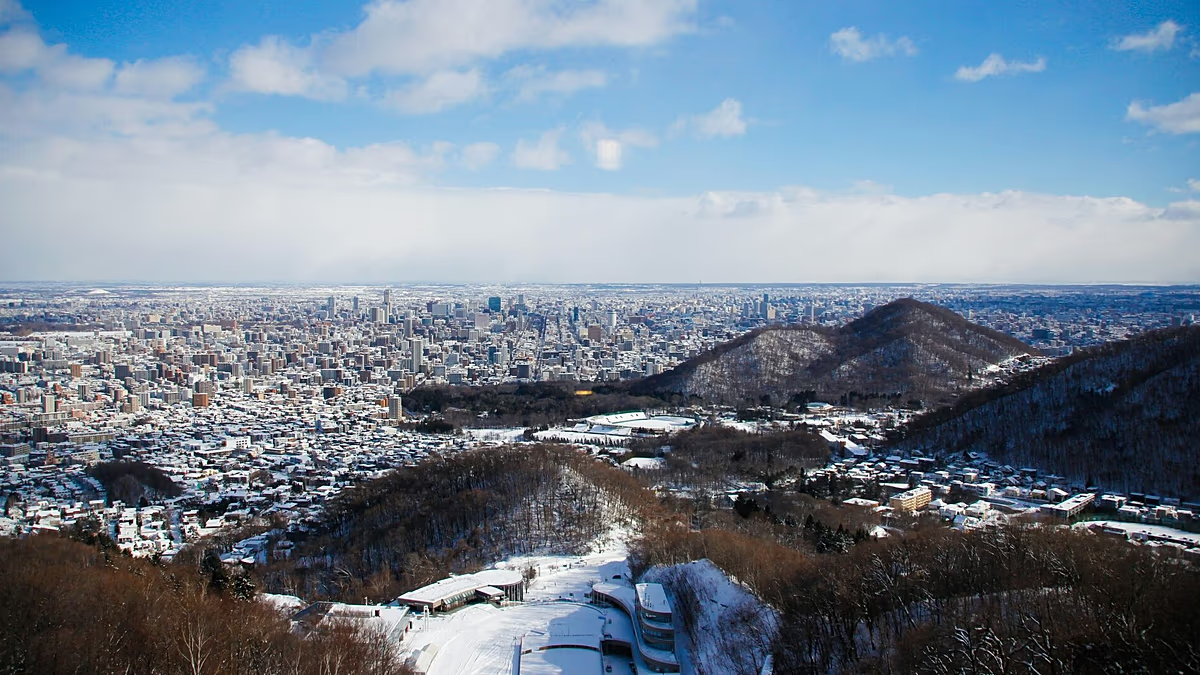
The timing of this seismic activity and subsequent warning coincides with Hokkaido’s crucial winter tourism season. The region, particularly Niseko, has become one of Japan’s premier winter destinations, recording impressive numbers during the previous 2024-25 season with over 11 million lift rides and an estimated 2.2 million visitors across its four resorts. With forecasts predicting another snowy La Niña winter, tourism operators had been anticipating another strong season. Despite the alarming nature of a “megaquake” warning, daily operations continue largely unaffected across the region. Flights and most rail routes are functioning normally, with authorities not imposing any travel restrictions to northern Japan or Hokkaido. Importantly, there have been no reports of direct impact at major ski areas like Niseko and Furano – no significant building damage or resort closures have occurred, allowing the tourism industry to continue operating while maintaining heightened awareness.
Living with seismic risk is an intrinsic part of Japanese culture and infrastructure planning. Japan ranks among the world’s most seismically active nations, with nearly 2,000 earthquakes of magnitude 4 or higher striking within 300 kilometers of Hokkaido over the past decade, according to open-source data. This geological reality has shaped both Japan’s building codes and its emergency response systems, which are considered among the most advanced globally. For travelers visiting during this period, authorities recommend staying informed through official channels and understanding basic earthquake safety procedures. The Japan National Tourism Organisation (JNTO) specifically suggests downloading the Safety Tips app, which provides multilingual alerts for earthquakes, tsunamis, and other weather warnings throughout Japan, ensuring that visitors can receive critical information regardless of language barriers.
The current situation in northern Japan illustrates the delicate balance between acknowledging natural disaster risks and maintaining everyday life in a country that has long adapted to seismic activity. For those in Japan during an earthquake, safety guidance remains straightforward but essential: drop, cover, and hold onto something stable. Indoor occupants should remain inside away from windows, while those outdoors should move away from buildings, trees, and power lines to avoid falling debris. Elevators should be avoided during and immediately after seismic events. As Hokkaido’s winter tourism activities continue under the shadow of this advisory, the situation highlights Japan’s pragmatic approach to living with geological uncertainty – implementing robust warning systems and preparedness measures while continuing daily activities with appropriate caution. This balanced approach allows Japan to maintain its vibrant tourism industry even while acknowledging and preparing for the natural forces that have shaped its islands for millennia.