







Navigating the Skies During Global Tensions: How Airlines Manage Airspace Challenges
In times of global conflict, a curious phenomenon emerges online—netizens flock to platforms like X, news websites, and Flightradar24 to “monitor the situation.” Those yellow aircraft icons clustered together on digital maps tell only part of the story, however. Behind these seemingly simple visualizations lies an intricate dance of decision-making, coordination, and prioritization that ensures flights continue to operate safely even when geopolitical tensions soar. The aviation industry has developed sophisticated systems to navigate these challenges, with passenger safety always remaining the paramount concern. From sudden airspace closures to ongoing conflicts, airlines and air traffic control organizations work tirelessly to maintain the complex global network of flight routes while minimizing disruptions to travelers.
When airlines plan routes between destinations, they’re essentially choosing among multiple “roads in the sky.” According to Lindi-Lee Kirkman, IATA’s regional head of operations for Africa and the Middle East, these decisions involve numerous considerations including weather patterns and emissions reduction, but safety and security always take precedence. “If those two are not met, then none of the other factors come into play,” Kirkman explains. Each airline conducts thorough safety and security assessments at every stage of flight planning, from initial strategic planning to the moments before departure. These assessments follow clearly defined criteria that determine whether a flight can proceed as planned. Importantly, airlines maintain their own individual safety parameters, which may lead them to avoid certain airspaces even when they haven’t been officially closed. This layered approach to safety means that different carriers might make different routing decisions based on their own risk tolerance and assessment protocols, even when facing the same geopolitical situation.
The mechanics of airspace closure reveal the intricate international framework governing our skies. Each nation exercises exclusive sovereignty over its airspace—a principle established in the 1944 Convention on International Civil Aviation. When a country decides to close its airspace due to conflict or other security concerns, it issues a NOTAM (Notice to Airmen), triggering a cascade of communications between airlines and air traffic controllers. Pilots communicate with both their current air traffic control authorities and those in neighboring regions to determine safe alternative routes. While the resulting pattern of diverted flights may appear chaotic on flight tracking applications, this type of demand and capacity balancing is something the aviation industry handles regularly. Air traffic controllers have several tactical options for managing increased traffic through certain corridors—they might space flights at specific intervals (accepting traffic every 10 minutes, for example) or slightly alter flight paths to extend air time and prevent congestion. This operational flexibility allows the system to absorb significant disruptions while maintaining safety standards.
Long-term conflicts present different challenges than sudden, short-term airspace closures. Russia’s invasion of Ukraine exemplifies how regional air traffic patterns can be permanently altered by ongoing hostilities. Countries like Poland, Estonia, and Latvia have dealt with reduced usable airspace due to issues like GNSS spoofing and jamming, while other nations such as Azerbaijan have absorbed additional traffic as planes divert around unsafe areas. Despite the scale of these disruptions, Enrico Parini from the Civil Air Navigation Services Organisation (CANSO) notes that the industry has demonstrated remarkable resilience. “We cannot say that back then we were ready, but we were found ready, because the level of contingency and of resilience that we built previously has allowed us to handle this,” he explains. The aviation industry has adapted to these challenges to the point where managing such geopolitical complications has become nearly standardized, allowing operations to continue without compromising safety.
Different conflict zones require tailored approaches to airspace management. In Sudan, where fighting has been ongoing, contingency routes allow aircraft to traverse safe portions of the country rather than bypassing it entirely. This strategic approach saves hours of flying time, resulting in delays of approximately 30 minutes rather than major route changes. The Middle East presents a different scenario, where conflicts can flare up with minimal warning, making permanent contingency routes impractical. Instead, when tensions rise, a contingency coordination team forms under the leadership of the International Civil Aviation Organization (ICAO). This team works with regional air traffic control organizations and IATA to gather intelligence and anticipate traffic pattern changes, allowing affected states to prepare for increased demand before it materializes. This proactive approach helps minimize disruptions even when situations evolve rapidly, demonstrating the aviation industry’s ability to adapt to varying conflict scenarios with different operational solutions.
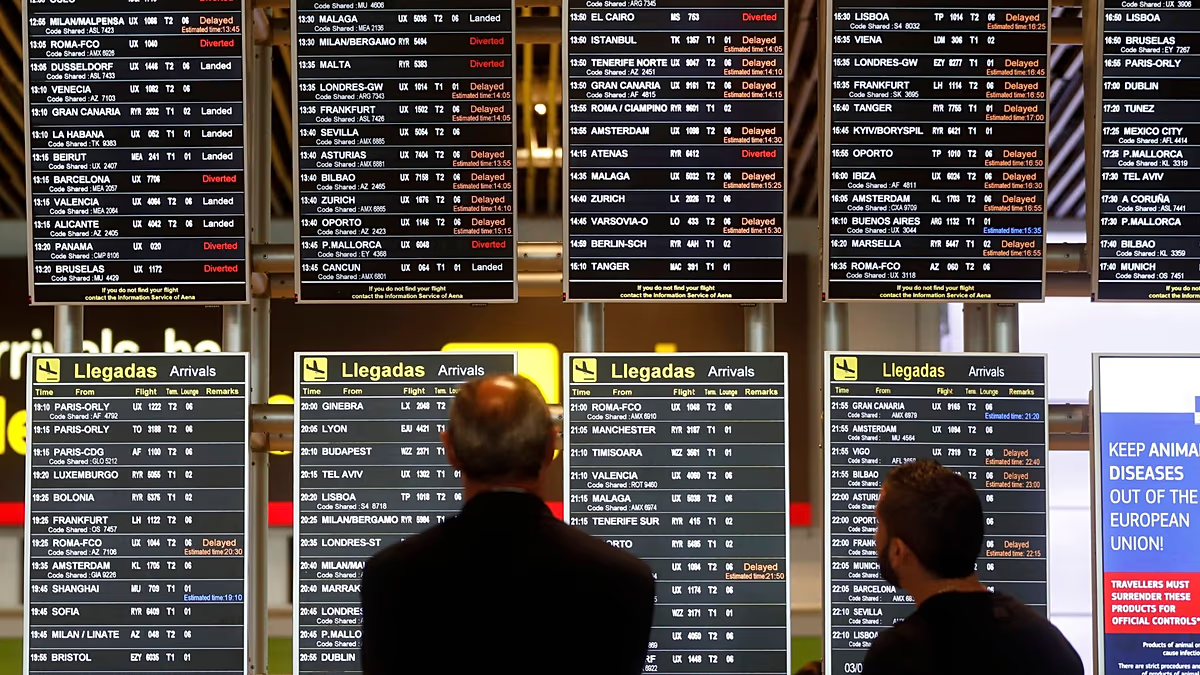
For travelers whose journeys might intersect with closed airspaces, the primary impact is typically delays rather than cancellations. Kirkman explains to Euronews Travel that “Cancellations generally are not favourable because that impacts everybody.” Instead, airlines often opt to fly longer routes, which may significantly extend flight times depending on the specific situation. The key advice for passengers during such disruptions is straightforward: stay in communication with your airline, which remains your best source for updated information. Airlines prioritize passenger safety and security above all else and will communicate necessary changes to itineraries as situations develop. The remarkable resilience of the global aviation system means that even amid significant geopolitical tensions, the vast majority of flights continue to operate safely, albeit sometimes with altered routes and schedules. This testament to international cooperation and technical expertise often goes unnoticed by passengers, who may experience nothing more than a slightly longer flight time while complex diplomatic and security challenges are navigated overhead.