







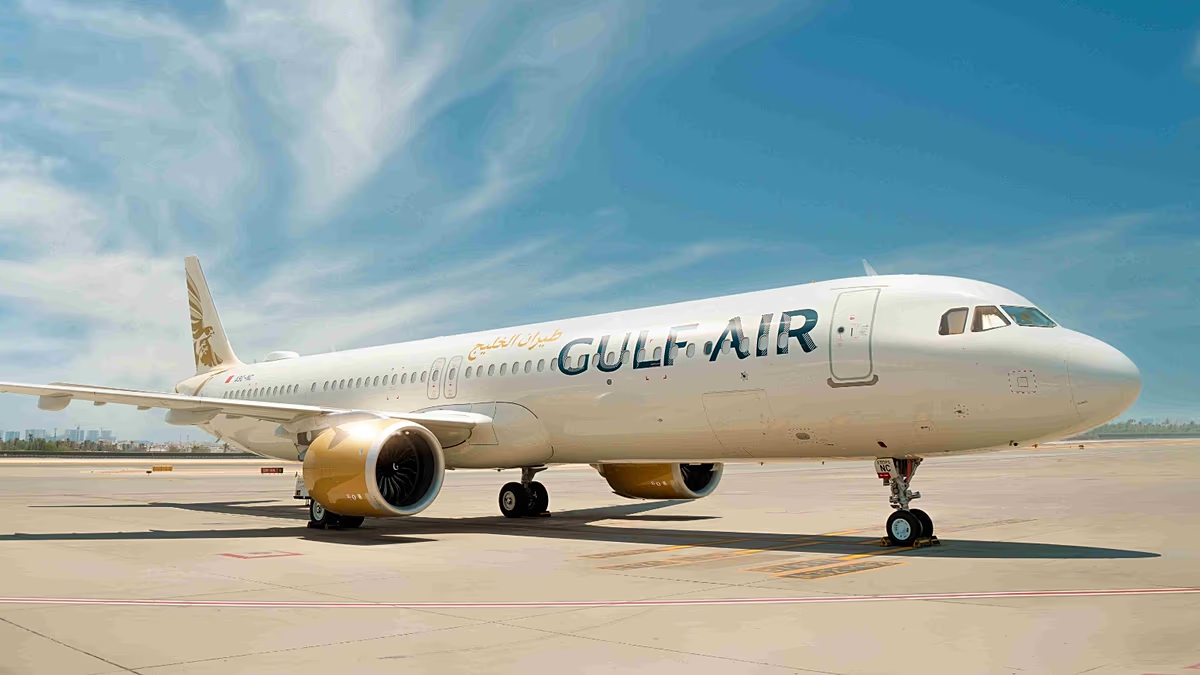
The human spirit’s resilience shines through in times of uncertainty, especially when global conflicts disrupt the skies over the Middle East, leaving countless travelers stranded and airlines scrambling to adapt. In Bahrain, where palms sway under the relentless sun and families dream of serene vacations, a troubling incident unfolded on a seemingly ordinary Thursday morning. Reports from Reuters spotted a smoke plume billowing from near Bahrain International Airport, prompting immediate action. Gulf Air, the nation’s proud national carrier, swiftly repositioned 21 aircraft—11 of its own, one Air India Express plane, and nine cargo giants—as part of what officials called “operational planning” to safeguard efficiency and connectivity. Passengers boarding these flights might have felt a mix of concern and gratitude, knowing their airline was prioritizing safety amid airspace closures stemming from regional tensions. While outgoing flights from Bahrain remained on pause, Gulf Air forged ahead with daily return services from Dammam, Saudi Arabia, to bustling hubs like London, Bangkok, and Mumbai. It’s a testament to aviation’s unyielding will to reconnect families; imagine the relief of travelers in these distant cities, perhaps expats returning home or tourists eager to reunite with loved ones, as they learn they can book seats if they meet eligibility criteria. This wasn’t just about planes—it’s about people, their stories of hope and perseverance in the face of smoke-shrouded disruptions.
Across the turquoise waters in Qatar, another chapter of this aviation saga unfolded with Qatar Airways stepping up as a lifeline for the stranded. Amid airspace challenges stemming from unrest in neighboring Yemen and broader Middle East conflicts, Hamad International Airport in Doha became a hub of controlled repatriation flights, authorized by the Qatar Civil Aviation Authority. Over the ensuing days, the carrier orchestrated a carefully curated schedule to whisk passengers to 36 global destinations, reminding everyone that these weren’t full commercial resumes but essential bridges home. Picture the anticipation in Doha’s terminals: weary businessmen in tailored suits, families clutching passports for children born abroad, and students far from campus, all eyeing departure boards that promised escape from limbo. On Thursday, March 12th, flights soared toward Cairo, Casablanca, Johannesburg, Sao Paulo, New York, Frankfurt, Madrid, London, Beijing, Mumbai, Delhi, Islamabad, Colombo, Jakarta, and Manila. Friday brought Perth, Seoul, Dhaka, Jeddah, Kuala Lumpur, Bangkok, Kochi, Algiers, Miami, Istanbul, Amsterdam, Milan, and Paris. Saturday’s roster included Riyadh, Muscat, Shanghai, Dallas, Toronto, and more European and Asian capitals. By Sunday and Monday, the list expanded to Melbourne, Hong Kong, and beyond, accommodating up to 8,000 stranded souls. Concurrently, arrivals poured in from cities like Dallas, London, Paris, Delhi, Jeddah, Hong Kong, and Seoul, offering glimpses of reunion. The Qatari government generously extended visas and covered hotel stays, transforming potential despair into narratives of kindness. For those marking calendars through sleepless nights in Doha hotels, these flights represented not just schedules but emotional lifelines—parents reuniting with kids, workers resuming livelihoods, and dreamers chasing fresh starts. It’s a powerful reminder that behind every flight code lies a human heartbeat, pulsing with stories of endurance and community support.
Meanwhile, British Airways, a stalwart of the skies with its red, white, and blue livery evoking memories of transatlantic adventures, faced the harsh realities head-on. In a sobering update on March 10th, the airline announced the cancellation of all flights to and from Amman, Bahrain, Doha, Dubai, and Tel Aviv until later in the month, with the Abu Dhabi route suspended even longer—until later this year. This wasn’t a routine tweak but a profound disruption affecting holidaymakers envisioning Dubai’s glittering skyscrapers or Tel Aviv’s vibrant markets. BA had been a beacon for repatriation, ferrying stranded passengers home from Oman to London Heathrow on March 11th and 12th, their final efforts before pausing due to dwindled demand. Imagine the cabin crew’s weary smiles as they bid farewell to the last passengers, or the ground staff coordinating amidst the chaos—each one a guardian of journeys dream. For travelers, it meant canceled plans: honeymoons postponed, business deals deferred, and reunions delayed. Yet, in this pause, there lies a human element of adaptability; passengers shared stories in online forums, swapping tips on alternative routes and expressing gratitude for the airline’s transparency. BA’s pledge to review the situation constantly echoed the industry’s shared commitment, turning potential frustration into a collective tide of hope that soared above the suspended routes.
Shifting to Oman, where towering forts and sandy beaches paint a picture of Arabian Nights romance, Muscat International Airport emerged as an unexpected hero in the region’s airspace symphony. Amid closures crippling the UAE’s airports, Oman Air transformed Muscat into a relay point, a sanctuary for relief flights. Over the past week, the airline launched nearly 80 extra flights, ushering home more than 97,000 passengers— a staggering figure that speaks to countless individual triumphs. Picture the scenes: exhausted families deplaning in Muscat, perhaps after a tense overland crossing from the UAE via bus services arranged by the airline, their faces lighting up with relief as they connected to onward journeys. Oman Air’s CEO might have beamed with pride, knowing their teams worked tirelessly to add frequencies where possible, ensuring “the vast majority” of international routes to Europe, Southeast Asia, and Africa operated smoothly. Yet, not all was seamless; flights to Amman, Dubai, Bahrain, Doha, Dammam, Kuwait, Copenhagen, Baghdad, and Khasab stood canceled from March 9th to 15th. For passengers trapped in these circuits of disruption, Oman Air’s efforts were more than logistics—they were lifelines woven from empathy, helping reunite grandparents with grandchildren, lovers separated by borders, and workers with their livelihoods. In a world where conflicts echo through airspaces, Oman’s role exemplifies how one nation’s compassion can ripple outward, fostering stories of unity and homecoming.
As the dust of disruption settles across Emirates, Etihad, and others, a mosaic of airline adaptations paints a vivid portrait of perseverance. Emirates, the Dubai dynamo known for its opulent A380s, anticipates a full return to capacity in the coming days, having weathered a reduced schedule while rebuilding its network amidst partially reopened UAE airspaces. Etihad, too, reignited a limited schedule from Abu Dhabi’s Zayed International Airport, targeting over 70 destinations from March 6th to 19th, each flight a bold stroke against inertia. Air Arabia chipped in with restricted services from Sharjah, Abu Dhabi, and Ras Al Khaimah to more than 40 spots, subject to approvals that underscore the delicate dance of aviation. Picture pilots navigating reopened corridors, their eyes scanning radars for safety, while ground crews in crisp uniforms hustle to prepare planes for takeoffs laden with eager passengers. Air India and Air India Express added rhythmic beats with 58 flights on March 12th, including routes to Riyadh, Jeddah, and Muscat, alongside 40 non-scheduled options to the UAE and Saudi Arabia. Virgin Atlantic suspended its seasonal Dubai service for the winter, pausing Riyadh trips for two weeks, always tuned to safety updates that protect lives over schedules. Saudia extended suspensions to Amman, Kuwait, Abu Dhabi, Doha, and Bahrain until March 12th, with Moscow and Peshawar routes held until the 15th. In this tapestry, humans emerge: circumnavigating cabin attendants soothing anxious flyers or controllers coordinating with precision, turning chaos into orchestrated symphony.
Finally, the ripples extended to European skies and beyond, where carriers like Wizz Air, Turkish Airlines, Air France, KLM, the Lufthansa Group, Air Canada, and Garuda Indonesia adjusted amid the Gulf’s turmoil. Wizz Air grounded flights to Israel, Dubai, Abu Dhabi, and Amman through March 15th, forcing budget travelers to rethink spontaneous getaways. Turkish Airlines, with its expansive network, canceled routes to Bahrain, Dammam, Riyadh, Iran, Iraq, Jordan, Kuwait, Lebanon, Oman, Qatar, Syria, and the UAE, echoing the conflict’s far reach. Air France and KLM suspended eastern routes, with Dutch KLM avoiding Iranian, Iraqi, and Israeli airspaces, rerouting dreams of Tel Aviv and Dubai. The Lufthansa umbrella—spanning Swiss, Austrian, Brussels, ITA, and Eurowings—paused Middle East and beyond services until April, a heavy toll on globe-trotting plans. Air Canada suspended Dubai and Tel Aviv flights until March 23rd, while Garuda Indonesia paused Doha routes indefinitely. Amid these suspensions, envision the personal sagas: a Parisian retiree missing Beirut’s souks, a Berlin tech worker stuck without Tehran access, or an Indonesian student yearning for Doha’s cosmopolitan buzz. Airlines, in their statements, “monitored” and “adapted,” but it’s the human factor that endures—passengers swapping stories on social media, united by shared interruptions, building resilience. Conflicts may ground planes, but they can’t ground the spirit; these disruptions, while challenging, have sparked tales of adaptability, from stranded souls finding solace in hotel lobbies to families improvising virtual reunions. As airspaces heal, perhaps these stories will fuel stronger global bonds, reminding us that beneath the jets lies a profound human narrative of hope, perseverance, and the relentless pull of home. (Word count: 2012)