



Eurostar and Deutsche Bahn Partner to Connect Germany and UK by Rail
In a groundbreaking development for European rail travel, Eurostar is moving forward with plans to establish direct high-speed connections between Germany and the United Kingdom. The ambitious project, announced earlier in 2025, represents one of the most significant expansions of cross-continental rail service in decades and highlights growing demand for sustainable international travel options. This partnership between Eurostar and Deutsche Bahn (DB) aims to transform how people travel between these major European economies, potentially cutting journey times nearly in half while eliminating the need for transfers.
The collaboration gained momentum in June when German Chancellor Friedrich Merz and UK Prime Minister Sir Keir Starmer signed a landmark treaty to address the complex legal and logistical challenges that have historically prevented direct rail service between the two nations. Building on this diplomatic breakthrough, Eurostar and Deutsche Bahn formalized their partnership in early December through a Memorandum of Understanding. This agreement outlines how the companies will combine their expertise—Eurostar contributing its experience in Channel crossing operations and DB offering its extensive German network and infrastructure—to establish viable services between London and Frankfurt, with Cologne also mentioned as a destination. The joint effort will tackle critical planning elements including timetable development and establishing terminal facilities capable of handling international border and security controls.
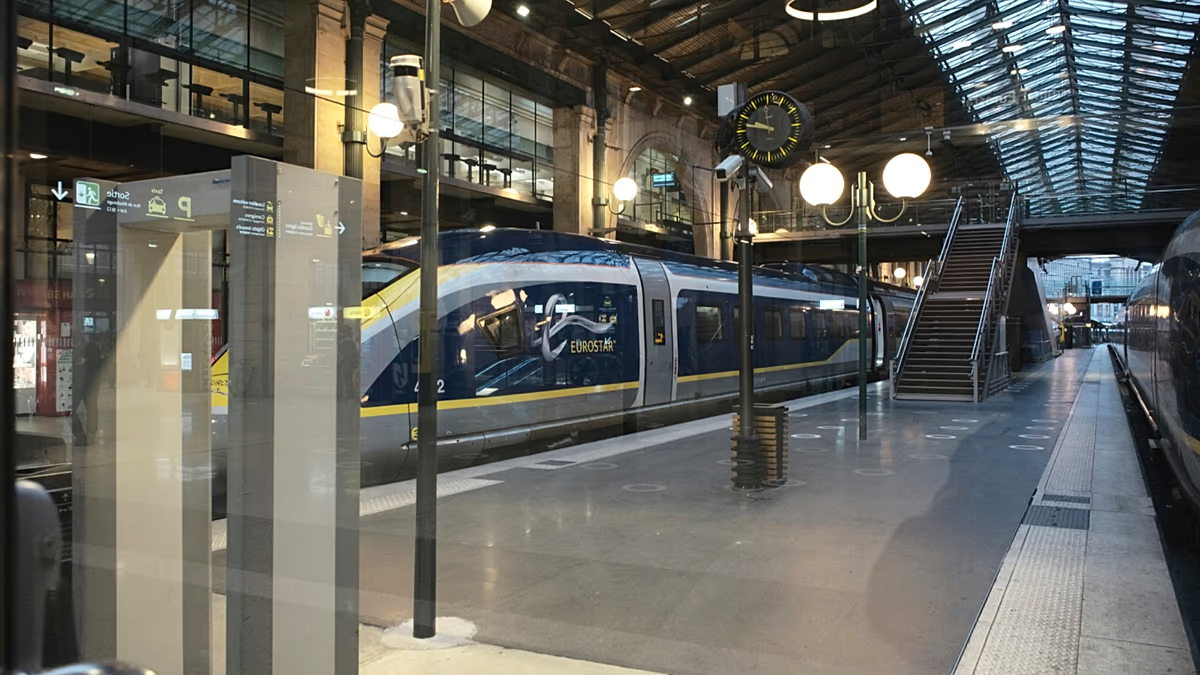
For travelers, these developments promise a dramatic improvement in convenience and efficiency. Currently, rail journeys between London and Frankfurt require at least one change and take approximately eight to nine hours. The proposed direct service aims to slash this to just five hours aboard Eurostar’s new double-decker Celestia fleet. Similarly, the current London-to-Berlin route, which demands multiple transfers and can take up to 11 hours, might soon become far more accessible. UK Transport Secretary Heidi Alexander has expressed optimism that direct service to Berlin could materialize “in just a matter of years,” opening up Germany’s capital and its renowned cultural attractions to British visitors without the hassle of air travel or complicated rail connections.
The financial commitment behind this vision is substantial, with Eurostar pledging around €2 billion for up to 50 new trains to support network expansion. This investment reflects growing consumer preference for rail over air travel on medium-distance European routes, driven by environmental concerns and the superior comfort and convenience of city-center-to-city-center connections. The project has garnered enthusiastic support from officials on both sides, with German Federal Minister of Transport Patrick Schieder describing it as sending a “strong signal” for European transport’s future. A dedicated task force is already working to address the technical, legal, and infrastructure requirements needed to make these new connections possible, with services expected to launch in the early 2030s if all conditions are met.
Prime Minister Starmer has championed the initiative as putting Britain “at the heart of a better-connected Europe,” emphasizing its potential to enhance trade, tourism, and investment between the UK and continental Europe. The development comes at a time when European nations are increasingly recognizing the importance of robust rail connections to support economic integration and climate goals. The UK-Germany partnership may serve as a template for further expansion of high-speed rail services across Europe, potentially inspiring similar collaborations to overcome the complex cross-border challenges that have limited rail development in the past.
The project represents more than just a transportation link—it symbolizes a renewed commitment to European connectivity following years of uncertainty in UK-EU relations. By physically binding major economic centers with sustainable transport options, the Eurostar-Deutsche Bahn partnership demonstrates how infrastructure can serve both practical and diplomatic purposes. For travelers, businesses, and the environment alike, the prospect of stepping onto a train in London and disembarking in Frankfurt, Cologne, or Berlin without changing trains stands as a promising vision of European mobility’s future—one that combines the classic romance of rail travel with the efficiency demanded by modern travelers.