





The Shifting Dynamics of Global Travel
In recent years, a quiet revolution has been brewing in the world of international travel, one that reflects changing traveler priorities and a quest for more seamless journeys. Those once-thrilling stopovers in bustling hubs like Dubai and Doha, with their luxury malls, vibrant street food scenes, and opportunities for quick cultural immersions, are losing their allure for many. Instead, more and more people are seeking the pure simplicity of direct long-haul flights—straight shots across oceans and continents without the hassle of layovers. It’s a shift driven by a mix of post-pandemic fatigue, where crowds and extra touchpoints feel risky, and a broader desire for efficiency in an era of increasing time constraints. Imagine packing light, boarding a plane in New York or London, and landing in Sydney or Tokyo hours later, refreshed and ready for the destination rather than delayed by jet lag compounded by transit hub chaos. This trend isn’t just anecdotal; travel agencies and airlines report a surge in demand for non-stop routes, with passengers willing to pay premiums for the convenience. Travelers are rethinking their itineraries, favoring direct connections that align with modern lifestyles—whether it’s a business executive racing against tight schedules or a family planning a stress-free holiday. The appeal lies in avoiding the unknowns: potential flight delays that snowball into missed connections, the tedium of customs queues, or even the temptation to overspend in duty-free havens that interrupt the flow of travel. As airlines respond by expanding their direct route networks, this movement signals a broader evolution in how we view global mobility, prioritizing the journey’s end over its scenic detours.
Reasons Behind the Pivot to Direct Flights
What lies beneath this growing preference for direct long-haul enthusiasts is a tapestry of practical and emotional motivations that resonate with everyday travelers. For starters, the COVID-19 pandemic reshaped attitudes toward travel, making proximity a concern rather than a perk; stopovers, once seen as opportunities for exotic breaks, now evoke images of crowded terminals and the risk of exposure in shared spaces. Health protocols, lingering uncertainties about variants, and the sheer exhaustion of multi-stage journeys have pushed people toward routes that minimize human contact and potential disruptions. Beyond health, there’s the factor of time— in our hyper-connected world, where every minute counts, a 16-hour direct flight feels more feasible than 12 hours plus a layover, even if the total duration is similar. Personal stories illustrate this vividly: take Sarah, a marketing executive from San Francisco, who recently opted for a non-stop to Mumbai instead of her usual stop in Dubai. “I used to love the spice souks and the buzz of the Emirates, but now I just want to sleep and arrive alert,” she shared, echoing sentiments from online forums where travelers lament the “lost day” to jet lag exacerbated by stopovers. Economically, direct flights can sometimes prove cost-effective at premium fares, avoiding additional fees for layovers or taxes in intermediary countries. Moreover, environmental concerns are creeping in; fewer takeoffs and landings mean lower carbon footprints, appealing to eco-conscious voyagers. This isn’t just about luxury—it’s about aligning travel with personal values, where convenience trumps the old-school romance of hub-hopping. As regulations ease and vaccines become commonplace, this avoidance of popular stopovers like Doha, with its commercial overtones, hints at a deeper cultural shift toward travel that’s less about spectacle and more about sustainability and sanity.
Airlines Adapting to the New Normal
Airlines, ever the barometers of traveler sentiment, are recalibrating their strategies to meet this rising demand for direct transoceanic routes, effectively rewriting the map of global aviation. Carriers like Emirates and Qatar Airways, previously reliant on hubs like Dubai and Doha as connective tissues for their networks, are seeing market shares dip as competitors launch more point-to-point services. For instance, European airlines such as Lufthansa and British Airways are ramping up direct flights from Europe to Asia-Pacific destinations, bypassing traditional Middle Eastern gateways. In the U.S., United and Delta are enhancing their non-stop offerings, like the booming routes between New York and Delhi or Los Angeles to Sydney. This shift requires massive investments in aircraft technology—longer-range planes like the Boeing 787 Dreamliner and Airbus A350, capable of flying 15-18 hours without refueling. Pilots and crew must adapt too, with training in fatigue management for ultra-long hauls. Industry analysts predict that by 2025, direct routes could account for 40% more passenger traffic in certain transatlantic corridors, driven by premium economy and business class demand where speed justifies the higher cost. Yet, it’s not all smooth sailing; smaller carriers face challenges in securing slot availability at congested airports like JFK or Heathrow. For the flyers, this evolution means more choices— from ultra-long hauls like London’s Heathrow to Auckland (over 20,000 miles with a need for antipodal routing) to comparatively shorter ones like Toronto to Cape Town. Anecdotal evidence from travel trade shows highlights hopeful boarding announcements for new direct links, like the proposed San Francisco to Dubai non-stop, though that’s ironically targeting the avoided hub. Ultimately, airlines are humanizing travel in this context by designing cabins for comfort, with ergonomic seats, onboard wellness zones, and entertainment curated to distract from the distance, turning what was once a grueling ordeal into a contained adventure.
Personal Tales from the Skies
To truly humanize this trend, let’s delve into the real-life experiences of those embracing direct long-haul flights, stories that breathe life into the statistics and strategies. Consider John, a retired teacher from Boston, who booked a 16-hour non-stop to Johannesburg for a safari trip, eschewing his daughter’s suggestion of a comfortable layover in Doha. “I’ve traveled enough layovers to know they’re traps—expensive impulses and lost luggage,” he chuckled over coffee upon return. For him, the direct flight meant savoring a onboard meal while watching documentaries, arriving energized to chase elephants on the veldt. Then there’s Maria, a young artist from Barcelona, who chose a straight shot to Tokyo for her first solo exhibition, avoiding Dubai’s sensory overload. “The non-stop allowed me to sketch ideas in the sky, uninterrupted by airport chaos,” she recounted, her art now infused with the serene momentum of her journey. Families add another layer: the Patel family from London, traveling with two teenagers to Orlando for a Disney break, opted for a transatlantic direct instead of routing through Doha, citing “peace of mind in turbulent times.” Vignettes like these from social media and traveler blogs reveal a spectrum—from thrill-seekers who find the isolation meditative to pragmatists who dodge hub taxes. Even comedians and influencers are weighing in, posting memes about surviving 20-hour flights with sleeping pills and podcasts. These narratives underscore how direct routes empower personal agency, turning travel from a series of transactional pitstops into a reflective odyssey. In essence, they’re not just avoiding places like Doha and Dubai; they’re reclaiming their travel narratives, one seamless flight at a time.
Broader Impacts on Hubs and Economies
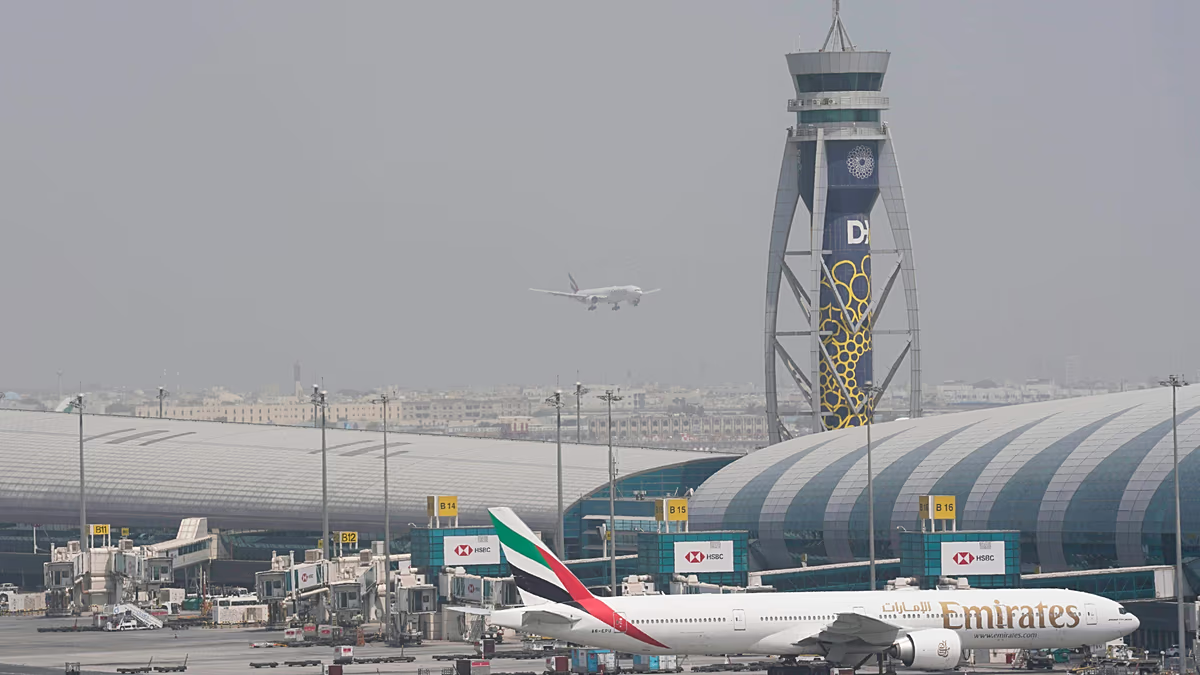
As travelers veer toward direct routes, the ripple effects on once-dominant stopover hubs like Dubai and Doha are profound, reshaping economies and urban landscapes tied to aviation. Dubai, with its iconic Burj Khalifa and sprawling free zones, has historically thrived on its role as a global transfer point, funneling over 100 million passengers annually through transits that pump billions into retail and hospitality. But with direct flights rising, projections suggest a 15-20% drop in transfer traffic by the mid-2020s, prompting a scramble for reinvention—think diversifying into tourism, tech, and renewables rather than just air traffic. Doha, Qatar’s gleaming capital with its award-winning Hamad International, faces similar pressures; despite being a gateway for Middle Eastern and Asian connectivities, fewer Americans and Europeans pivoting to non-stops mean hotels and duty-free shops reporting slumps. Economically, this could strain labor markets dependent on aviation jobs, from ground staff to taxi drivers, yet it opens avenues for luxury direct-tour operators catering to affluent bypassers. Environmentalists note cautiously that while direct flights might reduce localized emissions at hubs, longer distances could increase overall carbon outputs— a double-edged sword. On a human level, residents of these cities express mixed views: some expatriates appreciate quieter neighborhoods, while locals mourn the lost vibrancy of cultural exchanges in transit lounges. Airlines are negotiating alliances to mitigate losses, blending hub strengths with direct offerings. This shift humanizes global economic flows, reminding us that behind the airports are families and communities adapting to evolving desires for frictionless travel.
Looking Ahead: The Future of Flight Paths
Peering into the horizon, the push for direct long-haul routes portends a transformative chapter in aviation, where traveler autonomy and innovation converge to redefine sky journeys. Predictions from industry giants like IATA envision a world where AI-driven routing optimizes these non-stops, making them more affordable and accessible. Governments are incentivizing green initiatives, such as biofuel subsidies for extended ranges, to lure eco-travelers away from fossil-reliant hubs. Socially, it fosters inclusivity— retired folks with mobility issues gain easier access, while millennials document their adventures on platforms like TikTok, inspiring the next generation. Challenges persist: infrastructure for ultra-long hauls demands global coordination, from airspace rights to health contingencies. Yet, optimism abounds in human stories of reconnection—reunited families, cultural exchanges without intermediaries, and personal growth during those hours aloft. This evolution isn’t merely logistical; it’s a reflection of our collective psyche post-global crises, prioritizing direct connections in life as in flight. As more voices join the chorus, perhaps future travel will see us soaring not just over oceans, but toward a more intimate understanding of the world—one flight at a time.